Pearson Edexcel · A-Level · History
Course version: 9HI0 · Version from Sept 2015
The end of the English aristocracy: changes in land tenure; the creation…
Full specification wording
State, church and society, 1066–1106: The end of the English aristocracy: changes in land tenure; the creation of new earldoms; a Norman aristocracy based on military and political service; the extent of Norman influence as revealed by the Domesday Survey 1086.
After 1066 the English aristocracy was largely displaced.
Checked against the Pearson Edexcel 9HI0 specification (opens in a new tab) on .
- Point 2 of 4
- 4 key terms
Study notes
From the checked teaching notes for this specification point.
The idea
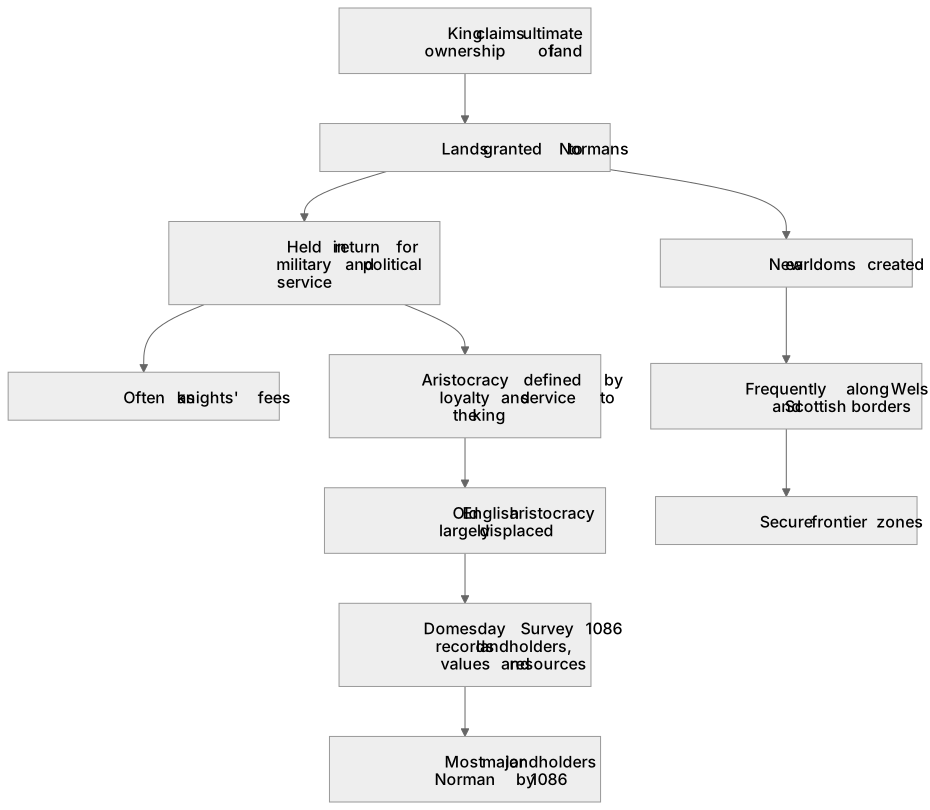
After 1066 the English aristocracy was largely displaced. Land tenure changed as the king claimed ultimate ownership and granted lands to Normans in return for military and political service, often as knights’ fees. New earldoms were created, frequently along the Welsh and Scottish borders, to secure frontier zones. The new aristocracy was defined by loyalty and service to the king rather than inherited English lineage. The Domesday Survey of 1086 reveals the extent of this transformation: it records landholders, values, and resources, showing that by 1086 most major landholders were Norman.
For example: The survey lists tenants-in-chief and their subtenants, demonstrating the new military and political hierarchy.
What earns the marks
- Explains how changes in land tenure after 1066 transferred land from English to Norman lords, with the king as ultimate owner and lands held for military and political service.
- Describes the creation of new earldoms, especially in frontier regions, and their role in defending and governing the kingdom.
- Analyses how the new Norman aristocracy was based on military and political service to the king, rather than English hereditary right.
- Uses the Domesday Survey of 1086 as evidence of the extent of Norman influence, including the recording of landholders, values, and resources.
- Assesses the overall impact of these changes on the English aristocracy, showing how the old elite was replaced by a new Norman-dominated class.
Common mistakes and how to put them right
Assuming that all English aristocrats were immediately killed or dispossessed.
Put it right: Explain that displacement occurred gradually through rebellion, forfeiture, and redistribution, with some English survivors.
Treating the Domesday Survey as a simple census rather than a detailed record of landholding and resources for taxation and royal rights.
Put it right: Describe its purpose and contents accurately.
Confusing earldoms with modern counties or assuming they were purely honorary.
Put it right: Explain their military and political functions, especially in border areas.
Exam tips
- Use specific examples of new earldoms and Norman landholders to support your points.
- Refer to the Domesday Survey as evidence, explaining what it reveals about the extent of Norman influence.
- Link changes in land tenure to the broader theme of royal control and the end of the English aristocracy.
Try the lesson
The start of the State, church and society, 1066–1106: The end of the English aristocracy: changes in land tenure; the creation of new earldoms; a Norman aristocracy based on military and political service; the extent of Norman influence as revealed by the Domesday Survey 1086. lesson, made from checked teaching notes for this specification point.
Have a go first
What does the Domesday Survey of 1086 reveal about landholding in England after the Norman Conquest?
Listen
After 1066 the English aristocracy was largely displaced. Land tenure changed as the king claimed ultimate ownership and granted lands to Normans in return for military and political service, often as knights’ fees. New earldoms were created, frequently along the Welsh and Scottish borders, to secure frontier zones. The new aristocracy was defined by loyalty and service to the king rather than inherited English lineage. The Domesday Survey of 1086 reveals the extent of this transformation: it records landholders, values, and resources, showing that by 1086 most major landholders were Norman. For example, the survey lists tenants-in-chief and their subtenants, demonstrating the new military and political hierarchy. A strong answer earns marks for these points. Explains how changes in land tenure after 1066 transferred land from English to Norman lords, with the king as ultimate owner and lands held for military and political service. Describes the creation of new earldoms, especially in frontier regions, and their role in defending and governing the kingdom. Analyses how the new Norman aristocracy was based on military and political service to the king, rather than English hereditary right. Uses the Domesday Survey of 1086 as evidence of the extent of Norman influence, including the recording of landholders, values, and resources. A common slip: Assuming that all English aristocrats were immediately killed or dispossessed. Instead, explain that displacement occurred gradually through rebellion, forfeiture, and redistribution, with some English survivors. Exam tip: Use specific examples of new earldoms and Norman landholders to support your points.
See it
Key words
Say what each word means before you turn the card.
Land tenure
Try answering aloud or in your head before turning the card.
New earldoms
Try answering aloud or in your head before turning the card.
Norman aristocracy
Try answering aloud or in your head before turning the card.
Domesday Survey 1086
Try answering aloud or in your head before turning the card.
See every definition
- Land tenure
- The holding of land, which changed after 1066 as the king claimed ultimate ownership and granted lands to Normans in return for military and political service.
- New earldoms
- These were created, frequently along the Welsh and Scottish borders, to secure frontier zones.
- Norman aristocracy
- A new ruling class defined by loyalty and service to the king rather than inherited English lineage, based on military and political service.
- Domesday Survey 1086
- A record of landholders, values and resources revealing the extent of Norman influence, showing that by 1086 most major landholders were Norman.
Label the diagram
Some boxes have lost their names. Pick the right name for each number.
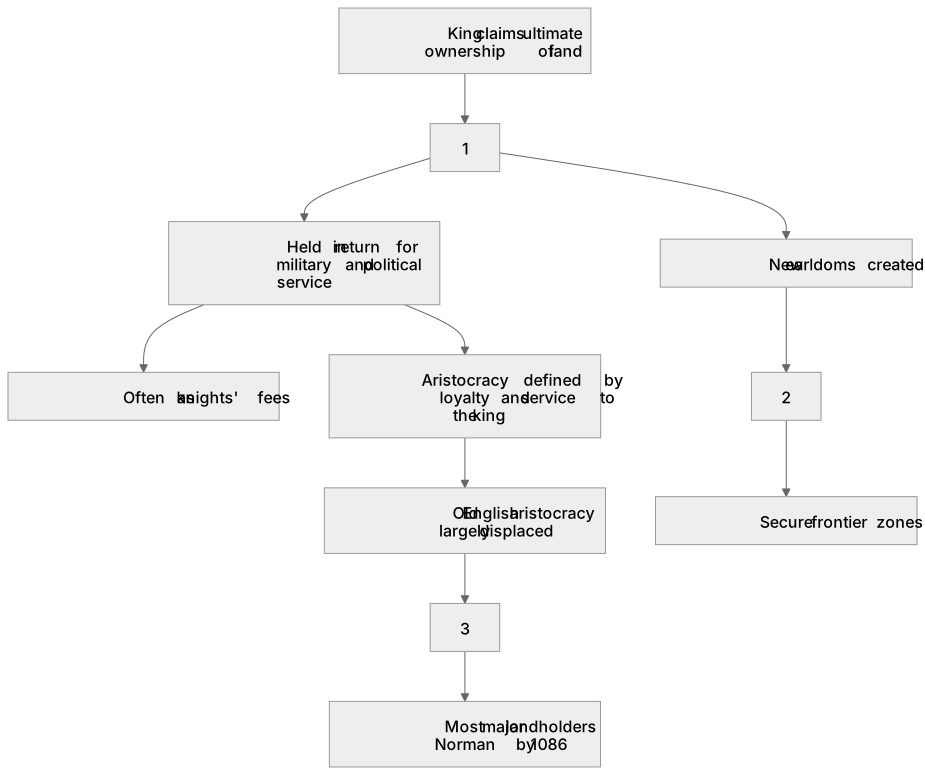
1Box 1
2Box 2
3Box 3
There is more to this lesson
The full lesson goes on to check your understanding and help you earn the marks. Create a free account to carry on, with your progress saved.
A week of Premium from your first lesson · Then the free plan continues · No card, no charge
Test your understanding of State, church and society, 1066–1106: The end of the English aristocracy: changes in land tenure; the creation of new earldoms; a Norman aristocracy based on military and political service; the extent of Norman influence as revealed by the Domesday Survey 1086.
Active recall beats re-reading. Take an instant quiz now to test what you’ve learned and lock it into long-term memory.
A week of Premium from your first lesson · Then the free plan continues · No card, no charge