Pearson Edexcel · A-Level · History
Course version: 9HI0 · Version from Sept 2015
The growth of Muslim power, 1144–69: Zingi and the seizure of Edessa 1144;…
Full specification wording
The changing Muslim response to the crusades, 1095–1192: The growth of Muslim power, 1144–69: Zingi and the seizure of Edessa 1144; Nur ad-Din’s consolidation of power, 1146–54. Nur’s growing rift with Saladin.
This topic traces how Muslim power grew between 1144 and 1169.
Checked against the Pearson Edexcel 9HI0 specification (opens in a new tab) on .
- Point 2 of 3
- 3 key terms
Study notes
From the checked teaching notes for this specification point.
The idea
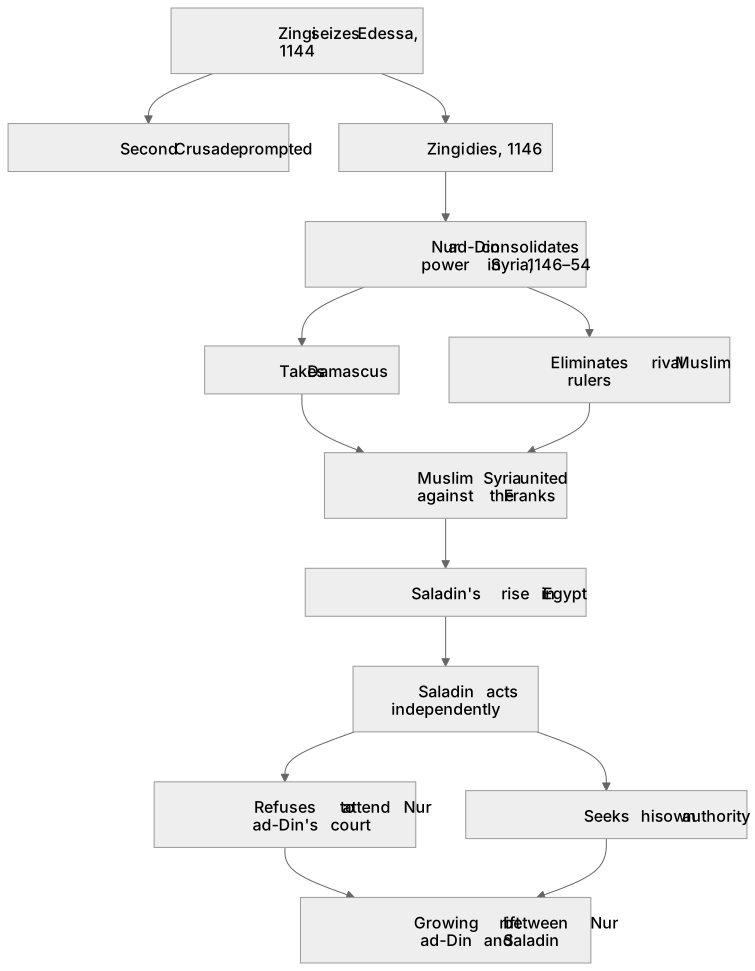
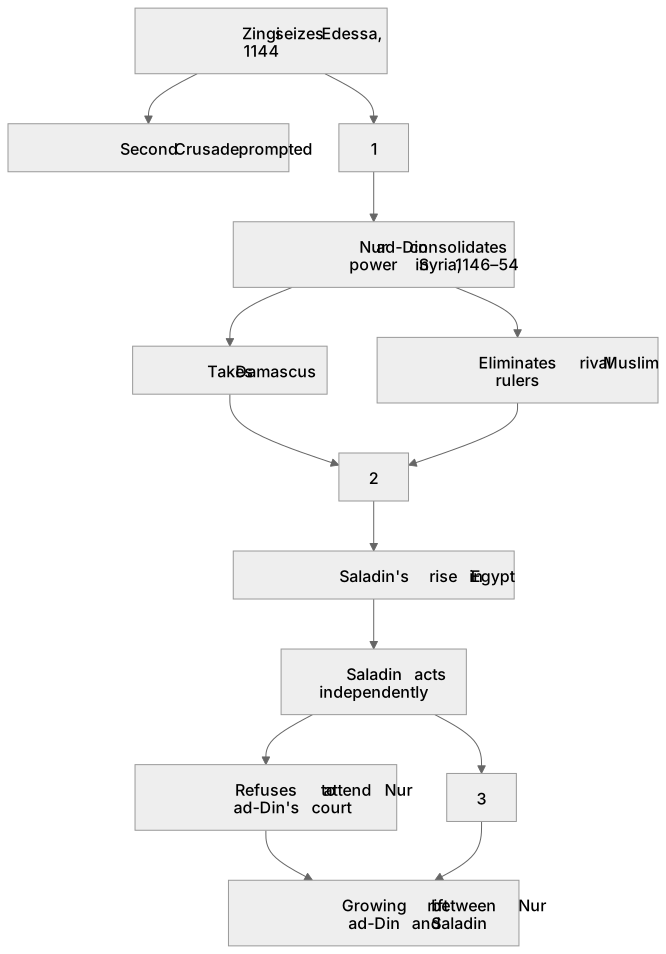
This topic traces how Muslim power grew between 1144 and 1169. In 1144 Zingi, ruler of Mosul and Aleppo, captured the city of Edessa; this shocked Latin Christendom and prompted the Second Crusade. After Zingi’s death in 1146, his son Nur ad-Din consolidated power in Syria by 1154, taking Damascus and uniting Muslim Syria against the Franks. Nur ad-Din’s growing rift with Saladin developed after Saladin’s rise in Egypt: although Saladin nominally served Nur ad-Din, he acted independently, refused to attend Nur ad-Din’s court, and sought his own authority. The rift reflected competition for leadership of the Muslim counter-crusade and shaped later conflict.
What earns the marks
- Explains Zingi’s capture of Edessa in 1144 as a turning point that severely weakened the crusader state and triggered the Second Crusade.
- Analyses how Nur ad-Din consolidated power in Syria between 1146 and 1154, including the acquisition of Damascus and the elimination of rival Muslim rulers.
- Explains the significance of Nur ad-Din’s consolidation for the Muslim response to the crusades, such as greater unity and pressure on the Latin states.
- Analyses the growing rift between Nur ad-Din and Saladin, including Saladin’s independent actions in Egypt and Nur ad-Din’s suspicion or demands for obedience.
- Evaluates the extent to which Muslim power had grown by 1169, considering both Zingi’s and Nur ad-Din’s achievements and the limits of unity.
Common mistakes and how to put them right
Confusing Zingi with Nur ad-Din.
Put it right: Keep their roles and dates distinct.
Treating the rift with Saladin as a sudden event rather than a gradual development rooted in Saladin’s independent rule in Egypt.
Put it right: Explain the sequence and causes of the growing tension.
Assuming Edessa’s fall immediately destroyed the entire county of Edessa.
Put it right: The county survived in reduced form until 1150, when the remnant was sold to Byzantium following Joscelin II's capture.
Exam tips
- Use precise dates and place names to anchor your argument, for example 1144, 1146–54, Damascus, Edessa.
- When discussing the rift, explain both Nur ad-Din’s perspective and Saladin’s actions to show causation.
Try the lesson
The start of the The changing Muslim response to the crusades, 1095–1192: The growth of Muslim power, 1144–69: Zingi and the seizure of Edessa 1144; Nur ad-Din’s consolidation of power, 1146–54. Nur’s growing rift with Saladin. lesson, made from checked teaching notes for this specification point.
Have a go first
Which city did Zingi seize in 1144, an event that marked the first major growth of Muslim power against the crusader states?
Listen
This topic traces how Muslim power grew between 1144 and 1169. In 1144 Zingi, ruler of Mosul and Aleppo, captured the city of Edessa; this shocked Latin Christendom and prompted the Second Crusade. After Zingi’s death in 1146, his son Nur ad-Din consolidated power in Syria by 1154, taking Damascus and uniting Muslim Syria against the Franks. Nur ad-Din’s growing rift with Saladin developed after Saladin’s rise in Egypt: although Saladin nominally served Nur ad-Din, he acted independently, refused to attend Nur ad-Din’s court, and sought his own authority. The rift reflected competition for leadership of the Muslim counter-crusade and shaped later conflict. A strong answer earns marks for these points. Explains Zingi’s capture of Edessa in 1144 as a turning point that severely weakened the crusader state and triggered the Second Crusade. Analyses how Nur ad-Din consolidated power in Syria between 1146 and 1154, including the acquisition of Damascus and the elimination of rival Muslim rulers. Explains the significance of Nur ad-Din’s consolidation for the Muslim response to the crusades, such as greater unity and pressure on the Latin states. Analyses the growing rift between Nur ad-Din and Saladin, including Saladin’s independent actions in Egypt and Nur ad-Din’s suspicion or demands for obedience. A common slip: Confusing Zingi with Nur ad-Din: Zingi seized Edessa in 1144, while Nur ad-Din consolidated power after 1146. Instead, Keep their roles and dates distinct. Exam tip: Use precise dates and place names to anchor your argument, for example 1144, 1146–54, Damascus, Edessa.
See it
Key words
Say what each word means before you turn the card.
Muslim political unification and competition
Try answering aloud or in your head before turning the card.
The impact of crusader state weakness
Try answering aloud or in your head before turning the card.
Leadership and legitimacy in jihad
Try answering aloud or in your head before turning the card.
See every definition
- Muslim political unification and competition
- The growth of Muslim power between 1144 and 1169, including Nur ad-Din's consolidation of power in Syria and his growing rift with Saladin.
- The impact of crusader state weakness
- Zingi's seizure of Edessa in 1144 severely weakened the crusader state and triggered the Second Crusade.
- Leadership and legitimacy in jihad
- Competition for leadership of the Muslim counter-crusade, reflected in Saladin acting independently although he nominally served Nur ad-Din.
Label the diagram
Some boxes have lost their names. Pick the right name for each number.
1Box 1
2Box 2
3Box 3
There is more to this lesson
The full lesson goes on to check your understanding and help you earn the marks. Create a free account to carry on, with your progress saved.
A week of Premium from your first lesson · Then the free plan continues · No card, no charge
Test your understanding of The changing Muslim response to the crusades, 1095–1192: The growth of Muslim power, 1144–69: Zingi and the seizure of Edessa 1144; Nur ad-Din’s consolidation of power, 1146–54. Nur’s growing rift with Saladin.
Active recall beats re-reading. Take an instant quiz now to test what you’ve learned and lock it into long-term memory.
A week of Premium from your first lesson · Then the free plan continues · No card, no charge