Pearson Edexcel · A-Level · History
Course version: 9HI0 · Version from Sept 2015
The power of Saladin, 1169–92: consolidation of Saladin’s power in Egypt…
Full specification wording
The changing Muslim response to the crusades, 1095–1192: The power of Saladin, 1169–92: consolidation of Saladin’s power in Egypt and Syria, 1169–84; the attack on Tiberias, the battle of Hattin and fall of Jerusalem to Saladin 1187; the siege of Acre and the battle of Arsuf, 1189–91; Saladin’s success in keeping Muslim control of Jerusalem in 1192.
This topic examines Saladin’s rise and the fluctuating fortunes of Muslim power from 1169 to 1192.
Checked against the Pearson Edexcel 9HI0 specification (opens in a new tab) on .
- Point 3 of 3
- 3 key terms
Study notes
From the checked teaching notes for this specification point.
The idea
This topic examines Saladin’s rise and the fluctuating fortunes of Muslim power from 1169 to 1192. From 1169 Saladin consolidated authority in Egypt, becoming vizier and then sultan, and extended his power into Syria by 1184, often at the expense of Nur ad-Din’s heirs and rivals. In 1187 he attacked Tiberias, drew the crusaders into battle at Hattin, destroyed their army and captured Jerusalem, a major psychological and strategic victory. The Third Crusade responded: the siege of Acre (1189–91) ended with Saladin losing the city, and the battle of Arsuf (1191) saw Richard I defeat Saladin’s forces. Despite these setbacks, Saladin successfully retained Muslim control of Jerusalem in 1192 through the Treaty of Jaffa, which allowed unarmed Christian pilgrims to visit.
What earns the marks
- Explains how Saladin consolidated power in Egypt from 1169, including his role as vizier and later sultan, and his elimination of rivals.
- Analyses Saladin’s extension of power into Syria between 1169 and 1184, including campaigns against Nur ad-Din’s heirs and the capture of key cities.
- Explains the sequence and significance of the attack on Tiberias, the battle of Hattin and the fall of Jerusalem in 1187.
- Analyses the impact of the siege of Acre and the battle of Arsuf (1189–91) on Saladin’s military position and reputation.
- Evaluates how and why Saladin kept Muslim control of Jerusalem in 1192, including the terms of the Treaty of Jaffa and his strategic priorities.
Common mistakes and how to put them right
Confusing the chronology of the Third Crusade.
Put it right: Place the siege of Acre (1189–91) before the battle of Arsuf (1191).
Assuming Saladin’s capture of Jerusalem in 1187 ended the crusader presence entirely.
Put it right: The Third Crusade recovered Acre and a coastal strip, and Jerusalem remained Muslim-held in 1192.
Treating the Treaty of Jaffa as a total Christian victory or a total Muslim defeat.
Put it right: It was a negotiated settlement that preserved Muslim control of Jerusalem while granting pilgrim access.
Exam tips
- Use a clear chronological framework: 1169–84 consolidation, 1187 Hattin and Jerusalem, 1189–91 Acre and Arsuf, 1192 Treaty of Jaffa.
- When assessing Saladin’s success, distinguish between military defeats and the achievement of his core objective in Jerusalem.
- Support arguments with specific evidence, such as the terms of the Treaty of Jaffa or the impact of Hattin on crusader manpower.
Try the lesson
The start of the The changing Muslim response to the crusades, 1095–1192: The power of Saladin, 1169–92: consolidation of Saladin’s power in Egypt and Syria, 1169–84; the attack on Tiberias, the battle of Hattin and fall of Jerusalem to Saladin 1187; the siege of Acre and the battle of Arsuf, 1189–91; Saladin’s success in keeping Muslim control of Jerusalem in 1192. lesson, made from checked teaching notes for this specification point.
Have a go first
At which battle in 1187 did Saladin's forces defeat the army of the Kingdom of Jerusalem, leading directly to the fall of Jerusalem later that year?
Listen
This topic examines Saladin’s rise and the fluctuating fortunes of Muslim power from 1169 to 1192. From 1169 Saladin consolidated authority in Egypt, becoming vizier and then sultan, and extended his power into Syria by 1184, often at the expense of Nur ad-Din’s heirs and rivals. In 1187 he attacked Tiberias, drew the crusaders into battle at Hattin, destroyed their army and captured Jerusalem, a major psychological and strategic victory. The Third Crusade responded: the siege of Acre (1189–91) ended with Saladin losing the city, and the battle of Arsuf (1191) saw Richard I defeat Saladin’s forces. Despite these setbacks, Saladin successfully retained Muslim control of Jerusalem in 1192 through the Treaty of Jaffa, which allowed unarmed Christian pilgrims to visit. A strong answer earns marks for these points. Explains how Saladin consolidated power in Egypt from 1169, including his role as vizier and later sultan, and his elimination of rivals. Analyses Saladin’s extension of power into Syria between 1169 and 1184, including campaigns against Nur ad-Din’s heirs and the capture of key cities. Explains the sequence and significance of the attack on Tiberias, the battle of Hattin and the fall of Jerusalem in 1187. Analyses the impact of the siege of Acre and the battle of Arsuf (1189–91) on Saladin’s military position and reputation. A common slip: Confusing the chronology of the Third Crusade: Acre fell in 1191 before Arsuf, not after. Instead, place the siege of Acre (1189–91) before the battle of Arsuf (1191). Exam tip: Use a clear chronological framework: 1169–84 consolidation, 1187 Hattin and Jerusalem, 1189–91 Acre and Arsuf, 1192 Treaty of Jaffa.
See it
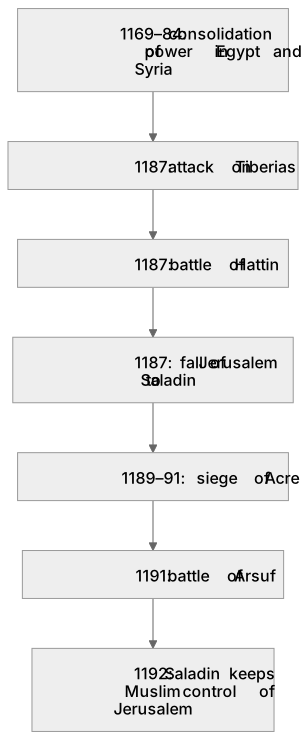
Put it in order
Put these steps in the order they happen.
- 1. 1192: Saladin keeps Muslim control of Jerusalem
- 2. 1191: battle of Arsuf
- 3. 1187: battle of Hattin
- 4. 1189–91: siege of Acre
- 5. 1169–84: consolidation of power in Egypt and Syria
- 6. 1187: attack on Tiberias
- 7. 1187: fall of Jerusalem to Saladin
Key words
Say what each word means before you turn the card.
Consolidation of Muslim power
Try answering aloud or in your head before turning the card.
Diplomacy and negotiation
Try answering aloud or in your head before turning the card.
The impact of the Third Crusade
Try answering aloud or in your head before turning the card.
See every definition
- Consolidation of Muslim power
- Saladin consolidated authority in Egypt, becoming vizier and then sultan, and extended his power into Syria by 1184.
- Diplomacy and negotiation
- Saladin retained Muslim control of Jerusalem in 1192 through the Treaty of Jaffa, a negotiated settlement allowing unarmed Christian pilgrims to visit.
- The impact of the Third Crusade
- The siege of Acre ended with Saladin losing the city, and at Arsuf Richard I defeated his forces, yet he kept Muslim control of Jerusalem in 1192.
Label the diagram
Some boxes have lost their names. Pick the right name for each number.
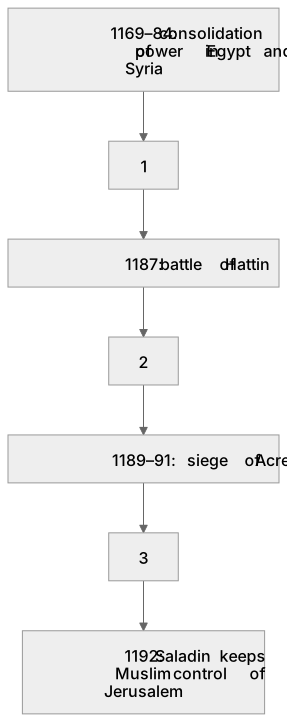
1Box 1
2Box 2
3Box 3
There is more to this lesson
The full lesson goes on to check your understanding and help you earn the marks. Create a free account to carry on, with your progress saved.
A week of Premium from your first lesson · Then the free plan continues · No card, no charge
Test your understanding of The changing Muslim response to the crusades, 1095–1192: The power of Saladin, 1169–92: consolidation of Saladin’s power in Egypt and Syria, 1169–84; the attack on Tiberias, the battle of Hattin and fall of Jerusalem to Saladin 1187; the siege of Acre and the battle of Arsuf, 1189–91; Saladin’s success in keeping Muslim control of Jerusalem in 1192.
Active recall beats re-reading. Take an instant quiz now to test what you’ve learned and lock it into long-term memory.
A week of Premium from your first lesson · Then the free plan continues · No card, no charge