Pearson Edexcel · A-Level · History
Course version: 9HI0 · Version from Sept 2015
A changing presidency: the rise and decline of Republicanism to 1933; the…
Full specification wording
The changing political environment, 1917–80: A changing presidency: the rise and decline of Republicanism to 1933; the influence of Roosevelt; changing styles of presidential leadership, 1945–72; a decline in confidence, 1968–80.
This theme traces the presidency from Republican dominance in the 1920s to its post-war peaks and later loss of trust.
Checked against the Pearson Edexcel 9HI0 specification (opens in a new tab) on .
- Point 1 of 3
- 4 key terms
Study notes
From the checked teaching notes for this specification point.
The idea
This theme traces the presidency from Republican dominance in the 1920s to its post-war peaks and later loss of trust. Republican ascendancy rested on business confidence, laissez-faire economics and victories such as Harding, Coolidge and Hoover, but the Depression discredited that approach by 1933. Roosevelt then expanded federal power through the New Deal, fireside chats and crisis leadership, creating a more personal, interventionist presidency. After 1945, styles varied: Truman's decisiveness, Eisenhower's managerial authority, Kennedy's televised charisma, Johnson's legislative drive and Nixon's centralised control. From 1968, Vietnam, Watergate and economic strain eroded confidence, culminating in Nixon's resignation and Carter's difficulties.
What earns the marks
- Explains how Republican presidents in the 1920s linked prosperity to business-friendly policies, low regulation and limited federal intervention, and why this dominance declined after 1929.
- Assesses Roosevelt's influence through the New Deal, emergency legislation, public communication and the growth of federal responsibility for welfare and economic management.
- Compares presidential leadership styles from 1945 to 1972, including Truman's crisis decisions, Eisenhower's staff system, Kennedy's media presence, Johnson's congressional tactics and Nixon's centralised White House.
- Analyses the causes of declining confidence from 1968 to 1980, such as Vietnam, Watergate, inflation, oil shocks and perceptions of presidential deception or ineffectiveness.
- Evaluates continuity and change across the period, for example whether Roosevelt permanently transformed the presidency or whether later presidents partially reversed federal activism.
- Uses specific evidence, such as the 1932 election, the First New Deal, the 1968 Tet Offensive, the 1974 resignation or the 1979 'malaise' speech, to support judgements.
Common mistakes and how to put them right
Treating Republicanism as identical to one president's policies.
Put it right: Distinguish between Harding's return to normalcy, Coolidge's business ethos and Hoover's later interventionism.
Assuming Roosevelt's influence was only economic.
Put it right: Include political communication, federal institution-building and the altered expectations of government.
Describing post-1945 leadership as a single style.
Put it right: Compare methods such as Eisenhower's cabinet system with Kennedy's personal television appeal and Nixon's centralised control.
Attributing declining confidence solely to Watergate.
Put it right: Link Vietnam, economic dislocation and social conflict alongside the scandal.
Exam tips
- Plan by theme rather than president alone, so comparisons of leadership style and public confidence are explicit.
- Anchor each paragraph with a precise date, event or policy and explain its consequence for presidential power or reputation.
- When judging decline, weigh short-term crises against longer-term changes in expectations of the presidency.
- Use the wording of the question to decide whether the focus is rise, decline, influence or style, and keep that focus throughout.
Try the lesson
The start of the The changing political environment, 1917–80: A changing presidency: the rise and decline of Republicanism to 1933; the influence of Roosevelt; changing styles of presidential leadership, 1945–72; a decline in confidence, 1968–80. lesson, made from checked teaching notes for this specification point.
Have a go first
Which Republican president won the 1920 election and presided over the return to Republican dominance in the 1920s?
Listen
This theme traces the presidency from Republican dominance in the 1920s to its post-war peaks and later loss of trust. Republican ascendancy rested on business confidence, laissez-faire economics and victories such as Harding, Coolidge and Hoover, but the Depression discredited that approach by 1933. Roosevelt then expanded federal power through the New Deal, fireside chats and crisis leadership, creating a more personal, interventionist presidency. After 1945, styles varied: Truman's decisiveness, Eisenhower's managerial authority, Kennedy's televised charisma, Johnson's legislative drive and Nixon's centralised control. From 1968, Vietnam, Watergate and economic strain eroded confidence, culminating in Nixon's resignation and Carter's difficulties. A strong answer earns marks for these points. Explains how Republican presidents in the 1920s linked prosperity to business-friendly policies, low regulation and limited federal intervention, and why this dominance declined after 1929. Assesses Roosevelt's influence through the New Deal, emergency legislation, public communication and the growth of federal responsibility for welfare and economic management. Compares presidential leadership styles from 1945 to 1972, including Truman's crisis decisions, Eisenhower's staff system, Kennedy's media presence, Johnson's congressional tactics and Nixon's centralised White House. Analyses the causes of declining confidence from 1968 to 1980, such as Vietnam, Watergate, inflation, oil shocks and perceptions of presidential deception or ineffectiveness. A common slip: Treating Republicanism as identical to one president's policies. Instead, distinguish between Harding's return to normalcy, Coolidge's business ethos and Hoover's later interventionism. Exam tip: Plan by theme rather than president alone, so comparisons of leadership style and public confidence are explicit.
See it
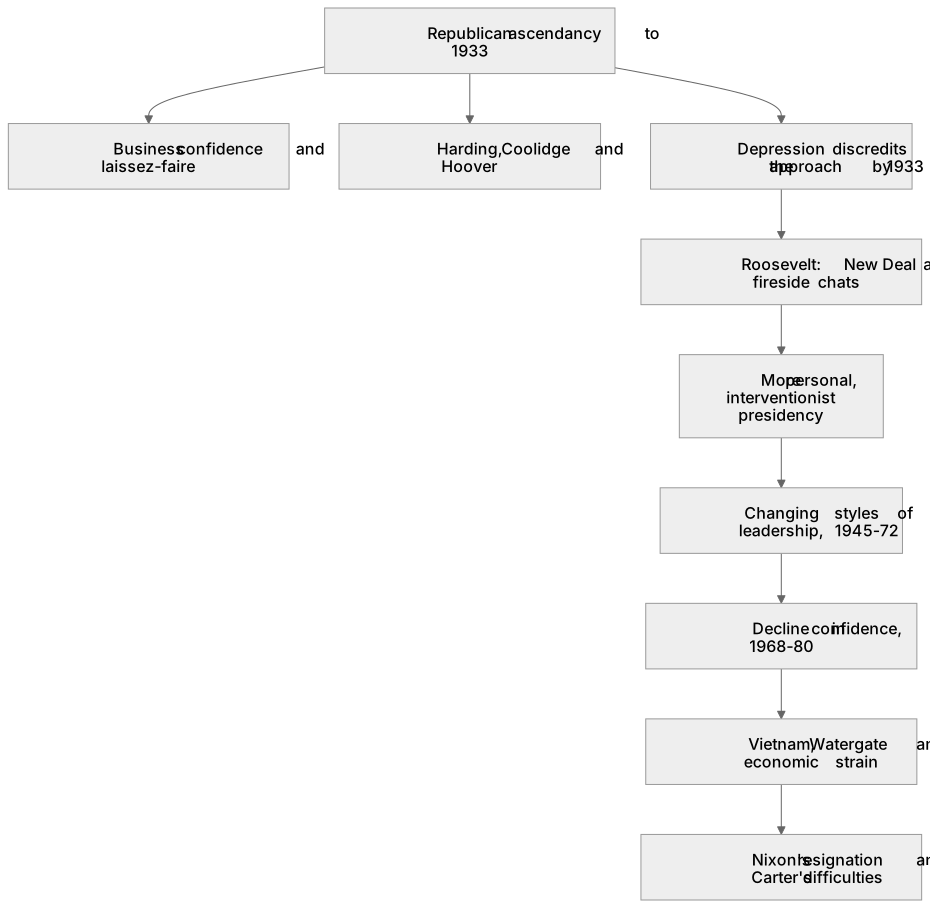
Put the events in order
Put these events in the order they happened, earliest first.
- 1. Carter's 'malaise' speech
- 2. Election that helped discredit Republican approach
- 3. Nixon resigned, culminating declining confidence
- 4. Tet Offensive eroded confidence in the presidency
Key words
Say what each word means before you turn the card.
Republican dominance and its collapse after 1929
Try answering aloud or in your head before turning the card.
Roosevelt and the expansion of federal presidential power
Try answering aloud or in your head before turning the card.
Varieties of post-war presidential leadership
Try answering aloud or in your head before turning the card.
Erosion of public trust in the presidency, 1968–80
Try answering aloud or in your head before turning the card.
See every definition
- Republican dominance and its collapse after 1929
- Ascendancy resting on business confidence, laissez-faire economics and victories such as Harding, Coolidge and Hoover, discredited by the Depression by 1933.
- Roosevelt and the expansion of federal presidential power
- Growth of federal power through the New Deal, fireside chats and crisis leadership, creating a more personal, interventionist presidency.
- Varieties of post-war presidential leadership
- Differing styles after 1945, including Truman's decisiveness, Eisenhower's managerial authority, Kennedy's televised charisma, Johnson's legislative drive and Nixon's centralised control.
- Erosion of public trust in the presidency, 1968–80
- Decline in confidence from Vietnam, Watergate and economic strain, culminating in Nixon's resignation and Carter's difficulties.
Label the diagram
Some boxes have lost their names. Pick the right name for each number.
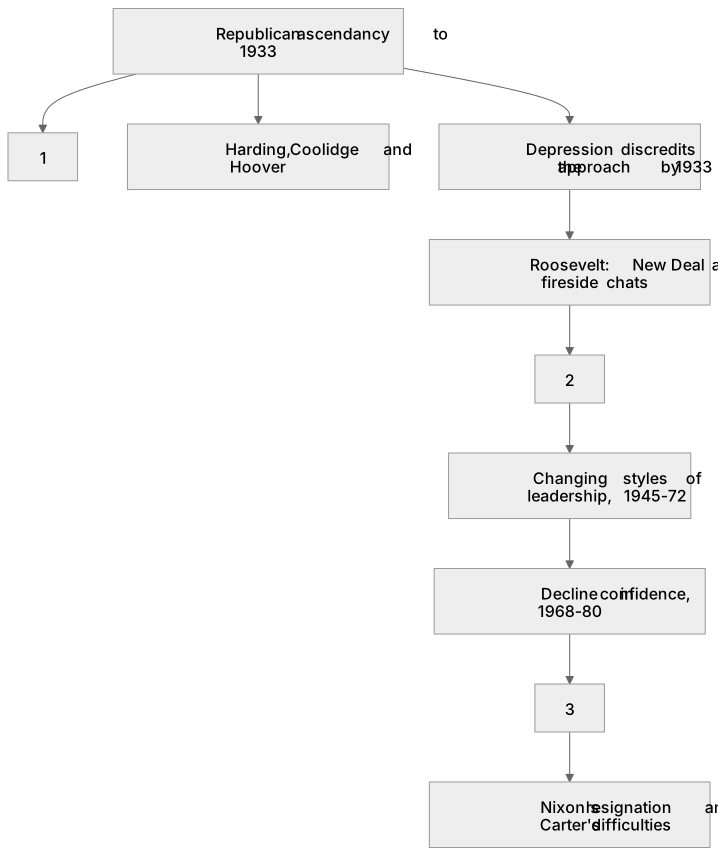
1Box 1
2Box 2
3Box 3
There is more to this lesson
The full lesson goes on to check your understanding and help you earn the marks. Create a free account to carry on, with your progress saved.
A week of Premium from your first lesson · Then the free plan continues · No card, no charge
Test your understanding of The changing political environment, 1917–80: A changing presidency: the rise and decline of Republicanism to 1933; the influence of Roosevelt; changing styles of presidential leadership, 1945–72; a decline in confidence, 1968–80.
Active recall beats re-reading. Take an instant quiz now to test what you’ve learned and lock it into long-term memory.
A week of Premium from your first lesson · Then the free plan continues · No card, no charge