Pearson Edexcel · A-Level · History
Course version: 9HI0 · Version from Sept 2015
Influences on the political landscape: from rugged individualism to New…
Full specification wording
The changing political environment, 1917–80: Influences on the political landscape: from rugged individualism to New Deal ideas in the 1920s and 30s; the Red Scares and anti-communism, 1917–80; liberalism, counter-culture and the conservative reaction, c1960–80.
This theme examines the ideas and movements that shaped US politics.
Checked against the Pearson Edexcel 9HI0 specification (opens in a new tab) on .
- Point 2 of 3
- 4 key terms
Study notes
From the checked teaching notes for this specification point.
The idea
This theme examines the ideas and movements that shaped US politics. In the 1920s, rugged individualism celebrated self-reliance, business enterprise and limited federal help, but the Depression pushed many towards New Deal ideas of government responsibility for jobs, welfare and regulation. Meanwhile, the Red Scares from 1917 onwards made anti-communism a recurring force, from the first Palmer Raids through McCarthyism to later Cold War anxieties. From about 1960, liberalism expanded civil rights and social programmes, while a counter-culture challenged traditional values. This provoked a conservative reaction that defended order, tax cuts, states' rights and religious values, helping to realign politics by 1980.
What earns the marks
- Explains rugged individualism in the 1920s as a belief in self-reliance, private enterprise and minimal federal intervention, and shows how the Depression weakened its appeal.
- Assesses how New Deal ideas shifted expectations towards federal action on unemployment, welfare, regulation and infrastructure.
- Traces the Red Scares and anti-communism from 1917 to 1980, including the first Red Scare, the second Red Scare, McCarthyism and Cold War defence policies.
- Analyses liberalism and counter-culture from about 1960, including civil rights, Great Society programmes, youth protest, changing gender roles and cultural conflict.
- Explains the conservative reaction of the late 1960s and 1970s, including backlash against protest, tax revolts, law-and-order politics and the rise of the New Right.
- Evaluates how these influences interacted, for example how anti-communism limited liberal reform or how counter-culture energised conservative mobilisation.
Common mistakes and how to put them right
Treating rugged individualism as a fixed national creed.
Put it right: Show it as a contested idea that lost ground during the Depression.
Equating all anti-communism with McCarthyism.
Put it right: Distinguish earlier Red Scares, institutional loyalty programmes and later Cold War anxieties.
Presenting the counter-culture as only cultural and not political.
Put it right: Link it to anti-war protest, civil rights, feminism and challenges to authority.
Assuming the conservative reaction was sudden in 1980.
Put it right: Trace its growth through the 1960s and 1970s, including grassroots activism and party realignment.
Exam tips
- Organise essays around the named influences and show connections between them rather than listing them separately.
- Use precise examples such as the Palmer Raids, the Wagner Act, the Montgomery bus boycott, the 1968 Democratic convention or the 1978 tax revolt.
- When discussing ideas, explain how they translated into political action, votes or policy.
- Balance coverage across the whole period 1917–80, not only the 1920s and 1960s.
Try the lesson
The start of the The changing political environment, 1917–80: Influences on the political landscape: from rugged individualism to New Deal ideas in the 1920s and 30s; the Red Scares and anti-communism, 1917–80; liberalism, counter-culture and the conservative reaction, c1960–80. lesson, made from checked teaching notes for this specification point.
Have a go first
Which idea, associated with the 1920s, stressed that individuals should succeed through their own effort rather than rely on government help?
Listen
This theme examines the ideas and movements that shaped US politics. In the 1920s, rugged individualism celebrated self-reliance, business enterprise and limited federal help, but the Depression pushed many towards New Deal ideas of government responsibility for jobs, welfare and regulation. Meanwhile, the Red Scares from 1917 onwards made anti-communism a recurring force, from the first Palmer Raids through McCarthyism to later Cold War anxieties. From about 1960, liberalism expanded civil rights and social programmes, while a counter-culture challenged traditional values. This provoked a conservative reaction that defended order, tax cuts, states' rights and religious values, helping to realign politics by 1980. A strong answer earns marks for these points. Explains rugged individualism in the 1920s as a belief in self-reliance, private enterprise and minimal federal intervention, and shows how the Depression weakened its appeal. Assesses how New Deal ideas shifted expectations towards federal action on unemployment, welfare, regulation and infrastructure. Traces the Red Scares and anti-communism from 1917 to 1980, including the first Red Scare, the second Red Scare, McCarthyism and Cold War defence policies. Analyses liberalism and counter-culture from about 1960, including civil rights, Great Society programmes, youth protest, changing gender roles and cultural conflict. A common slip: Treating rugged individualism as a fixed national creed. Instead, show it as a contested idea that lost ground during the Depression. Exam tip: Organise essays around the named influences and show connections between them rather than listing them separately.
See it
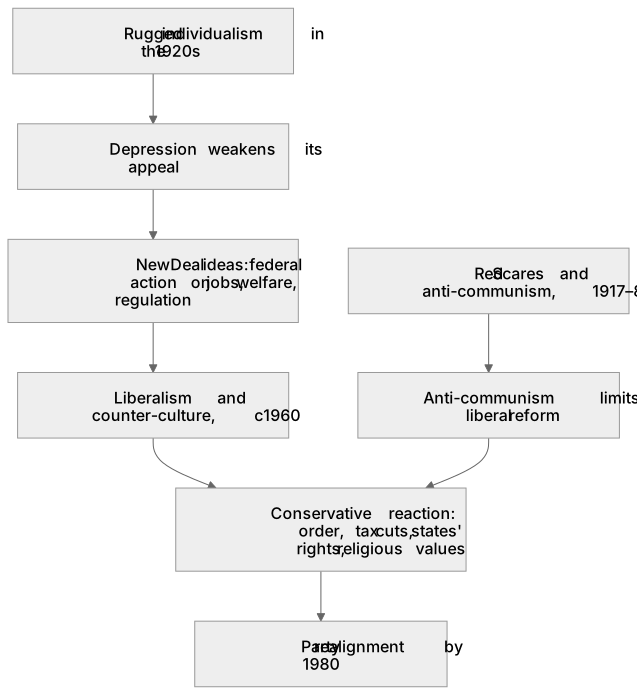
Key words
Say what each word means before you turn the card.
Individualism and collectivist responses to economic crisis
Try answering aloud or in your head before turning the card.
Anti-communism as a recurring political force
Try answering aloud or in your head before turning the card.
Liberal reform and cultural rebellion
Try answering aloud or in your head before turning the card.
Conservative backlash and political realignment
Try answering aloud or in your head before turning the card.
See every definition
- Individualism and collectivist responses to economic crisis
- Rugged individualism celebrated self-reliance, business enterprise and limited federal help in the 1920s, but the Depression pushed many towards New Deal ideas of government responsibility for jobs, welfare and regulation.
- Anti-communism as a recurring political force
- The Red Scares from 1917 onwards made anti-communism a recurring force, from the first Palmer Raids through McCarthyism to later Cold War anxieties.
- Liberal reform and cultural rebellion
- From about 1960, liberalism expanded civil rights and social programmes, while a counter-culture challenged traditional values.
- Conservative backlash and political realignment
- A conservative reaction defended order, tax cuts, states' rights and religious values, helping to realign politics by 1980.
Label the diagram
Some boxes have lost their names. Pick the right name for each number.
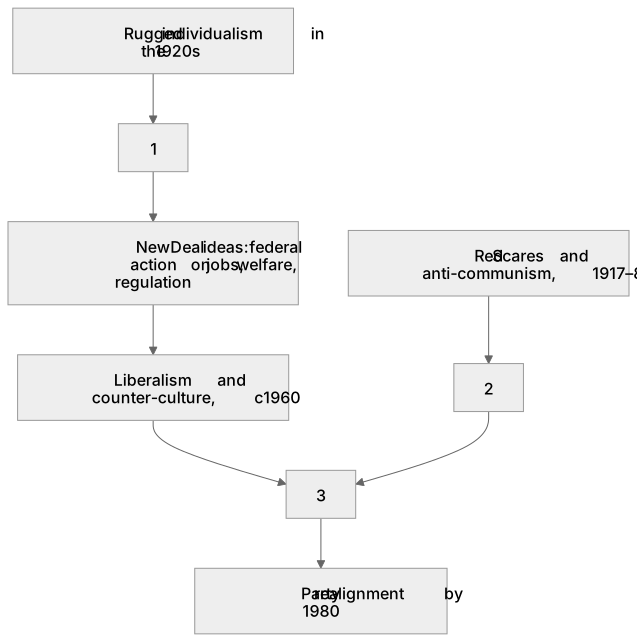
1Box 1
2Box 2
3Box 3
There is more to this lesson
The full lesson goes on to check your understanding and help you earn the marks. Create a free account to carry on, with your progress saved.
A week of Premium from your first lesson · Then the free plan continues · No card, no charge
Test your understanding of The changing political environment, 1917–80: Influences on the political landscape: from rugged individualism to New Deal ideas in the 1920s and 30s; the Red Scares and anti-communism, 1917–80; liberalism, counter-culture and the conservative reaction, c1960–80.
Active recall beats re-reading. Take an instant quiz now to test what you’ve learned and lock it into long-term memory.
A week of Premium from your first lesson · Then the free plan continues · No card, no charge