Pearson Edexcel · A-Level · History
Course version: 9HI0 · Version from Sept 2015
The impact of war on domestic politics: the reasons for a return to…
Full specification wording
The changing political environment, 1917–80: The impact of war on domestic politics: the reasons for a return to ‘normalcy’ and a commitment to isolationism, 1917–41; US emergence as a Cold War superpower from 1941; the impact of involvement in Korea and Vietnam.
This topic examines how war reshaped US domestic politics from 1917 to the 1970s.
Checked against the Pearson Edexcel 9HI0 specification (opens in a new tab) on .
- Point 3 of 3
- 4 key terms
Study notes
From the checked teaching notes for this specification point.
The idea
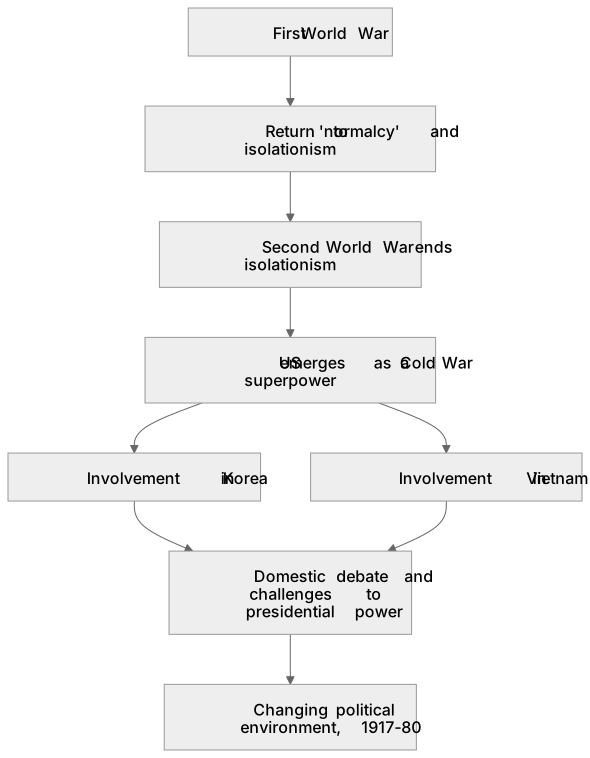
This topic examines how war reshaped US domestic politics from 1917 to the 1970s. After the First World War, desire for a return to ‘normalcy’ and isolationism shaped the 1920s: Republican dominance, tariffs, and rejection of the League of Nations. The Second World War ended isolationism and created a Cold War superpower, with a permanent military-industrial complex and global commitments. Involvement in Korea and Vietnam provoked domestic debate, protest, and challenges to presidential power, influencing the political environment.
What earns the marks
- Explains the meaning of ‘normalcy’ in the context of 1920s politics, linking it to a reaction against wartime controls and progressive reform.
- Identifies specific isolationist policies and attitudes, such as rejection of the Treaty of Versailles and the League of Nations, and their domestic political consequences.
- Analyses how the Second World War transformed the US into a Cold War superpower, including the growth of federal power and the military-industrial complex.
- Assesses the domestic impact of the Korean War, such as Truman’s dismissal of MacArthur and the expansion of presidential war powers.
- Evaluates the domestic consequences of the Vietnam War, including the anti-war movement, the Pentagon Papers, and the War Powers Act.
- Compares the impact of different wars on domestic politics, showing change over time in isolationism, presidential power, and public trust.
Common mistakes and how to put them right
Treating isolationism as complete withdrawal from world affairs.
Put it right: Recognise that the US remained economically and culturally engaged while avoiding political and military alliances.
Assuming the Cold War had only foreign policy effects.
Put it right: Explain how it reshaped domestic institutions, such as the National Security Act and the growth of the national security state.
Overlooking the specific domestic political consequences of the Korean War.
Put it right: Include Truman’s conflict with MacArthur, the stalemate’s effect on the 1952 election, and the precedent for undeclared war.
Confusing the Vietnam War’s impact with that of earlier wars.
Put it right: Highlight the unique scale of protest, the credibility gap, and legislative attempts to curb presidential power.
Exam tips
- Plan essays around clear criteria for measuring impact, such as changes to presidential power, public opinion, or party politics.
- Use precise examples, such as the Senate’s rejection of the Treaty of Versailles in 1919 or the Gulf of Tonkin Resolution in 1964, to support arguments.
- When comparing wars, avoid listing; instead, analyse similarities and differences in their domestic political effects over time.
- Integrate interpretations of ‘normalcy’ and isolationism to show understanding of contemporary debates.
Try the lesson
The start of the The changing political environment, 1917–80: The impact of war on domestic politics: the reasons for a return to ‘normalcy’ and a commitment to isolationism, 1917–41; US emergence as a Cold War superpower from 1941; the impact of involvement in Korea and Vietnam. lesson, made from checked teaching notes for this specification point.
Have a go first
Which term describes the policy of avoiding permanent political and military entanglements with other countries that shaped US foreign policy in the 1920s and 1930s?
Listen
This topic examines how war reshaped US domestic politics from 1917 to the 1970s. After the First World War, desire for a return to ‘normalcy’ and isolationism shaped the 1920s: Republican dominance, tariffs, and rejection of the League of Nations. The Second World War ended isolationism and created a Cold War superpower, with a permanent military-industrial complex and global commitments. Involvement in Korea and Vietnam provoked domestic debate, protest, and challenges to presidential power, influencing the political environment. A strong answer earns marks for these points. Explains the meaning of ‘normalcy’ in the context of 1920s politics, linking it to a reaction against wartime controls and progressive reform. Identifies specific isolationist policies and attitudes, such as rejection of the Treaty of Versailles and the League of Nations, and their domestic political consequences. Analyses how the Second World War transformed the US into a Cold War superpower, including the growth of federal power and the military-industrial complex. Assesses the domestic impact of the Korean War, such as Truman’s dismissal of MacArthur and the expansion of presidential war powers. A common slip: Treating isolationism as complete withdrawal from world affairs. Instead, recognise that the US remained economically and culturally engaged while avoiding political and military alliances. Exam tip: Plan essays around clear criteria for measuring impact, such as changes to presidential power, public opinion, or party politics.
See it
Key words
Say what each word means before you turn the card.
Isolationism versus internationalism
Try answering aloud or in your head before turning the card.
The growth of presidential power in wartime
Try answering aloud or in your head before turning the card.
The role of public opinion and protest
Try answering aloud or in your head before turning the card.
The economic and institutional impact of war
Try answering aloud or in your head before turning the card.
See every definition
- Isolationism versus internationalism
- A tension in which the US avoided political and military alliances while remaining economically and culturally engaged, before the Second World War ended isolationism and created a Cold War superpower.
- The growth of presidential power in wartime
- The expansion of presidential war powers, shown in Korea by Truman's dismissal of MacArthur and the precedent for undeclared war, and challenged after Vietnam by the War Powers Act.
- The role of public opinion and protest
- Domestic debate and protest provoked by involvement in Korea and Vietnam, including the anti-war movement, the credibility gap and challenges to presidential power.
- The economic and institutional impact of war
- The reshaping of domestic institutions by the Cold War, including a permanent military-industrial complex, global commitments and the growth of federal power.
Label the diagram
Some boxes have lost their names. Pick the right name for each number.
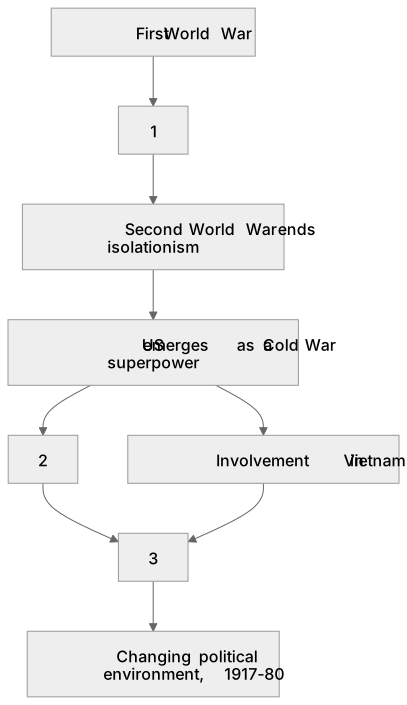
1Box 1
2Box 2
3Box 3
There is more to this lesson
The full lesson goes on to check your understanding and help you earn the marks. Create a free account to carry on, with your progress saved.
A week of Premium from your first lesson · Then the free plan continues · No card, no charge
Test your understanding of The changing political environment, 1917–80: The impact of war on domestic politics: the reasons for a return to ‘normalcy’ and a commitment to isolationism, 1917–41; US emergence as a Cold War superpower from 1941; the impact of involvement in Korea and Vietnam.
Active recall beats re-reading. Take an instant quiz now to test what you’ve learned and lock it into long-term memory.
A week of Premium from your first lesson · Then the free plan continues · No card, no charge