Pearson Edexcel · A-Level · History
Course version: 9HI0 · Version from Sept 2015
Attacks on Mao’s political and class enemies: Liu Shaoqi and Deng…
Full specification wording
The Cultural Revolution and its aftermath, 1966–76: Attacks on Mao’s political and class enemies: Liu Shaoqi and Deng Xiaoping; Lin Biao; the purging of the CCP membership; ‘capitalist roaders’ and foreigners living in China.
From 1966 Mao turned the Cultural Revolution against political and class enemies.
Checked against the Pearson Edexcel 9HI0 specification (opens in a new tab) on .
- Point 3 of 4
- 4 key terms
Study notes
From the checked teaching notes for this specification point.
The idea
From 1966 Mao turned the Cultural Revolution against political and class enemies. Liu Shaoqi and Deng Xiaoping were denounced as ‘capitalist roaders’ who favoured material incentives. Liu was humiliated and died in 1969. Deng was purged, rehabilitated in 1973, and purged again in 1976. Lin Biao, Mao’s designated successor, fell from favour and died in a plane crash in 1971 after an alleged coup plot. The purging of the CCP membership was driven by Red Guards and radical factions, expelling millions of cadres and disrupting party structures. Foreigners living in China, including diplomats and journalists, faced suspicion, surveillance and expulsion as ‘imperialist’ influences, culminating in the burning of the British mission.
What earns the marks
- Explains that ‘capitalist roaders’ meant officials accused of promoting market incentives, private plots and expert management rather than Maoist class struggle.
- Shows how Liu Shaoqi was publicly humiliated, stripped of office and died in detention in 1969, making him the most prominent civilian victim.
- Traces Deng Xiaoping’s initial purge, his 1973 rehabilitation, and his second removal in 1976, using this to show that purges were reversible when Mao’s political needs changed.
- Explains Lin Biao’s role as heir apparent and PLA leader, his fall from grace and death in a plane crash in 1971, and the shock this caused within the party.
- Describes the purging of the CCP membership through Red Guard attacks and radical factions, noting the scale of expulsions and the collapse of normal party discipline.
- Explains why foreigners living in China, including diplomats and journalists, were treated as class enemies or imperialist agents and faced surveillance, denunciation or expulsion.
Common mistakes and how to put them right
Treating Liu Shaoqi and Deng Xiaoping as identical victims.
Put it right: Distinguish Liu’s death in detention from Deng’s purge, rehabilitation and subsequent second purge.
Assuming Lin Biao remained loyal to Mao throughout.
Put it right: Explain his fall, the alleged coup plot and his death in 1971.
Confusing the role of work teams.
Put it right: Explain that work teams were sent by Liu and Deng in 1966 to restrain the movement, not as agents of Mao's purge of the CCP membership.
Exam tips
- Link each named victim to a specific charge, such as ‘capitalist roader’ or ‘counter-revolutionary’, rather than listing names without explanation.
- Use the purging of the CCP membership to show institutional impact, not just individual suffering.
Try the lesson
The start of the The Cultural Revolution and its aftermath, 1966–76: Attacks on Mao’s political and class enemies: Liu Shaoqi and Deng Xiaoping; Lin Biao; the purging of the CCP membership; ‘capitalist roaders’ and foreigners living in China. lesson, made from checked teaching notes for this specification point.
Have a go first
Which senior CCP leader was denounced during the Cultural Revolution as a ‘capitalist roader’ and died in 1969 after being removed from his posts?
Listen
From 1966 Mao turned the Cultural Revolution against political and class enemies. Liu Shaoqi and Deng Xiaoping were denounced as ‘capitalist roaders’ who favoured material incentives. Liu was humiliated and died in 1969. Deng was purged, rehabilitated in 1973, and purged again in 1976. Lin Biao, Mao’s designated successor, fell from favour and died in a plane crash in 1971 after an alleged coup plot. The purging of the CCP membership was driven by Red Guards and radical factions, expelling millions of cadres and disrupting party structures. Foreigners living in China, including diplomats and journalists, faced suspicion, surveillance and expulsion as ‘imperialist’ influences, culminating in the burning of the British mission. A strong answer earns marks for these points. Explains that ‘capitalist roaders’ meant officials accused of promoting market incentives, private plots and expert management rather than Maoist class struggle. Shows how Liu Shaoqi was publicly humiliated, stripped of office and died in detention in 1969, making him the most prominent civilian victim. Traces Deng Xiaoping’s initial purge, his 1973 rehabilitation, and his second removal in 1976, using this to show that purges were reversible when Mao’s political needs changed. Explains Lin Biao’s role as heir apparent and PLA leader, his fall from grace and death in a plane crash in 1971, and the shock this caused within the party. A common slip: Treating Liu Shaoqi and Deng Xiaoping as identical victims. Instead, distinguish Liu’s death in detention from Deng’s purge, rehabilitation and subsequent second purge. Exam tip: Link each named victim to a specific charge, such as ‘capitalist roader’ or ‘counter-revolutionary’, rather than listing names without explanation.
See it

Put the events in order
Put these events in the order they happened, earliest first.
- 1. Deng Xiaoping was purged again
- 2. Liu Shaoqi died in detention after public humiliation
- 3. Deng Xiaoping was rehabilitated
- 4. Lin Biao died in a plane crash after alleged coup plot
Key words
Say what each word means before you turn the card.
capitalist roaders
Try answering aloud or in your head before turning the card.
purging of the CCP membership
Try answering aloud or in your head before turning the card.
foreigners living in China
Try answering aloud or in your head before turning the card.
Lin Biao
Try answering aloud or in your head before turning the card.
See every definition
- capitalist roaders
- Officials accused of promoting market incentives, private plots and expert management rather than Maoist class struggle.
- purging of the CCP membership
- Driven by Red Guards and radical factions, expelling millions of cadres and disrupting party structures.
- foreigners living in China
- Including diplomats and journalists, they faced suspicion, surveillance and expulsion as ‘imperialist’ influences.
- Lin Biao
- Mao’s designated successor, who fell from favour and died in a plane crash in 1971 after an alleged coup plot.
Label the diagram
Some boxes have lost their names. Pick the right name for each number.
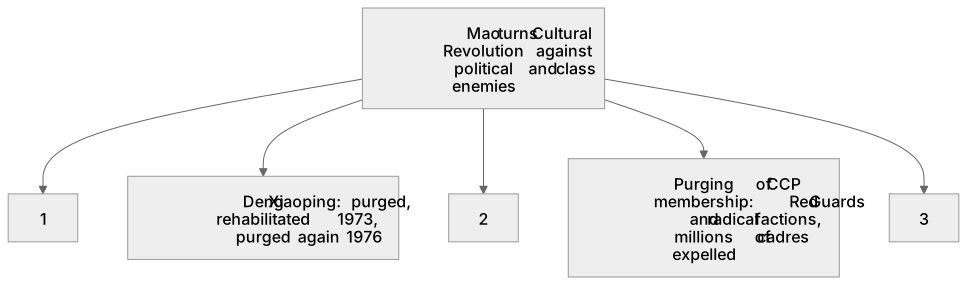
1Box 1
2Box 2
3Box 3
There is more to this lesson
The full lesson goes on to check your understanding and help you earn the marks. Create a free account to carry on, with your progress saved.
A week of Premium from your first lesson · Then the free plan continues · No card, no charge
Test your understanding of The Cultural Revolution and its aftermath, 1966–76: Attacks on Mao’s political and class enemies: Liu Shaoqi and Deng Xiaoping; Lin Biao; the purging of the CCP membership; ‘capitalist roaders’ and foreigners living in China.
Active recall beats re-reading. Take an instant quiz now to test what you’ve learned and lock it into long-term memory.
A week of Premium from your first lesson · Then the free plan continues · No card, no charge