Pearson Edexcel · A-Level · History
Course version: 9HI0 · Version from Sept 2015
The Red Guards and Red Terror: Mao’s hold on young people; the mass…
Full specification wording
The Cultural Revolution and its aftermath, 1966–76: The Red Guards and Red Terror: Mao’s hold on young people; the mass rallies of 1966; Red Guard attacks on the ‘four olds’ (culture, customs, habits, ideas); the growth of anarchy and the use of terror; cultural destruction.
From 1966 Mao mobilised students as Red Guards, exploiting his hold on young people who saw him as the revolution’s guardian.
Checked against the Pearson Edexcel 9HI0 specification (opens in a new tab) on .
- Point 2 of 4
- 4 key terms
Study notes
From the checked teaching notes for this specification point.
The idea
From 1966 Mao mobilised students as Red Guards, exploiting his hold on young people who saw him as the revolution’s guardian. Mass rallies in Beijing, notably between August and November 1966, brought millions before Mao and intensified loyalty. Red Guards attacked the ‘four olds’ — culture, customs, habits and ideas — destroying temples, books, art and clothing, and persecuting intellectuals and officials. As violence spread, anarchy grew and terror was used against alleged class enemies, with beatings, public struggle sessions and deaths. This cultural destruction and disorder damaged China’s heritage and social fabric, and eventually led Mao to curb the Red Guards.
What earns the marks
- Explains how Mao’s personality cult and revolutionary prestige gave him a strong hold on young people, especially students.
- Describes the scale and purpose of the 1966 mass rallies in Beijing as a means of mobilising and displaying loyalty.
- Analyses Red Guard attacks on the ‘four olds’ as an assault on culture, customs, habits and ideas, with examples such as temples, books and traditional dress.
- Assesses the growth of anarchy and the use of terror, including struggle sessions, beatings and intimidation of alleged class enemies.
- Evaluates the consequences of cultural destruction for China’s heritage and for the trajectory of the Cultural Revolution.
Common mistakes and how to put them right
Treating the Red Guards as a single unified organisation.
Put it right by noting diverse groups that often clashed with each other.
Assuming the ‘four olds’ referred only to physical objects.
Put it right by including customs, habits and ideas as well as culture.
Presenting the mass rallies as merely celebratory.
Put it right by explaining their role in legitimising Mao’s line and intimidating opponents.
Exam tips
- Use specific examples of cultural destruction, such as temples, books or traditional opera, to substantiate claims.
- Distinguish between Mao’s hold on young people, the rallies and the terror to structure a causal or thematic answer.
- Link the growth of anarchy to the wider breakdown of party and state authority in 1966–67.
Try the lesson
The start of the The Cultural Revolution and its aftermath, 1966–76: The Red Guards and Red Terror: Mao’s hold on young people; the mass rallies of 1966; Red Guard attacks on the ‘four olds’ (culture, customs, habits, ideas); the growth of anarchy and the use of terror; cultural destruction. lesson, made from checked teaching notes for this specification point.
Have a go first
What were the 'four olds' that Red Guards attacked during the Cultural Revolution?
Listen
From 1966 Mao mobilised students as Red Guards, exploiting his hold on young people who saw him as the revolution’s guardian. Mass rallies in Beijing, notably between August and November 1966, brought millions before Mao and intensified loyalty. Red Guards attacked the ‘four olds’ — culture, customs, habits and ideas — destroying temples, books, art and clothing, and persecuting intellectuals and officials. As violence spread, anarchy grew and terror was used against alleged class enemies, with beatings, public struggle sessions and deaths. This cultural destruction and disorder damaged China’s heritage and social fabric, and eventually led Mao to curb the Red Guards. A strong answer earns marks for these points. Explains how Mao’s personality cult and revolutionary prestige gave him a strong hold on young people, especially students. Describes the scale and purpose of the 1966 mass rallies in Beijing as a means of mobilising and displaying loyalty. Analyses Red Guard attacks on the ‘four olds’ as an assault on culture, customs, habits and ideas, with examples such as temples, books and traditional dress. Assesses the growth of anarchy and the use of terror, including struggle sessions, beatings and intimidation of alleged class enemies. A common slip: Treating the Red Guards as a single unified organisation. Instead, noting diverse groups that often clashed with each other. Exam tip: Use specific examples of cultural destruction, such as temples, books or traditional opera, to substantiate claims.
See it
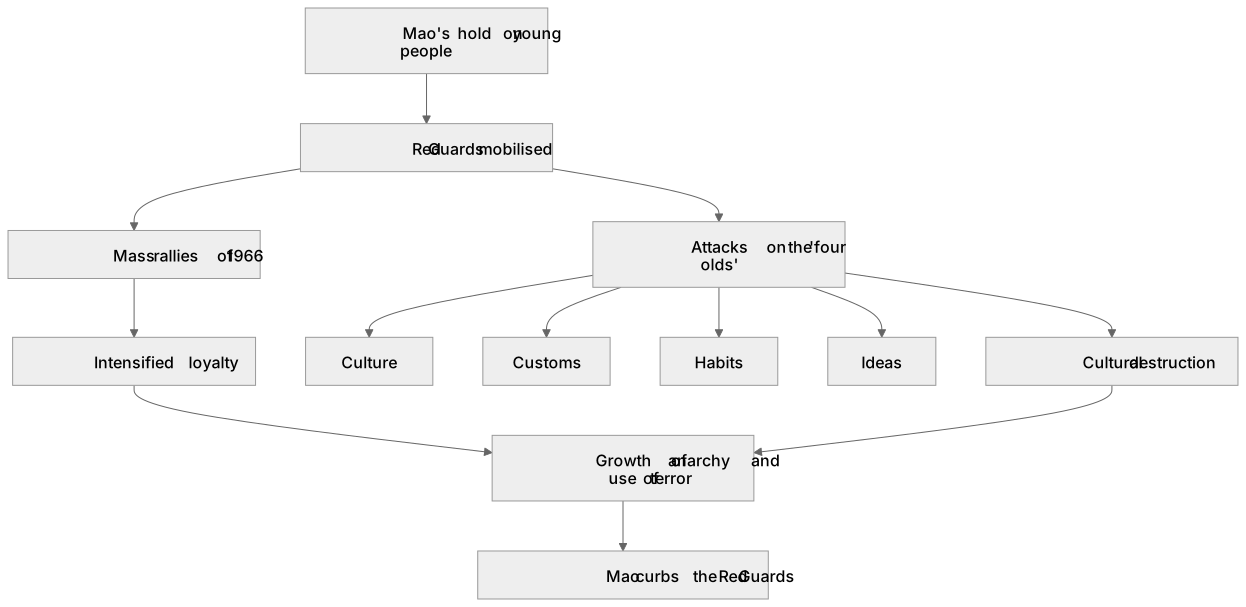
Key words
Say what each word means before you turn the card.
Mao’s personality cult and youth mobilisation
Try answering aloud or in your head before turning the card.
Mass mobilisation and political theatre
Try answering aloud or in your head before turning the card.
The ‘four olds’ and cultural destruction
Try answering aloud or in your head before turning the card.
Anarchy, terror and social breakdown
Try answering aloud or in your head before turning the card.
See every definition
- Mao’s personality cult and youth mobilisation
- Mao exploited his hold on young people, who saw him as the revolution’s guardian, by mobilising students as Red Guards from 1966.
- Mass mobilisation and political theatre
- Mass rallies in Beijing, notably between August and November 1966, brought millions before Mao and intensified loyalty.
- The ‘four olds’ and cultural destruction
- Red Guards attacked the ‘four olds’ — culture, customs, habits and ideas — destroying temples, books, art and clothing, and persecuting intellectuals and officials.
- Anarchy, terror and social breakdown
- As violence spread, anarchy grew and terror was used against alleged class enemies, with beatings, public struggle sessions and deaths.
Label the diagram
Some boxes have lost their names. Pick the right name for each number.
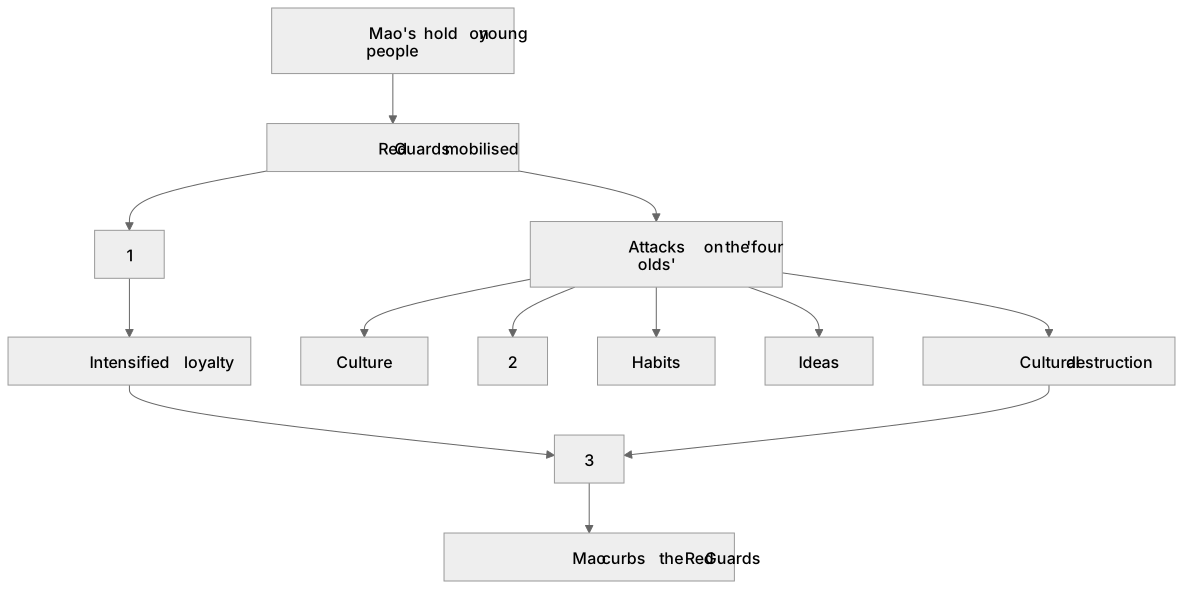
1Box 1
2Box 2
3Box 3
There is more to this lesson
The full lesson goes on to check your understanding and help you earn the marks. Create a free account to carry on, with your progress saved.
A week of Premium from your first lesson · Then the free plan continues · No card, no charge
Test your understanding of The Cultural Revolution and its aftermath, 1966–76: The Red Guards and Red Terror: Mao’s hold on young people; the mass rallies of 1966; Red Guard attacks on the ‘four olds’ (culture, customs, habits, ideas); the growth of anarchy and the use of terror; cultural destruction.
Active recall beats re-reading. Take an instant quiz now to test what you’ve learned and lock it into long-term memory.
A week of Premium from your first lesson · Then the free plan continues · No card, no charge