Pearson Edexcel · A-Level · History
Course version: 9HI0 · Version from Sept 2015
Relations with West Germany: Ostpolitik; the agreements of 1970–72; the…
Full specification wording
The development of the East German state, 1961–85: Relations with West Germany: Ostpolitik; the agreements of 1970–72; the relaxation of travel restrictions and the growth of communications with the Federal Republic. The impact of Ostpolitik on the GDR’s economy and standard of living.
Ostpolitik was West Germany's attempt, from 1969, to ease relations with the East.
Checked against the Pearson Edexcel 9HI0 specification (opens in a new tab) on .
- Point 3 of 4
- 3 key terms
Study notes
From the checked teaching notes for this specification point.
The idea
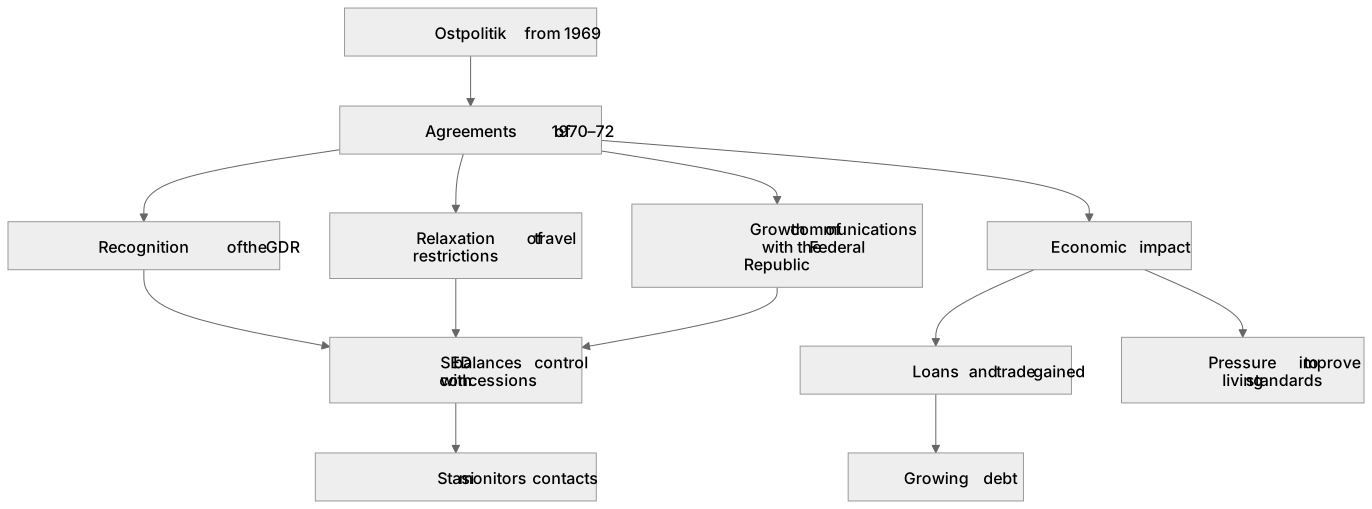
Ostpolitik was West Germany's attempt, from 1969, to ease relations with the East. For the GDR, the 1970–72 agreements (Moscow, Warsaw, Berlin, Basic Treaty) brought recognition but also exposure to Western influence. Travel restrictions relaxed: more visits, letters and phone calls. Economically, the GDR gained loans and trade, but faced pressure to improve living standards. The SED balanced control with concessions, using the Stasi to monitor contacts. This topic examines how far Ostpolitik changed the GDR's economy and daily life.
What earns the marks
- Explain the aims and methods of West German Ostpolitik under Brandt, including the Moscow and Warsaw Treaties of 1970 and the Four Power Agreement on Berlin in 1971.
- Analyse the significance of the Basic Treaty of 1972 for the GDR's international position and its internal legitimacy.
- Assess the relaxation of travel restrictions, including the 1971 and 1972 agreements on visits and the growth of telephone and postal communications.
- Evaluate the economic impact of Ostpolitik, such as West German loans, trade credits and the effect on the GDR's debt and consumer supply.
- Discuss the impact on the standard of living, including improvements in housing, consumer goods and the role of the Stasi in monitoring discontent.
Common mistakes and how to put them right
Treating Ostpolitik as solely a West German policy without considering the GDR's response.
Put it right: Show how the SED under Honecker used Ostpolitik to gain recognition while trying to limit its domestic effects.
Assuming the Basic Treaty meant full diplomatic recognition.
Put it right: Explain that it was a de facto recognition, with both states exchanging permanent representatives rather than ambassadors.
Overstating the economic benefits without noting the growing debt.
Put it right: Balance the short-term gains in loans and trade with the long-term dependence on Western credit.
Exam tips
- Use specific dates and agreements (1970 Moscow Treaty, 1971 Four Power Agreement, 1972 Basic Treaty) to support your arguments.
- Link economic changes to political control: for example, how loans funded consumer goods but also increased GDR debt.
- Compare the GDR's standard of living with West Germany to highlight the relative nature of improvements.
Try the lesson
The start of the The development of the East German state, 1961–85: Relations with West Germany: Ostpolitik; the agreements of 1970–72; the relaxation of travel restrictions and the growth of communications with the Federal Republic. The impact of Ostpolitik on the GDR’s economy and standard of living. lesson, made from checked teaching notes for this specification point.
Have a go first
Which West German Chancellor launched the policy of Ostpolitik towards the Eastern bloc from 1969?
Listen
Ostpolitik was West Germany's attempt, from 1969, to ease relations with the East. For the GDR, the 1970–72 agreements (Moscow, Warsaw, Berlin, Basic Treaty) brought recognition but also exposure to Western influence. Travel restrictions relaxed: more visits, letters and phone calls. Economically, the GDR gained loans and trade, but faced pressure to improve living standards. The SED balanced control with concessions, using the Stasi to monitor contacts. This topic examines how far Ostpolitik changed the GDR's economy and daily life. A strong answer earns marks for these points. Explain the aims and methods of West German Ostpolitik under Brandt, including the Moscow and Warsaw Treaties of 1970 and the Four Power Agreement on Berlin in 1971. Analyse the significance of the Basic Treaty of 1972 for the GDR's international position and its internal legitimacy. Assess the relaxation of travel restrictions, including the 1971 and 1972 agreements on visits and the growth of telephone and postal communications. Evaluate the economic impact of Ostpolitik, such as West German loans, trade credits and the effect on the GDR's debt and consumer supply. A common slip: treating Ostpolitik as solely a West German policy without considering the GDR's response. Instead, show how the SED under Honecker used Ostpolitik to gain recognition while trying to limit its domestic effects. Exam tip: Use specific dates and agreements (1970 Moscow Treaty, 1971 Four Power Agreement, 1972 Basic Treaty) to support your arguments.
See it
Key words
Say what each word means before you turn the card.
Ostpolitik
Try answering aloud or in your head before turning the card.
Basic Treaty
Try answering aloud or in your head before turning the card.
Stasi
Try answering aloud or in your head before turning the card.
See every definition
- Ostpolitik
- West Germany's attempt, from 1969, to ease relations with the East.
- Basic Treaty
- The 1972 agreement that brought the GDR recognition, though only de facto, with both states exchanging permanent representatives rather than ambassadors.
- Stasi
- The body used by the SED to monitor contacts and discontent as it balanced control with concessions.
Label the diagram
Some boxes have lost their names. Pick the right name for each number.
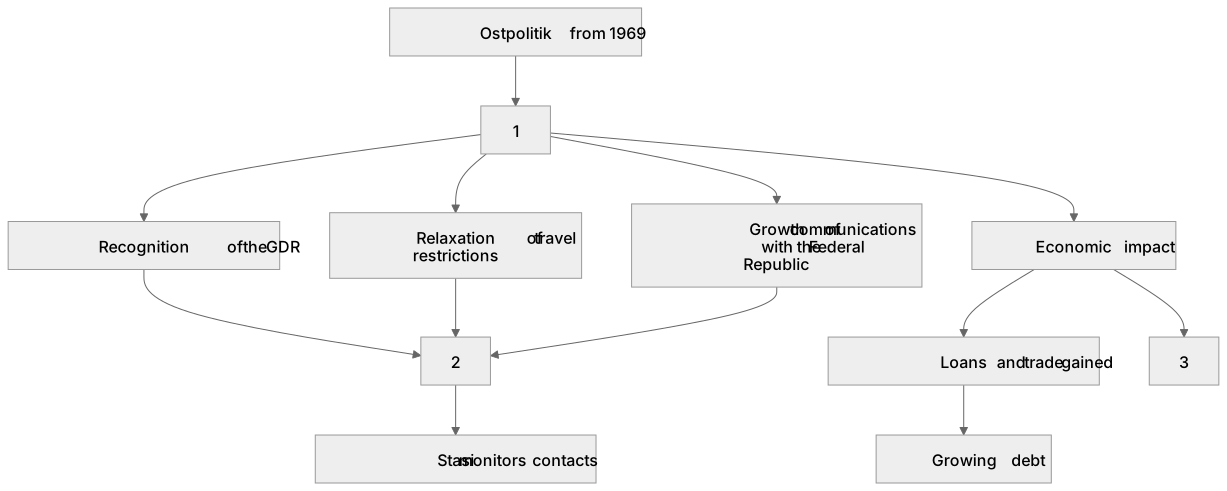
1Box 1
2Box 2
3Box 3
There is more to this lesson
The full lesson goes on to check your understanding and help you earn the marks. Create a free account to carry on, with your progress saved.
A week of Premium from your first lesson · Then the free plan continues · No card, no charge
Test your understanding of The development of the East German state, 1961–85: Relations with West Germany: Ostpolitik; the agreements of 1970–72; the relaxation of travel restrictions and the growth of communications with the Federal Republic. The impact of Ostpolitik on the GDR’s economy and standard of living.
Active recall beats re-reading. Take an instant quiz now to test what you’ve learned and lock it into long-term memory.
A week of Premium from your first lesson · Then the free plan continues · No card, no charge