Pearson Edexcel · A-Level · History
Course version: 9HI0 · Version from Sept 2015
The growing international prestige of the GDR: international recognition…
Full specification wording
The development of the East German state, 1961–85: The growing international prestige of the GDR: international recognition of the GDR; state visits; relations with COMECON and the Warsaw Pact countries. The attitude of the Soviet government towards the GDR.
From the early 1970s, the GDR gained wider international recognition, joining the UN in 1973 and receiving state visits.
Checked against the Pearson Edexcel 9HI0 specification (opens in a new tab) on .
- Point 4 of 4
Study notes
From the checked teaching notes for this specification point.
The idea
From the early 1970s, the GDR gained wider international recognition, joining the UN in 1973 and receiving state visits. It played a key role in COMECON and the Warsaw Pact, hosting events and signing treaties. The Soviet Union treated the GDR as a loyal ally but also a strategic buffer, providing subsidies and troops while expecting conformity. This topic examines how the GDR's prestige grew, its relations with communist states, and the limits set by Moscow.
For example: Honecker's state visits to other communist states in the 1970s demonstrate growing prestige, while the stationing of Soviet troops highlights dependency.
What earns the marks
- Explain the process of international recognition, including the Basic Treaty, UN membership in 1973 and diplomatic relations with non-communist states.
- Analyse the significance of state visits by Honecker and other leaders, such as Honecker's visits to other communist states in the 1970s, and to West Germany in 1987 (outside this period).
- Assess the GDR's role in COMECON, including trade, specialisation and its position as a leading industrial economy within the bloc.
- Evaluate the GDR's relations with Warsaw Pact countries, including its military contribution and hosting of exercises.
- Discuss the Soviet attitude, including economic subsidies, the stationing of Soviet troops and political expectations of the SED.
Common mistakes and how to put them right
Claiming the GDR was fully independent in foreign policy.
Put it right: Show that the Soviet Union constrained major decisions, as seen in the GDR's support for the invasion of Czechoslovakia in 1968.
Confusing COMECON with the Warsaw Pact.
Put it right: Distinguish COMECON as an economic organisation and the Warsaw Pact as a military alliance.
Ignoring the limits of recognition, such as the Hallstein Doctrine's earlier effects.
Put it right: Note that recognition grew only after West Germany's Ostpolitik and the Basic Treaty.
Exam tips
- Use specific examples of state visits and treaties to demonstrate the GDR's growing prestige.
- Explain how COMECON and Warsaw Pact membership benefited the GDR economically and militarily.
- Analyse the Soviet attitude by referring to both support and control, such as subsidies and the presence of Soviet troops.
Try the lesson
The start of the The development of the East German state, 1961–85: The growing international prestige of the GDR: international recognition of the GDR; state visits; relations with COMECON and the Warsaw Pact countries. The attitude of the Soviet government towards the GDR. lesson, made from checked teaching notes for this specification point.
Have a go first
Which Soviet-led economic organisation did the GDR join in 1950, integrating its economy into the Eastern Bloc?
Listen
From the early 1970s, the GDR gained wider international recognition, joining the UN in 1973 and receiving state visits. It played a key role in COMECON and the Warsaw Pact, hosting events and signing treaties. The Soviet Union treated the GDR as a loyal ally but also a strategic buffer, providing subsidies and troops while expecting conformity. This topic examines how the GDR's prestige grew, its relations with communist states, and the limits set by Moscow. For example, Honecker's state visits to other communist states in the 1970s demonstrate growing prestige, while the stationing of Soviet troops highlights dependency. A strong answer earns marks for these points. Explain the process of international recognition, including the Basic Treaty, UN membership in 1973 and diplomatic relations with non-communist states. Analyse the significance of state visits by Honecker and other leaders, such as Honecker's visits to other communist states in the 1970s, and to West Germany in 1987 (outside this period). Assess the GDR's role in COMECON, including trade, specialisation and its position as a leading industrial economy within the bloc. Evaluate the GDR's relations with Warsaw Pact countries, including its military contribution and hosting of exercises. A common slip: claiming the GDR was fully independent in foreign policy. Instead, show that the Soviet Union constrained major decisions, as seen in the GDR's support for the invasion of Czechoslovakia in 1968. Exam tip: Use specific examples of state visits and treaties to demonstrate the GDR's growing prestige.
See it

Label the diagram
Some boxes have lost their names. Pick the right name for each number.
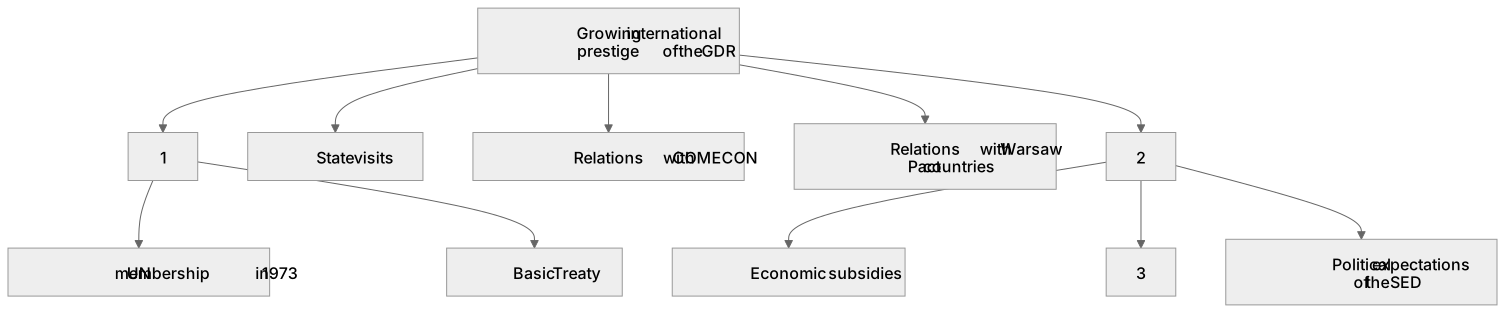
1Box 1
2Box 2
3Box 3
There is more to this lesson
The full lesson goes on to check your understanding and help you earn the marks. Create a free account to carry on, with your progress saved.
A week of Premium from your first lesson · Then the free plan continues · No card, no charge
Test your understanding of The development of the East German state, 1961–85: The growing international prestige of the GDR: international recognition of the GDR; state visits; relations with COMECON and the Warsaw Pact countries. The attitude of the Soviet government towards the GDR.
Active recall beats re-reading. Take an instant quiz now to test what you’ve learned and lock it into long-term memory.
A week of Premium from your first lesson · Then the free plan continues · No card, no charge