Pearson Edexcel · A-Level · History
Course version: 9HI0 · Version from Sept 2015
The coup of Thermidor: growing economic and political fear; Robespierre…
Full specification wording
The National Convention, the Jacobins and the Terror, 1793–94: The coup of Thermidor: growing economic and political fear; Robespierre under pressure; the arrest and execution of Robespierre and his supporters; Thermidorean government established.
By mid-1794, growing economic and political fear created a volatile climate.
Checked against the Pearson Edexcel 9HI0 specification (opens in a new tab) on .
- Point 4 of 4
- 3 key terms
Study notes
From the checked teaching notes for this specification point.
The idea
By mid-1794, growing economic and political fear created a volatile climate. The resolution of the military emergency, notably the victory at Fleurus, undermined the justification for the Terror. The Law of 22 Prairial accelerated executions, and Robespierre's absence from the Committee fuelled rumours. His Festival of the Supreme Being and speech of 8 Thermidor appeared to threaten unnamed deputies, putting Robespierre under pressure and uniting radicals and moderates against him. On 9 Thermidor (27 July 1794), the Convention decreed the arrest of Robespierre and his supporters; the Commune briefly resisted, but the prisoners were executed the next day. The Thermidorean government was then established, dismantling emergency structures, curbing the Committee's powers, and releasing suspects to form a more conservative republic.
What earns the marks
- Explains the growing economic and political fear in 1794, including inflation, food shortages, and anxiety among deputies about further purges.
- Analyses Robespierre under pressure, noting how the victory at Fleurus removed the military justification for the Terror, while the Law of 22 Prairial and his 8 Thermidor speech alienated the Convention.
- Describes the arrest and execution of Robespierre and his supporters on 9–10 Thermidor, including the roles of the Convention and the Paris Commune.
- Explains how the Thermidorean government was established, with reduced emergency powers, a more conservative Convention, and the release of suspects.
- Evaluates the significance of the coup of Thermidor as a turning point from radical revolutionary government towards a more moderate republic.
Common mistakes and how to put them right
Presenting Thermidor as a simple personal fall.
Put it right by explaining the broad coalition of deputies, including former terrorists and moderates, who feared Robespierre.
Ignoring the economic context.
Put it right by linking inflation, the Maximum, and shortages to political instability in mid-1794.
Assuming the Terror ended immediately on 9 Thermidor.
Put it right by noting the gradual Thermidorean Reaction, continued executions in some areas, and the piecemeal dismantling of emergency government.
Exam tips
- Use the revolutionary calendar alongside Gregorian dates, for example 9 Thermidor (27 July 1794), to show precision.
- Explain the motives of different groups in the Convention rather than treating opposition to Robespierre as unanimous or inevitable.
Try the lesson
The start of the The National Convention, the Jacobins and the Terror, 1793–94: The coup of Thermidor: growing economic and political fear; Robespierre under pressure; the arrest and execution of Robespierre and his supporters; Thermidorean government established. lesson, made from checked teaching notes for this specification point.
Have a go first
In which month and year was Robespierre arrested and executed?
Listen
By mid-1794, growing economic and political fear created a volatile climate. The resolution of the military emergency, notably the victory at Fleurus, undermined the justification for the Terror. The Law of 22 Prairial accelerated executions, and Robespierre's absence from the Committee fuelled rumours. His Festival of the Supreme Being and speech of 8 Thermidor appeared to threaten unnamed deputies, putting Robespierre under pressure and uniting radicals and moderates against him. On 9 Thermidor (27 July 1794), the Convention decreed the arrest of Robespierre and his supporters; the Commune briefly resisted, but the prisoners were executed the next day. The Thermidorean government was then established, dismantling emergency structures, curbing the Committee's powers, and releasing suspects to form a more conservative republic. A strong answer earns marks for these points. Explains the growing economic and political fear in 1794, including inflation, food shortages, and anxiety among deputies about further purges. Analyses Robespierre under pressure, noting how the victory at Fleurus removed the military justification for the Terror, while the Law of 22 Prairial and his 8 Thermidor speech alienated the Convention. Describes the arrest and execution of Robespierre and his supporters on 9–10 Thermidor, including the roles of the Convention and the Paris Commune. Explains how the Thermidorean government was established, with reduced emergency powers, a more conservative Convention, and the release of suspects. A common slip: Presenting Thermidor as a simple personal fall. Instead, explaining the broad coalition of deputies, including former terrorists and moderates, who feared Robespierre. Exam tip: Use the revolutionary calendar alongside Gregorian dates, for example 9 Thermidor (27 July 1794), to show precision.
See it
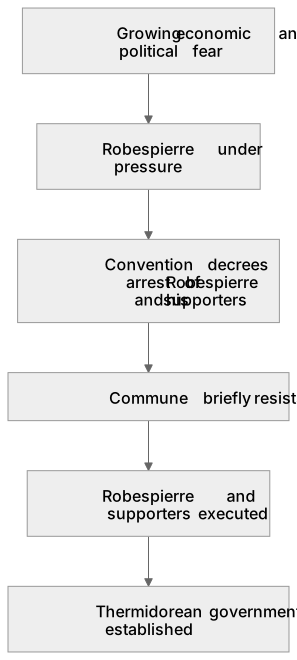
Put it in order
Put these steps in the order they happen.
- 1. Convention decrees arrest of Robespierre and his supporters
- 2. Robespierre under pressure
- 3. Growing economic and political fear
- 4. Thermidorean government established
- 5. Robespierre and supporters executed
- 6. Commune briefly resists
Key words
Say what each word means before you turn the card.
Revolutionary crisis and political fear
Try answering aloud or in your head before turning the card.
Factional coalitions and the fall of Robespierre
Try answering aloud or in your head before turning the card.
The end of the Terror and the Thermidorean Reaction
Try answering aloud or in your head before turning the card.
See every definition
- Revolutionary crisis and political fear
- Growing economic and political fear by mid-1794 created a volatile climate, with inflation, food shortages and anxiety among deputies about further purges.
- Factional coalitions and the fall of Robespierre
- Radicals and moderates united against Robespierre after his 8 Thermidor speech appeared to threaten unnamed deputies, leading to his arrest and execution.
- The end of the Terror and the Thermidorean Reaction
- The Thermidorean government dismantled emergency structures, curbed the Committee's powers and released suspects to form a more conservative republic.
Label the diagram
Some boxes have lost their names. Pick the right name for each number.
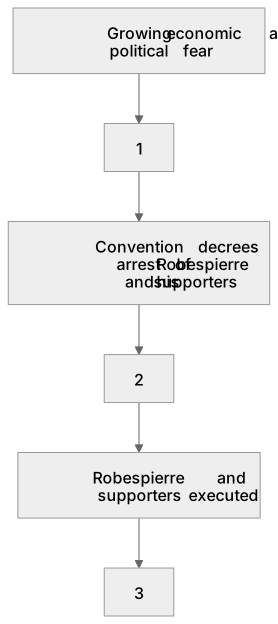
1Box 1
2Box 2
3Box 3
There is more to this lesson
The full lesson goes on to check your understanding and help you earn the marks. Create a free account to carry on, with your progress saved.
A week of Premium from your first lesson · Then the free plan continues · No card, no charge
Test your understanding of The National Convention, the Jacobins and the Terror, 1793–94: The coup of Thermidor: growing economic and political fear; Robespierre under pressure; the arrest and execution of Robespierre and his supporters; Thermidorean government established.
Active recall beats re-reading. Take an instant quiz now to test what you’ve learned and lock it into long-term memory.
A week of Premium from your first lesson · Then the free plan continues · No card, no charge