Pearson Edexcel · A-Level · History
Course version: 9HI0 · Version from Sept 2015
Problems facing France in the 1780s: rural poverty and urban food prices;…
Full specification wording
The origins and onset of revolution, 1774–89: Problems facing France in the 1780s: rural poverty and urban food prices; taxation and crown debt; corruption at court; impact of the American Revolution.
In the 1780s, France faced interconnected crises.
Checked against the Pearson Edexcel 9HI0 specification (opens in a new tab) on .
- Point 2 of 4
- 4 key terms
Study notes
From the checked teaching notes for this specification point.
The idea
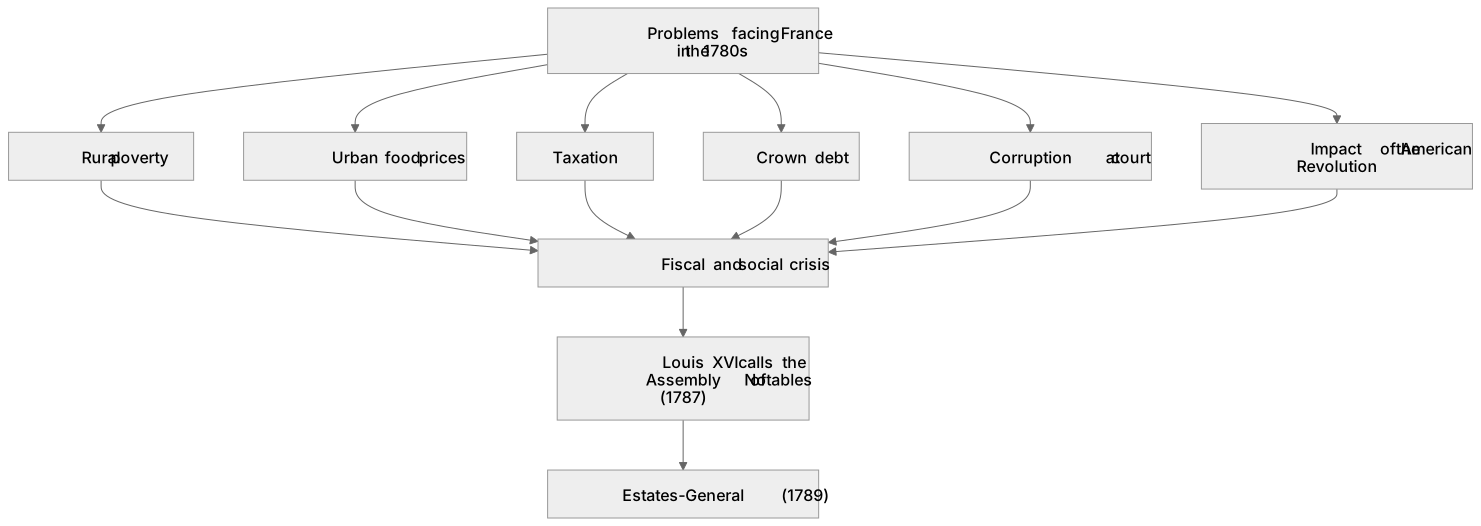
In the 1780s, France faced interconnected crises. Rural poverty was widespread: peasants paid seigneurial dues, tithes, and royal taxes, and many were landless or near-landless. Urban food prices, especially for bread, rose sharply, causing hunger and unrest. Taxation was regressive and inefficient: the taille fell on commoners, while nobles and clergy were largely exempt; tax farming and venal offices drained revenue. Crown debt soared due to war, especially the American Revolution, which added over 1 billion livres. Corruption at court, such as lavish spending by Marie-Antoinette and the diamond necklace affair, discredited the monarchy. The American Revolution inspired hopes for liberty and reform, but also worsened finances. These problems forced Louis XVI to call the Assembly of Notables (1787) and then the Estates-General (1789).
Common mistakes and how to put them right
Stating that only the Third Estate paid taxes.
Put it right: Some nobles and clergy paid certain taxes (e.g., the capitation), but they were largely exempt from the taille and other direct taxes, so the burden fell disproportionately on commoners.
Attributing the debt solely to the American Revolution.
Put it right: The debt was cumulative from earlier wars, but the American Revolution added significantly to it and forced new loans at high interest.
Claiming that bread prices were uniformly high throughout the 1780s.
Put it right: Prices fluctuated; the crisis was most acute in 1788–89 due to harvest failure, but the overall trend was volatile and contributed to popular unrest.
Exam tips
- When discussing the impact of the American Revolution, distinguish between its financial cost and its ideological influence; use specific figures (e.g., over 1 billion livres) to support your argument.
- Link rural and urban problems to the fiscal crisis: show how poverty and food prices increased pressure on the crown to reform taxation, which in turn provoked aristocratic resistance.
- Use the Assembly of Notables and the Estates-General as evidence of the crown's inability to solve problems within the existing system, but avoid claiming they were inevitable.
Try the lesson
The start of the The origins and onset of revolution, 1774–89: Problems facing France in the 1780s: rural poverty and urban food prices; taxation and crown debt; corruption at court; impact of the American Revolution. lesson, made from checked teaching notes for this specification point.
Have a go first
In the 1780s, what was the main cause of rising bread prices in French towns?
Listen
In the 1780s, France faced interconnected crises. Rural poverty was widespread: peasants paid seigneurial dues, tithes, and royal taxes, and many were landless or near-landless. Urban food prices, especially for bread, rose sharply, causing hunger and unrest. Taxation was regressive and inefficient: the taille fell on commoners, while nobles and clergy were largely exempt; tax farming and venal offices drained revenue. Crown debt soared due to war, especially the American Revolution, which added over 1 billion livres. Corruption at court, such as lavish spending by Marie-Antoinette and the diamond necklace affair, discredited the monarchy. The American Revolution inspired hopes for liberty and reform, but also worsened finances. These problems forced Louis XVI to call the Assembly of Notables (1787) and then the Estates-General (1789). A strong answer earns marks for these points. Rural poverty: peasants faced seigneurial dues (e.g., champart, corvée), the tithe, and royal taxes such as the taille and gabelle; many were sharecroppers or day labourers, vulnerable to harvest failure and rising rents. Urban food prices: the price of bread, the staple of the urban diet, fluctuated with harvests; in the 1780s, deregulation of the grain trade and poor harvests (especially 1788) caused prices to spike, leading to riots and subsistence crises. Taxation: the tax system was inequitable and inefficient; the taille was levied on commoners, while nobles and clergy enjoyed exemptions; indirect taxes (aides, gabelle) were regressive; tax farming (the Ferme Générale) collected revenue but with high administrative costs and abuses. Crown debt: decades of war (Seven Years' War, American Revolution) had accumulated massive debt; by 1789, debt service consumed a large share of revenue; attempts to reform taxation (e.g., Turgot, Necker) failed due to opposition from privileged orders. A common slip: stating that only the Third Estate paid taxes. Instead, some nobles and clergy paid certain taxes (e.g., the capitation), but they were largely exempt from the taille and other direct taxes, so the burden fell disproportionately on commoners. Exam tip: When discussing the impact of the American Revolution, distinguish between its financial cost and its ideological influence; use specific figures (e.g., over 1 billion livres) to support your argument.
See it
Key words
Say what each word means before you turn the card.
Economic crisis and social distress
Try answering aloud or in your head before turning the card.
Fiscal crisis and reform failure
Try answering aloud or in your head before turning the card.
Court scandal and royal authority
Try answering aloud or in your head before turning the card.
International conflict and ideological transfer
Try answering aloud or in your head before turning the card.
See every definition
- Economic crisis and social distress
- Rural poverty was widespread, with peasants paying seigneurial dues, tithes and royal taxes, while sharp rises in urban food prices, especially bread, caused hunger and unrest.
- Fiscal crisis and reform failure
- Taxation was regressive and inefficient, crown debt soared due to war, and attempts to reform taxation failed due to opposition from privileged orders.
- Court scandal and royal authority
- Corruption at court, such as lavish spending by Marie-Antoinette and the diamond necklace affair, discredited the monarchy.
- International conflict and ideological transfer
- The American Revolution inspired hopes for liberty and reform, but also worsened finances, adding over 1 billion livres to crown debt.
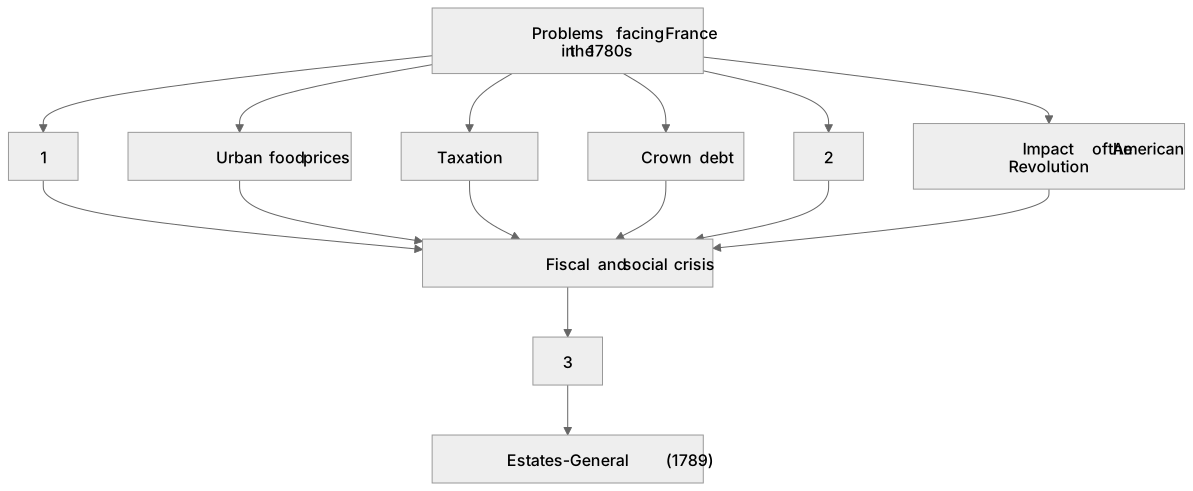
Label the diagram
Some boxes have lost their names. Pick the right name for each number.
1Box 1
2Box 2
3Box 3
There is more to this lesson
The full lesson goes on to check your understanding and help you earn the marks. Create a free account to carry on, with your progress saved.
A week of Premium from your first lesson · Then the free plan continues · No card, no charge
Test your understanding of The origins and onset of revolution, 1774–89: Problems facing France in the 1780s: rural poverty and urban food prices; taxation and crown debt; corruption at court; impact of the American Revolution.
Active recall beats re-reading. Take an instant quiz now to test what you’ve learned and lock it into long-term memory.
A week of Premium from your first lesson · Then the free plan continues · No card, no charge