Pearson Edexcel · A-Level · History
Course version: 9HI0 · Version from Sept 2015
The ancien régime and its challenges in 1774: absolutism and court…
Full specification wording
The origins and onset of revolution, 1774–89: The ancien régime and its challenges in 1774: absolutism and court faction; the parlements; the three estates; rights of nobles and church privilege; the impact of the Enlightenment and the spread of new ideas.
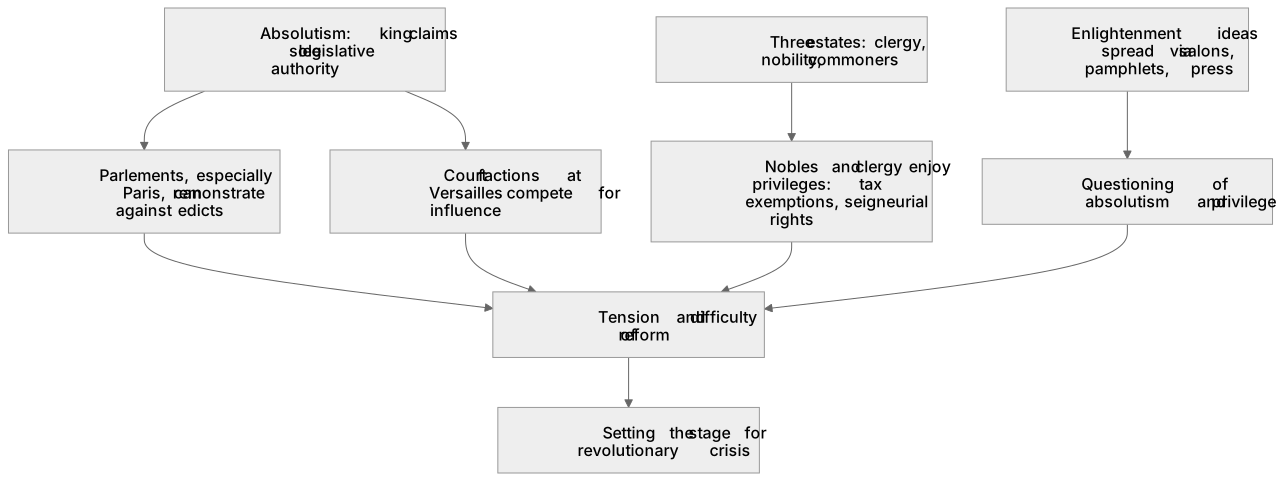
In 1774, France was an absolute monarchy: the king claimed sole legislative authority, but in practice court factions at Versailles competed for influence.
Checked against the Pearson Edexcel 9HI0 specification (opens in a new tab) on .
- Point 1 of 4
- 4 key terms
Study notes
From the checked teaching notes for this specification point.
The idea
In 1774, France was an absolute monarchy: the king claimed sole legislative authority, but in practice court factions at Versailles competed for influence. The parlements, especially Paris, could remonstrate against edicts, creating tension. Society was divided into three estates: clergy, nobility, and commoners. Nobles and clergy enjoyed privileges such as tax exemptions and seigneurial rights. Enlightenment ideas spread through salons, pamphlets, and the press, questioning absolutism and privilege. For example, Montesquieu's separation of powers and Rousseau's popular sovereignty challenged the status quo. These structural and intellectual challenges meant reform was difficult, setting the stage for revolutionary crisis.
What earns the marks
- Court faction: rival groups at Versailles, such as the dévots and the philosophes' patrons, competed for royal favour, influencing appointments and policy, which could undermine coherent reform.
Common mistakes and how to put them right
Assuming absolutism meant the king could do anything without limits.
Put it right: French absolutism was constrained by custom, provincial privileges, and the need to negotiate with elites; the parlements and estates could resist.
Treating the three estates as purely economic classes.
Put it right: They were legal orders defined by status and privilege, with the Third Estate encompassing diverse groups from wealthy financiers to landless peasants.
Claiming Enlightenment ideas directly caused the Revolution.
Put it right: They provided a language of critique and reform, but their impact was mediated by political crises, economic hardship, and social conflict.
Exam tips
- When analysing challenges to the ancien régime, link each factor to the difficulty of reform: for example, show how parlementary remonstrances could block tax edicts, forcing the king to back down.
- Use specific examples of Enlightenment thinkers and their ideas, and explain how those ideas circulated (e.g., salons, pamphlets) to demonstrate understanding of the spread of new ideas.
- Avoid vague statements like 'the Enlightenment made people think'; instead, specify which ideas (e.g., separation of powers, popular sovereignty) challenged which aspects of the old order.
Try the lesson
The start of the The origins and onset of revolution, 1774–89: The ancien régime and its challenges in 1774: absolutism and court faction; the parlements; the three estates; rights of nobles and church privilege; the impact of the Enlightenment and the spread of new ideas. lesson, made from checked teaching notes for this specification point.
Have a go first
In the ancien régime, which group formed the First Estate?
Listen
In 1774, France was an absolute monarchy: the king claimed sole legislative authority, but in practice court factions at Versailles competed for influence. The parlements, especially Paris, could remonstrate against edicts, creating tension. Society was divided into three estates: clergy, nobility, and commoners. Nobles and clergy enjoyed privileges such as tax exemptions and seigneurial rights. Enlightenment ideas spread through salons, pamphlets, and the press, questioning absolutism and privilege. For example, Montesquieu's separation of powers and Rousseau's popular sovereignty challenged the status quo. These structural and intellectual challenges meant reform was difficult, setting the stage for revolutionary crisis. A strong answer earns marks for these points. Absolutism: the king held executive, legislative, and judicial power, but was expected to rule within custom and consult councils; royal authority was limited by practical constraints such as provincial particularism and the need for cooperation from elites. Court faction: rival groups at Versailles, such as the dévots and the philosophes' patrons, competed for royal favour, influencing appointments and policy, which could undermine coherent reform. Parlements: sovereign courts, notably the Parlement of Paris, registered royal edicts and could issue remonstrances; they claimed the right to reject laws they deemed contrary to fundamental laws, acting as a check on absolutism. Three estates: the First Estate (clergy), Second Estate (nobility), and Third Estate (commoners) were legally distinct orders; the Third Estate included wealthy bourgeoisie, urban workers, and peasants, with the vast majority paying the heaviest taxes. A common slip: assuming absolutism meant the king could do anything without limits. Instead, French absolutism was constrained by custom, provincial privileges, and the need to negotiate with elites; the parlements and estates could resist. Exam tip: When analysing challenges to the ancien régime, link each factor to the difficulty of reform: for example, show how parlementary remonstrances could block tax edicts, forcing the king to back down.
See it
Key words
Say what each word means before you turn the card.
Absolutism
Try answering aloud or in your head before turning the card.
Parlements
Try answering aloud or in your head before turning the card.
Three estates
Try answering aloud or in your head before turning the card.
Enlightenment
Try answering aloud or in your head before turning the card.
See every definition
- Absolutism
- The king claimed sole legislative authority and held executive, legislative and judicial power, but was expected to rule within custom and consult councils.
- Parlements
- Sovereign courts, notably the Parlement of Paris, registered royal edicts and could issue remonstrances, claiming the right to reject laws contrary to fundamental laws.
- Three estates
- Legally distinct orders: the First Estate (clergy), Second Estate (nobility) and Third Estate (commoners), the last including wealthy bourgeoisie, urban workers and peasants.
- Enlightenment
- Thinkers such as Voltaire, Montesquieu and Rousseau criticised absolutism, privilege and religious intolerance, and their ideas circulated via salons, cafés, pamphlets and clandestine literature.
Label the diagram
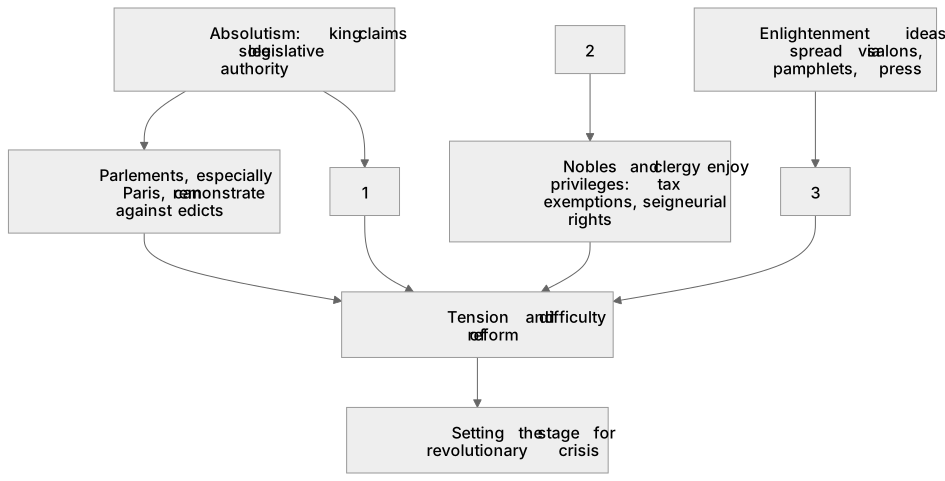
Some boxes have lost their names. Pick the right name for each number.
1Box 1
2Box 2
3Box 3
There is more to this lesson
The full lesson goes on to check your understanding and help you earn the marks. Create a free account to carry on, with your progress saved.
A week of Premium from your first lesson · Then the free plan continues · No card, no charge
Test your understanding of The origins and onset of revolution, 1774–89: The ancien régime and its challenges in 1774: absolutism and court faction; the parlements; the three estates; rights of nobles and church privilege; the impact of the Enlightenment and the spread of new ideas.
Active recall beats re-reading. Take an instant quiz now to test what you’ve learned and lock it into long-term memory.
A week of Premium from your first lesson · Then the free plan continues · No card, no charge