Pearson Edexcel · A-Level · History
Course version: 9HI0 · Version from Sept 2015
From restoration to revolution, 1660–88: the Restoration Settlement,…
Full specification wording
The quest for political stability, 1625–88: From restoration to revolution, 1660–88: the Restoration Settlement, 1660–64; conflicts between king and parliaments, 1665–81; personal rule and the collapse of royal power, 1681–88.
This topic examines how England moved from monarchy restored in 1660 to revolution in 1688.
Checked against the Pearson Edexcel 9HI0 specification (opens in a new tab) on .
- Point 3 of 3
- 4 key terms
Study notes
From the checked teaching notes for this specification point.
The idea
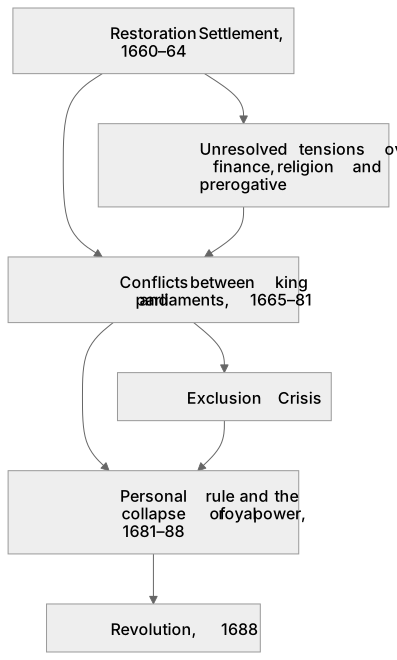
This topic examines how England moved from monarchy restored in 1660 to revolution in 1688. The Restoration Settlement (1660–64) re-established monarchy, Lords and Commons, but left unresolved tensions over finance, religion and prerogative. From 1665 to 1681, conflicts between king and parliaments centred on money, the succession and exclusion, producing repeated clashes and dissolution. After 1681, Charles II ruled personally without Parliament, using loyalist officeholders and the judiciary to suppress opposition. Yet by 1688 James II’s policies had collapsed royal power, leading to William of Orange’s invasion and James’s flight.
What earns the marks
- Analyses the religious and political legislation of the early Restoration, such as the Act of Indemnity and Oblivion, the Corporation Act and the Act of Uniformity, and how these shaped later conflict.
- Explains the nature and causes of conflicts between king and parliaments, 1665–81, including disputes over supply, the Cabal, the Test Acts, the Popish Plot and the Exclusion Crisis.
- Assesses how personal rule after 1681 worked in practice, including the role of loyalist sheriffs, the quo warranto campaign against borough charters and the packing of juries and commissions.
- Evaluates the collapse of royal power by 1688, including the impact of James II’s religious policies, the trial of the Seven Bishops and the decision of key nobles and army officers to defect to William of Orange.
Common mistakes and how to put them right
Treating the Restoration Settlement as a single event in 1660 rather than a series of measures spanning 1660–64.
Put it right: Identify specific statutes and decisions across the period and explain their cumulative effect.
Assuming that the Exclusion Crisis ended in 1681 with a clear royal victory that removed all opposition.
Put it right: Recognise that exclusion failed in the short term but the underlying fears about popery and arbitrary government persisted and resurfaced under James II.
Confusing personal rule after 1681 with the Personal Rule of Charles I in the 1630s.
Put it right: Distinguish the two periods by date, monarch and methods, and explain that Charles II’s personal rule relied on the compliance of local officeholders and the judiciary rather than on the absence of Parliament alone.
Exam tips
- Plan essays around the three phases in the statement, ensuring each paragraph addresses a distinct period and links to the next.
- Use precise dates and names of statutes, elections and individuals to support arguments; avoid vague references to ‘Parliament’ or ‘the king’ without specifying which Parliament or which royal action.
- When evaluating change, compare the extent of royal power in 1660, 1681 and 1688, and explain what had changed and why.
Try the lesson
The start of the The quest for political stability, 1625–88: From restoration to revolution, 1660–88: the Restoration Settlement, 1660–64; conflicts between king and parliaments, 1665–81; personal rule and the collapse of royal power, 1681–88. lesson, made from checked teaching notes for this specification point.
Have a go first
Which measure formed part of the Restoration Settlement of 1660–64?
Listen
This topic examines how England moved from monarchy restored in 1660 to revolution in 1688. The Restoration Settlement (1660–64) re-established monarchy, Lords and Commons, but left unresolved tensions over finance, religion and prerogative. From 1665 to 1681, conflicts between king and parliaments centred on money, the succession and exclusion, producing repeated clashes and dissolution. After 1681, Charles II ruled personally without Parliament, using loyalist officeholders and the judiciary to suppress opposition. Yet by 1688 James II’s policies had collapsed royal power, leading to William of Orange’s invasion and James’s flight. A strong answer earns marks for these points. Explains the main terms of the Restoration Settlement, 1660–64, including the restoration of the monarchy, the House of Lords and the House of Commons, and the financial settlement that gave Charles II limited ordinary revenue. Analyses the religious and political legislation of the early Restoration, such as the Act of Indemnity and Oblivion, the Corporation Act and the Act of Uniformity, and how these shaped later conflict. Explains the nature and causes of conflicts between king and parliaments, 1665–81, including disputes over supply, the Cabal, the Test Acts, the Popish Plot and the Exclusion Crisis. Assesses how personal rule after 1681 worked in practice, including the role of loyalist sheriffs, the quo warranto campaign against borough charters and the packing of juries and commissions. A common slip: Treating the Restoration Settlement as a single event in 1660 rather than a series of measures spanning 1660–64. Instead, identify specific statutes and decisions across the period and explain their cumulative effect. Exam tip: Plan essays around the three phases in the statement, ensuring each paragraph addresses a distinct period and links to the next.
See it
Key words
Say what each word means before you turn the card.
Restoration Settlement
Try answering aloud or in your head before turning the card.
Personal rule
Try answering aloud or in your head before turning the card.
Exclusion Crisis
Try answering aloud or in your head before turning the card.
Collapse of royal power
Try answering aloud or in your head before turning the card.
See every definition
- Restoration Settlement
- The series of measures from 1660 to 1664 that re-established monarchy, Lords and Commons, but left unresolved tensions over finance, religion and prerogative.
- Personal rule
- After 1681, Charles II ruled without Parliament, using loyalist officeholders and the judiciary to suppress opposition.
- Exclusion Crisis
- Part of the conflicts between king and parliaments from 1665 to 1681, centred on money, the succession and exclusion, producing repeated clashes and dissolution.
- Collapse of royal power
- By 1688 James II's policies had collapsed royal power, leading to William of Orange's invasion and James's flight.
Label the diagram
Some boxes have lost their names. Pick the right name for each number.
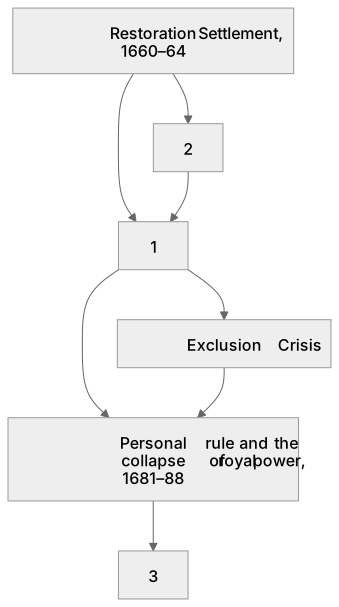
1Box 1
2Box 2
3Box 3
There is more to this lesson
The full lesson goes on to check your understanding and help you earn the marks. Create a free account to carry on, with your progress saved.
A week of Premium from your first lesson · Then the free plan continues · No card, no charge
Test your understanding of The quest for political stability, 1625–88: From restoration to revolution, 1660–88: the Restoration Settlement, 1660–64; conflicts between king and parliaments, 1665–81; personal rule and the collapse of royal power, 1681–88.
Active recall beats re-reading. Take an instant quiz now to test what you’ve learned and lock it into long-term memory.
A week of Premium from your first lesson · Then the free plan continues · No card, no charge