Pearson Edexcel · A-Level · History
Course version: 9HI0 · Version from Sept 2015
Republican rule, 1649–60: reasons for the failure of Republican attempts…
Full specification wording
The quest for political stability, 1625–88: Republican rule, 1649–60: reasons for the failure of Republican attempts to provide stable government; the role of Cromwell.
This topic examines why republican rule failed to provide stable government between 1649 and 1660, and the role of Oliver Cromwell.
Checked against the Pearson Edexcel 9HI0 specification (opens in a new tab) on .
- Point 2 of 3
- 4 key terms
Study notes
From the checked teaching notes for this specification point.
The idea
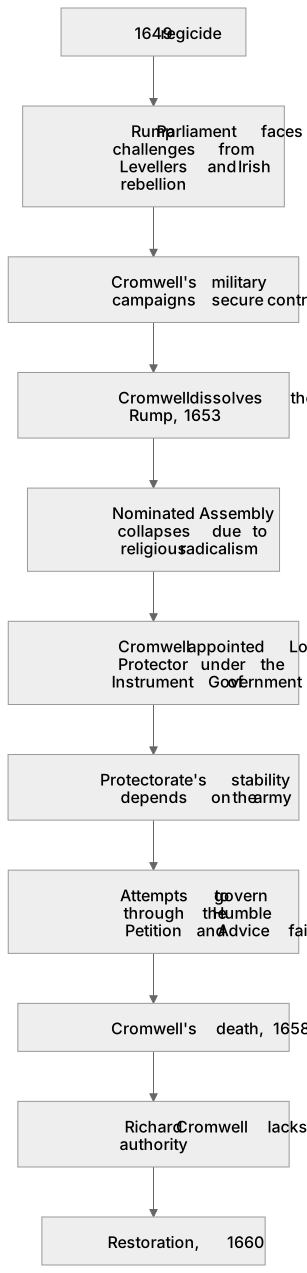
This topic examines why republican rule failed to provide stable government between 1649 and 1660, and the role of Oliver Cromwell. After the 1649 regicide, the Rump Parliament faced challenges from Levellers and Irish rebellion. Cromwell's military campaigns secured control, but he dissolved the Rump in 1653. The subsequent Nominated Assembly collapsed due to religious radicalism. Cromwell was then appointed Lord Protector under the Instrument of Government. The Protectorate's stability depended on the army, and attempts to govern through the Humble Petition and Advice failed. After Cromwell's death in 1658, his son Richard lacked authority, leading to the Restoration in 1660. Failure stemmed from a lack of legitimacy, financial weakness, religious radicalism, and the army's political role.
What earns the marks
- Explains the reasons for the failure of republican government, such as the lack of a stable constitutional settlement, financial difficulties, and religious divisions.
- Analyses the role of Cromwell in republican rule, including his military campaigns, dissolution of the Rump, the Nominated Assembly, and rule as Lord Protector.
- Assesses the impact of the army and the failure to establish civilian authority on the stability of the republic.
- Evaluates the extent to which the failure of republican rule was due to Cromwell's personal rule or broader structural factors.
Common mistakes and how to put them right
Assuming the republic was doomed from the start.
Put it right: Consider the initial possibilities for settlement and the specific decisions that undermined stability.
Attributing all failures to Cromwell alone.
Put it right: Recognise the roles of Parliament, the army, and religious sects in creating instability.
Confusing the chronological order of constitutional experiments.
Put it right: The Nominated Assembly (1653) preceded the Protectorate and the Instrument of Government.
Exam tips
- Structure essays around themes such as legitimacy, finance, religion, and the army to explain the failure of republican rule.
- Use specific examples, such as the Nominated Assembly, Instrument of Government or the Humble Petition and Advice, to illustrate constitutional experiments.
Try the lesson
The start of the The quest for political stability, 1625–88: Republican rule, 1649–60: reasons for the failure of Republican attempts to provide stable government; the role of Cromwell. lesson, made from checked teaching notes for this specification point.
Have a go first
Which body did Cromwell dissolve by force in April 1653, ending the first experiment in republican parliamentary rule?
Listen
This topic examines why republican rule failed to provide stable government between 1649 and 1660, and the role of Oliver Cromwell. After the 1649 regicide, the Rump Parliament faced challenges from Levellers and Irish rebellion. Cromwell's military campaigns secured control, but he dissolved the Rump in 1653. The subsequent Nominated Assembly collapsed due to religious radicalism. Cromwell was then appointed Lord Protector under the Instrument of Government. The Protectorate's stability depended on the army, and attempts to govern through the Humble Petition and Advice failed. After Cromwell's death in 1658, his son Richard lacked authority, leading to the Restoration in 1660. Failure stemmed from a lack of legitimacy, financial weakness, religious radicalism, and the army's political role. A strong answer earns marks for these points. Explains the reasons for the failure of republican government, such as the lack of a stable constitutional settlement, financial difficulties, and religious divisions. Analyses the role of Cromwell in republican rule, including his military campaigns, dissolution of the Rump, the Nominated Assembly, and rule as Lord Protector. Assesses the impact of the army and the failure to establish civilian authority on the stability of the republic. Evaluates the extent to which the failure of republican rule was due to Cromwell's personal rule or broader structural factors. A common slip: assuming the republic was doomed from the start. Instead, consider the initial possibilities for settlement and the specific decisions that undermined stability. Exam tip: Structure essays around themes such as legitimacy, finance, religion, and the army to explain the failure of republican rule.
See it
Key words
Say what each word means before you turn the card.
Legitimacy and authority
Try answering aloud or in your head before turning the card.
The role of the army in politics
Try answering aloud or in your head before turning the card.
Constitutional experiments and failure
Try answering aloud or in your head before turning the card.
Lord Protector
Try answering aloud or in your head before turning the card.
See every definition
- Legitimacy and authority
- Failure of republican rule stemmed from a lack of legitimacy, alongside financial weakness, religious radicalism and the army's political role.
- The role of the army in politics
- The stability of the Protectorate depended on the army, and the army's political role was a reason republican rule failed.
- Constitutional experiments and failure
- Attempts to govern through the Nominated Assembly, the Instrument of Government and the Humble Petition and Advice failed.
- Lord Protector
- Cromwell was appointed Lord Protector under the Instrument of Government after the Nominated Assembly collapsed due to religious radicalism.
Label the diagram
Some boxes have lost their names. Pick the right name for each number.
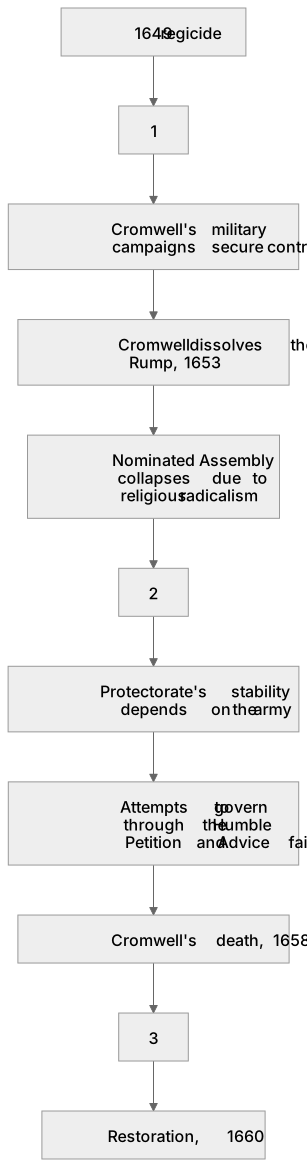
1Box 1
2Box 2
3Box 3
There is more to this lesson
The full lesson goes on to check your understanding and help you earn the marks. Create a free account to carry on, with your progress saved.
A week of Premium from your first lesson · Then the free plan continues · No card, no charge
Test your understanding of The quest for political stability, 1625–88: Republican rule, 1649–60: reasons for the failure of Republican attempts to provide stable government; the role of Cromwell.
Active recall beats re-reading. Take an instant quiz now to test what you’ve learned and lock it into long-term memory.
A week of Premium from your first lesson · Then the free plan continues · No card, no charge