Pearson Edexcel · A-Level · History
Course version: 9HI0 · Version from Sept 2015
The failure of monarchical government, 1625–46: Charles I and parliament,…
Full specification wording
The quest for political stability, 1625–88: The failure of monarchical government, 1625–46: Charles I and parliament, 1625–29; personal rule and its failure, 1629–40 and the failure to compromise, 1640–49.
This topic examines why monarchical government failed between 1625 and 1646.
Checked against the Pearson Edexcel 9HI0 specification (opens in a new tab) on .
- Point 1 of 3
- 4 key terms
Study notes
From the checked teaching notes for this specification point.
The idea
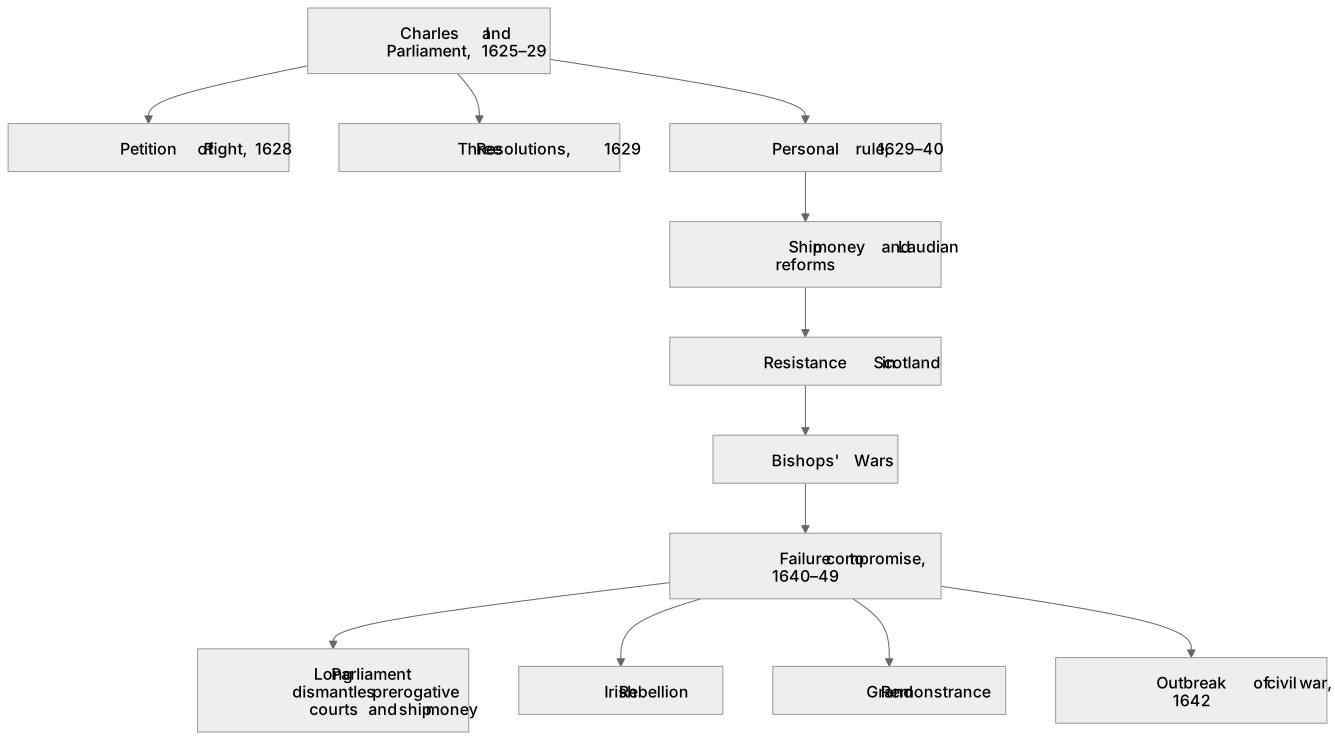
This topic examines why monarchical government failed between 1625 and 1646. From 1625 to 1629, Charles I clashed with Parliament over taxation, religion and the Duke of Buckingham, leading to the Petition of Right (1628) and the Three Resolutions (1629). From 1629 to 1640, Charles ruled personally without Parliament, raising revenue through prerogative means such as ship money and pursuing Laudian religious reforms, which provoked resistance in Scotland and led to the Bishops' Wars. The failure to compromise from 1640 to 1649 saw the Long Parliament dismantle prerogative courts and ship money, the Irish Rebellion, the Grand Remonstrance, and the outbreak of civil war in 1642. Ultimately, Charles's intransigence and Parliament's growing radicalism made a negotiated settlement impossible, resulting in regicide in 1649.
What earns the marks
- Explains how Charles I's relationship with Parliament deteriorated between 1625 and 1629, including disputes over tonnage and poundage, the Five Knights' Case, and the Petition of Right.
- Analyses the methods and impact of personal rule, 1629–40, such as ship money, Laudianism, and the absence of Parliament, and why these provoked opposition.
- Assesses the failure to compromise, 1640–49, including the roles of the Long Parliament, the Irish Rebellion, the Grand Remonstrance, and the outbreak of civil war.
- Evaluates the relative importance of different factors, such as Charles's personality, religious divisions, financial weakness, and parliamentary radicalism, in causing the failure of monarchical government.
Common mistakes and how to put them right
Treating the personal rule as a period of complete inactivity.
Put it right: Recognise that Charles actively pursued policies, such as ship money and Laudian reforms, which generated significant opposition.
Assuming the civil war was inevitable by 1640.
Put it right: Consider the contingency of events and the choices made by both sides that led to war.
Overlooking the impact of events in Scotland and Ireland.
Put it right: Integrate the Bishops' Wars and the Irish Rebellion into explanations of the breakdown.
Exam tips
- Plan essays around clear analytical categories, such as financial, religious, and political causes, rather than narrating events chronologically.
- Use specific evidence, such as the Petition of Right or the Grand Remonstrance, to support arguments about the failure of monarchical government.
- When evaluating interpretations, consider the criteria historians use, such as short-term versus long-term causes, and apply them to the evidence.
Try the lesson
The start of the The quest for political stability, 1625–88: The failure of monarchical government, 1625–46: Charles I and parliament, 1625–29; personal rule and its failure, 1629–40 and the failure to compromise, 1640–49. lesson, made from checked teaching notes for this specification point.
Have a go first
Which financial exaction did Charles I demand in 1626 without parliamentary consent, leading to the imprisonment of those who refused to pay it?
Listen
This topic examines why monarchical government failed between 1625 and 1646. From 1625 to 1629, Charles I clashed with Parliament over taxation, religion and the Duke of Buckingham, leading to the Petition of Right (1628) and the Three Resolutions (1629). From 1629 to 1640, Charles ruled personally without Parliament, raising revenue through prerogative means such as ship money and pursuing Laudian religious reforms, which provoked resistance in Scotland and led to the Bishops' Wars. The failure to compromise from 1640 to 1649 saw the Long Parliament dismantle prerogative courts and ship money, the Irish Rebellion, the Grand Remonstrance, and the outbreak of civil war in 1642. Ultimately, Charles's intransigence and Parliament's growing radicalism made a negotiated settlement impossible, resulting in regicide in 1649. A strong answer earns marks for these points. Explains how Charles I's relationship with Parliament deteriorated between 1625 and 1629, including disputes over tonnage and poundage, the Five Knights' Case, and the Petition of Right. Analyses the methods and impact of personal rule, 1629–40, such as ship money, Laudianism, and the absence of Parliament, and why these provoked opposition. Assesses the failure to compromise, 1640–49, including the roles of the Long Parliament, the Irish Rebellion, the Grand Remonstrance, and the outbreak of civil war. Evaluates the relative importance of different factors, such as Charles's personality, religious divisions, financial weakness, and parliamentary radicalism, in causing the failure of monarchical government. A common slip: treating the personal rule as a period of complete inactivity. Instead, recognise that Charles actively pursued policies, such as ship money and Laudian reforms, which generated significant opposition. Exam tip: Plan essays around clear analytical categories, such as financial, religious, and political causes, rather than narrating events chronologically.
See it
Put the events in order
Put these events in the order they happened, earliest first.
- 1. Regicide of Charles I
- 2. Petition of Right presented to Charles I
- 3. Outbreak of civil war
- 4. Three Resolutions passed by Parliament
Watch it explained
What is the one idea the video explains? Say it in a sentence.
Read the described scene instead
Between 1625 and 1646, monarchical government failed in England. Charles I clashed with Parliament over taxation, religion and the Duke of Buckingham. Disputes over money, religion and trust made cooperation increasingly difficult. The first breakdown came in 1625 to 1629. Charles clashed with Parliament over tonnage and poundage, the Five Knights' Case, and the Duke of Buckingham. The Petition of Right in 1628 and the Three Resolutions in 1629 marked further escalation. From 1629 to 1640, Charles ruled without Parliament. He raised revenue through prerogative levies, especially ship money, and promoted Laudian reforms in the church. These policies provoked resistance, above all in Scotland, where the Bishops' Wars exposed the regime's weakness and Parliament met in 1640. The Long Parliament from 1640 dismantled prerogative courts and ship money, but compromise collapsed. The Irish Rebellion deepened the crisis, the Grand Remonstrance showed the failure to compromise, and in 1642 civil war began. Ultimately, Charles's intransigence and Parliament's growing radicalism made a negotiated settlement impossible, leading to regicide in 1649. Avoid three mistakes. Personal rule was not inactivity: Charles actively pursued ship money and Laudian reforms. Civil war was not inevitable by 1640; choices and contingencies mattered. Events in Scotland and Ireland must be integrated, because the Bishops' Wars and Irish Rebellion shaped the crisis. So why did monarchical government fail? Financial weakness, religious division, Charles's inflexibility and parliamentary radicalism combined. No single factor explains the collapse; rather, trust eroded across successive crises until compromise became impossible.
Key words
Say what each word means before you turn the card.
Conflict between Crown and Parliament
Try answering aloud or in your head before turning the card.
Religious divisions and reform
Try answering aloud or in your head before turning the card.
Financial expedients and resistance
Try answering aloud or in your head before turning the card.
The collapse of trust and compromise
Try answering aloud or in your head before turning the card.
See every definition
- Conflict between Crown and Parliament
- Charles I clashed with Parliament over taxation, religion and the Duke of Buckingham, leading to the Petition of Right and the Three Resolutions.
- Religious divisions and reform
- Charles pursued Laudian religious reforms, which provoked resistance in Scotland and led to the Bishops' Wars.
- Financial expedients and resistance
- Charles raised revenue through prerogative means such as ship money, which provoked opposition.
- The collapse of trust and compromise
- Charles's intransigence and Parliament's growing radicalism made a negotiated settlement impossible, resulting in regicide.
Label the diagram
Some boxes have lost their names. Pick the right name for each number.
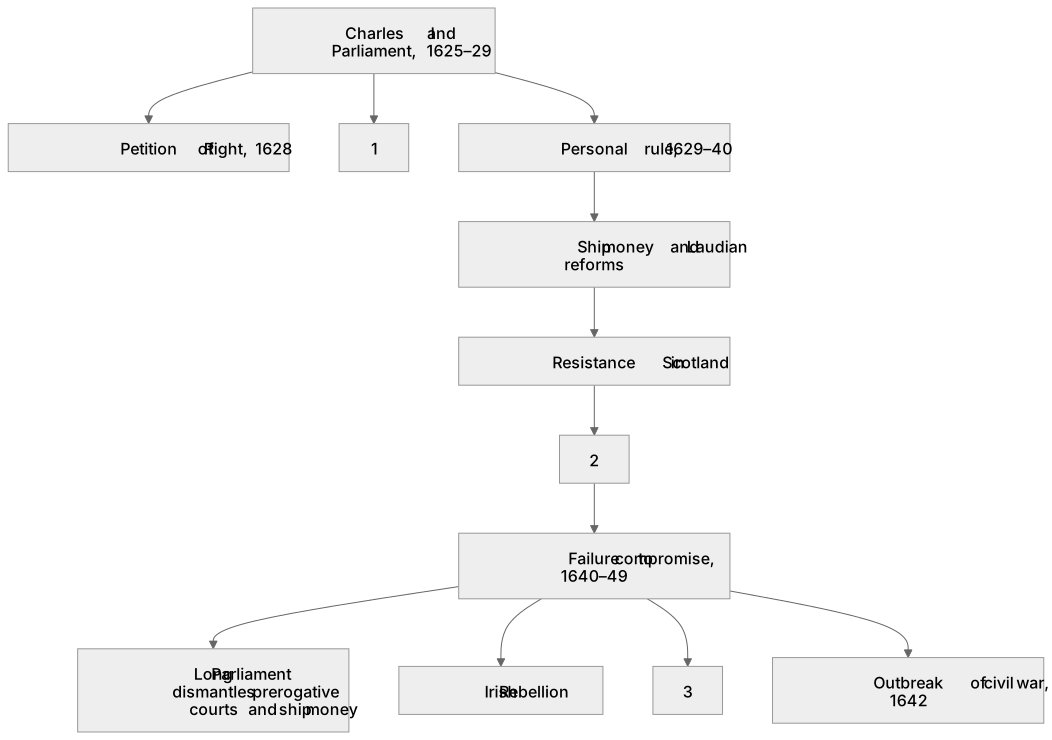
1Box 1
2Box 2
3Box 3
There is more to this lesson
The full lesson goes on to check your understanding and help you earn the marks. Create a free account to carry on, with your progress saved.
A week of Premium from your first lesson · Then the free plan continues · No card, no charge
Test your understanding of The quest for political stability, 1625–88: The failure of monarchical government, 1625–46: Charles I and parliament, 1625–29; personal rule and its failure, 1629–40 and the failure to compromise, 1640–49.
Active recall beats re-reading. Take an instant quiz now to test what you’ve learned and lock it into long-term memory.
A week of Premium from your first lesson · Then the free plan continues · No card, no charge