Pearson Edexcel · A-Level · History
Course version: 9HI0 · Version from Sept 2015
African nationalism, 1948–59: political opposition in 1948; the revival of…
Full specification wording
The response to apartheid, c1948–59: African nationalism, 1948–59: political opposition in 1948; the revival of the African National Congress (ANC); the Youth League and the Defiance Campaign; rural resistance; the Freedom Charter; the Pan-Africanist Congress (PAC).
In 1948 African political opposition was fragmented, but the ANC was revived through the Youth League, which pushed for mass action.
Checked against the Pearson Edexcel 9HI0 specification (opens in a new tab) on .
- Point 4 of 4
- 4 key terms
Study notes
From the checked teaching notes for this specification point.
The idea
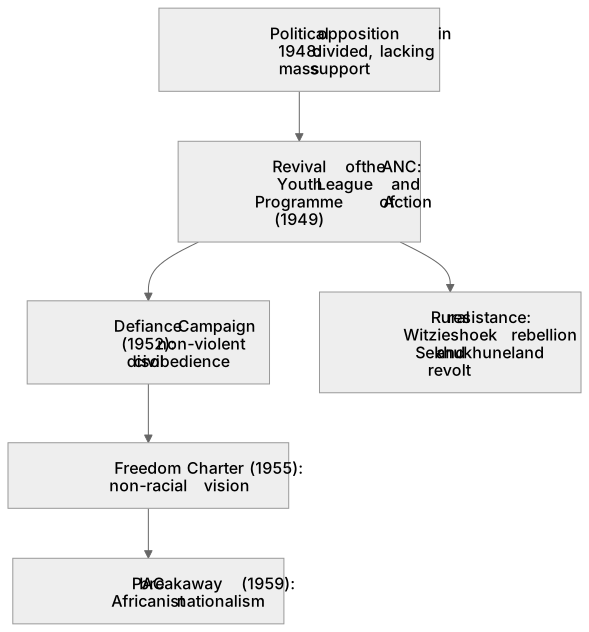
In 1948 African political opposition was fragmented, but the ANC was revived through the Youth League, which pushed for mass action. The Defiance Campaign (1952) used non-violent civil disobedience, while rural resistance included the 1950 Witzieshoek rebellion and later the Sekhukhuneland revolt. The Freedom Charter (1955) set out a vision of a non-racial South Africa. The PAC broke away in 1959, favouring Africanist and more confrontational methods. These developments show how African nationalism moved from petitioning to mass mobilisation and eventually to splinter groups.
What earns the marks
- Describes political opposition in 1948: the ANC was moderate, the All-African Convention and other groups existed, but opposition was divided and lacked mass support.
- Explains the revival of the ANC: the Youth League (formed 1944) influenced the ANC's Programme of Action (1949), which adopted mass action, boycotts, and civil disobedience.
- Analyses the Youth League and the Defiance Campaign: the 1952 campaign involved volunteers breaking unjust laws, leading to mass arrests and increased ANC membership, though it also faced government repression.
- Examines rural resistance: examples include the 1950 Witzieshoek rebellion against cattle culling and the 1950s Sekhukhuneland revolt against Bantu Authorities, showing resistance beyond urban areas.
Common mistakes and how to put them right
Claiming the ANC was always a mass-based organisation.
Put it right: In 1948 the ANC was small and moderate; it was revived through the Youth League and the 1949 Programme of Action.
Confusing the Freedom Charter with a government policy.
Put it right: The Freedom Charter was a statement of principles adopted by the Congress of the People, not a law or government document.
Stating the PAC was formed before the Freedom Charter.
Put it right: The PAC was formed in 1959, after the Freedom Charter was adopted in 1955.
Exam tips
- When discussing the Defiance Campaign, explain its methods and consequences, such as the use of passive resistance and the government's response, rather than just naming it.
- For rural resistance, use specific examples like the Witzieshoek rebellion or Sekhukhuneland revolt to show the breadth of opposition.
- Compare the ANC and PAC aims and methods to highlight the shift towards Africanist nationalism and the fragmentation of opposition.
Try the lesson
The start of the The response to apartheid, c1948–59: African nationalism, 1948–59: political opposition in 1948; the revival of the African National Congress (ANC); the Youth League and the Defiance Campaign; rural resistance; the Freedom Charter; the Pan-Africanist Congress (PAC). lesson, made from checked teaching notes for this specification point.
Have a go first
Which organisation was formed in 1944 to push the ANC towards mass action and African nationalism?
Listen
In 1948 African political opposition was fragmented, but the ANC was revived through the Youth League, which pushed for mass action. The Defiance Campaign (1952) used non-violent civil disobedience, while rural resistance included the 1950 Witzieshoek rebellion and later the Sekhukhuneland revolt. The Freedom Charter (1955) set out a vision of a non-racial South Africa. The PAC broke away in 1959, favouring Africanist and more confrontational methods. These developments show how African nationalism moved from petitioning to mass mobilisation and eventually to splinter groups. A strong answer earns marks for these points. Describes political opposition in 1948: the ANC was moderate, the All-African Convention and other groups existed, but opposition was divided and lacked mass support. Explains the revival of the ANC: the Youth League (formed 1944) influenced the ANC's Programme of Action (1949), which adopted mass action, boycotts, and civil disobedience. Analyses the Youth League and the Defiance Campaign: the 1952 campaign involved volunteers breaking unjust laws, leading to mass arrests and increased ANC membership, though it also faced government repression. Examines rural resistance: examples include the 1950 Witzieshoek rebellion against cattle culling and the 1950s Sekhukhuneland revolt against Bantu Authorities, showing resistance beyond urban areas. A common slip: claiming the ANC was always a mass-based organisation. Instead, in 1948 the ANC was small and moderate; it was revived through the Youth League and the 1949 Programme of Action. Exam tip: When discussing the Defiance Campaign, explain its methods and consequences, such as the use of passive resistance and the government's response, rather than just naming it.
See it
Put the events in order
Put these events in the order they happened, earliest first.
- 1. Witzieshoek rebellion against cattle culling
- 2. African political opposition was fragmented
- 3. Pan-Africanist Congress broke away
- 4. Defiance Campaign used non-violent civil disobedience
- 5. Freedom Charter adopted at the Congress of the People
Key words
Say what each word means before you turn the card.
Youth League
Try answering aloud or in your head before turning the card.
Defiance Campaign
Try answering aloud or in your head before turning the card.
Freedom Charter
Try answering aloud or in your head before turning the card.
Pan-Africanist Congress
Try answering aloud or in your head before turning the card.
See every definition
- Youth League
- Group formed in 1944 that influenced the ANC's Programme of Action, which adopted mass action, boycotts and civil disobedience.
- Defiance Campaign
- 1952 campaign in which volunteers broke unjust laws, leading to mass arrests and increased ANC membership, though it also faced government repression.
- Freedom Charter
- Adopted in 1955 at the Congress of the People, declaring that South Africa belongs to all who live in it.
- Pan-Africanist Congress
- Broke away in 1959, rejecting multiracialism and advocating Africanist nationalism with more confrontational methods.
Label the diagram
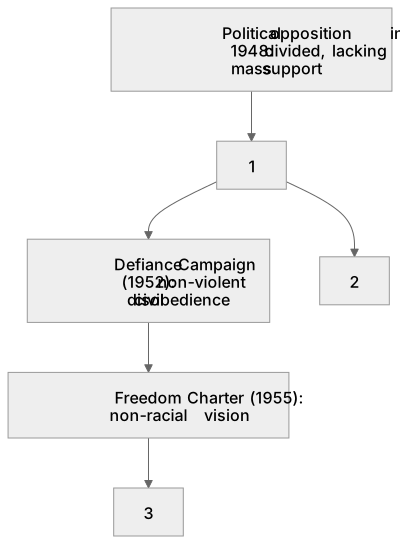
Some boxes have lost their names. Pick the right name for each number.
1Box 1
2Box 2
3Box 3
There is more to this lesson
The full lesson goes on to check your understanding and help you earn the marks. Create a free account to carry on, with your progress saved.
A week of Premium from your first lesson · Then the free plan continues · No card, no charge
Test your understanding of The response to apartheid, c1948–59: African nationalism, 1948–59: political opposition in 1948; the revival of the African National Congress (ANC); the Youth League and the Defiance Campaign; rural resistance; the Freedom Charter; the Pan-Africanist Congress (PAC).
Active recall beats re-reading. Take an instant quiz now to test what you’ve learned and lock it into long-term memory.
A week of Premium from your first lesson · Then the free plan continues · No card, no charge