Pearson Edexcel · A-Level · History
Course version: 9HI0 · Version from Sept 2015
Codifying and implementing apartheid, 1948–59: strengthening the National…
Full specification wording
The response to apartheid, c1948–59: Codifying and implementing apartheid, 1948–59: strengthening the National Party; apartheid laws; pass laws and education; the Tomlinson Report and Bantustans; political suppression and the Treason Trial.
After 1948 the National Party (NP) consolidated power by winning support among white voters, especially Afrikaners, and by removing parliamentary obstacles.
Checked against the Pearson Edexcel 9HI0 specification (opens in a new tab) on .
- Point 3 of 4
- 4 key terms
Study notes
From the checked teaching notes for this specification point.
The idea
After 1948 the National Party (NP) consolidated power by winning support among white voters, especially Afrikaners, and by removing parliamentary obstacles. It passed apartheid laws such as the Prohibition of Mixed Marriages Act (1949) and the Population Registration Act (1950), which classified people by race. Pass laws controlled African movement and employment, while the Bantu Education Act (1953) extended state control over schooling. The Tomlinson Report (1955) proposed separate development, building on the earlier Bantu Authorities Act (1951) to shape the Bantustans. Political suppression included banning orders and the Treason Trial (1956–61).
What earns the marks
- Explains how the NP strengthened its position after 1948, for example by winning the 1948 election, benefiting from rural weighting, and later enlarging the Senate in 1955.
- Identifies and explains key apartheid laws, such as the Prohibition of Mixed Marriages Act (1949) and the Population Registration Act (1950), showing how they codified racial separation.
- Evaluates the Tomlinson Report (1955) and Bantustans: the report rejected permanent urbanisation of Africans and recommended development of reserves, building on the 1951 Bantu Authorities Act.
- Assesses political suppression and the Treason Trial: the Suppression of Communism Act (1950) was used against opponents, and 156 people were arrested in 1956 and charged with treason, ending in acquittal in 1961.
Common mistakes and how to put them right
Treating apartheid as only a set of laws passed in 1948.
Put it right by noting apartheid was implemented gradually through legislation, administrative action, and enforcement across the 1950s.
Confusing the chronology of Bantustan policy.
Put it right by noting the Bantu Authorities Act (1951) preceded the Tomlinson Report (1955), which then recommended further separate development.
Stating that the Treason Trial ended in conviction.
Put it right by noting the Treason Trial ended in acquittal for all defendants in 1961, after charges were reduced and the case collapsed.
Exam tips
- When discussing apartheid laws, link each law to its purpose and impact rather than listing them; for example, explain how the Population Registration Act enabled other racial classifications.
- For the Treason Trial, explain its significance as both a legal and political event: it demonstrated state suppression but also the resilience of opposition.
Try the lesson
The start of the The response to apartheid, c1948–59: Codifying and implementing apartheid, 1948–59: strengthening the National Party; apartheid laws; pass laws and education; the Tomlinson Report and Bantustans; political suppression and the Treason Trial. lesson, made from checked teaching notes for this specification point.
Have a go first
Which 1950 law classified every South African by race and required people to be registered in one of those racial groups?
Listen
After 1948 the National Party (NP) consolidated power by winning support among white voters, especially Afrikaners, and by removing parliamentary obstacles. It passed apartheid laws such as the Prohibition of Mixed Marriages Act (1949) and the Population Registration Act (1950), which classified people by race. Pass laws controlled African movement and employment, while the Bantu Education Act (1953) extended state control over schooling. The Tomlinson Report (1955) proposed separate development, building on the earlier Bantu Authorities Act (1951) to shape the Bantustans. Political suppression included banning orders and the Treason Trial (1956–61). A strong answer earns marks for these points. Explains how the NP strengthened its position after 1948, for example by winning the 1948 election, benefiting from rural weighting, and later enlarging the Senate in 1955. Identifies and explains key apartheid laws, such as the Prohibition of Mixed Marriages Act (1949) and the Population Registration Act (1950), showing how they codified racial separation. Analyses pass laws and education: the Natives (Abolition of Passes and Co-ordination of Documents) Act (1952) required African men over 16 to carry reference books (women were covered later), and the Bantu Education Act (1953) placed African schooling under central state control. Evaluates the Tomlinson Report (1955) and Bantustans: the report rejected permanent urbanisation of Africans and recommended development of reserves, building on the 1951 Bantu Authorities Act. A common slip: Treating apartheid as only a set of laws passed in 1948. Instead, noting apartheid was implemented gradually through legislation, administrative action, and enforcement across the 1950s. Exam tip: When discussing apartheid laws, link each law to its purpose and impact rather than listing them; for example, explain how the Population Registration Act enabled other racial classifications.
See it
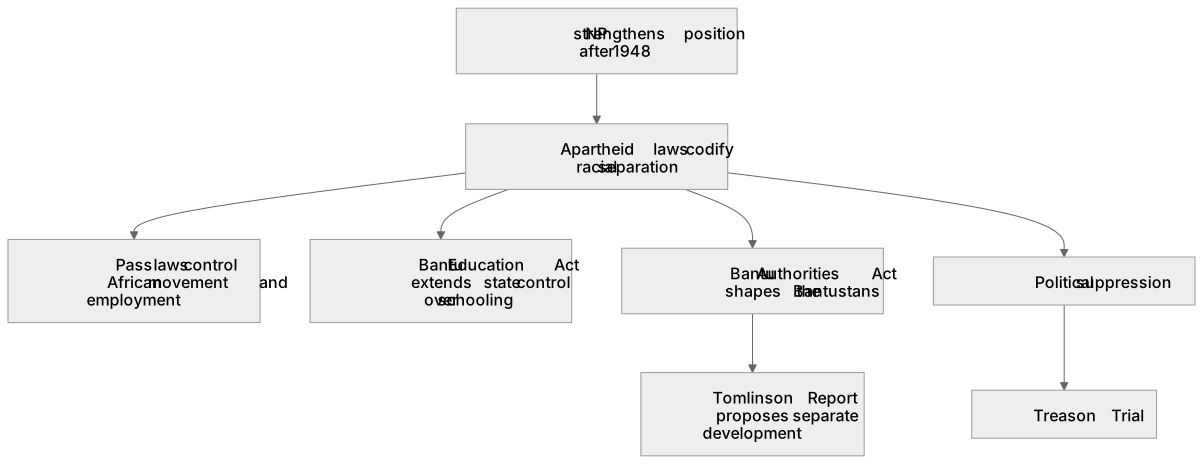
Put the events in order
Put these events in the order they happened, earliest first.
- 1. Bantu Authorities Act shaped the Bantustans
- 2. Pass law required African men to carry reference books
- 3. Bantu Education Act extended state control over schooling
- 4. Population Registration Act classified people by race
- 5. Prohibition of Mixed Marriages Act passed
- 6. Tomlinson Report proposed separate development
Key words
Say what each word means before you turn the card.
apartheid laws
Try answering aloud or in your head before turning the card.
pass laws
Try answering aloud or in your head before turning the card.
Bantu Education Act (1953)
Try answering aloud or in your head before turning the card.
Treason Trial (1956–61)
Try answering aloud or in your head before turning the card.
See every definition
- apartheid laws
- Laws such as the Prohibition of Mixed Marriages Act (1949) and the Population Registration Act (1950), which classified people by race and codified racial separation.
- pass laws
- Controls on African movement and employment, including the Natives (Abolition of Passes and Co-ordination of Documents) Act (1952), which required African men over 16 to carry reference books.
- Bantu Education Act (1953)
- Legislation that placed African schooling under central state control and extended state control over schooling.
- Treason Trial (1956–61)
- A legal and political event in which 156 people were arrested in 1956 and charged with treason, ending in acquittal in 1961.
Label the diagram
Some boxes have lost their names. Pick the right name for each number.
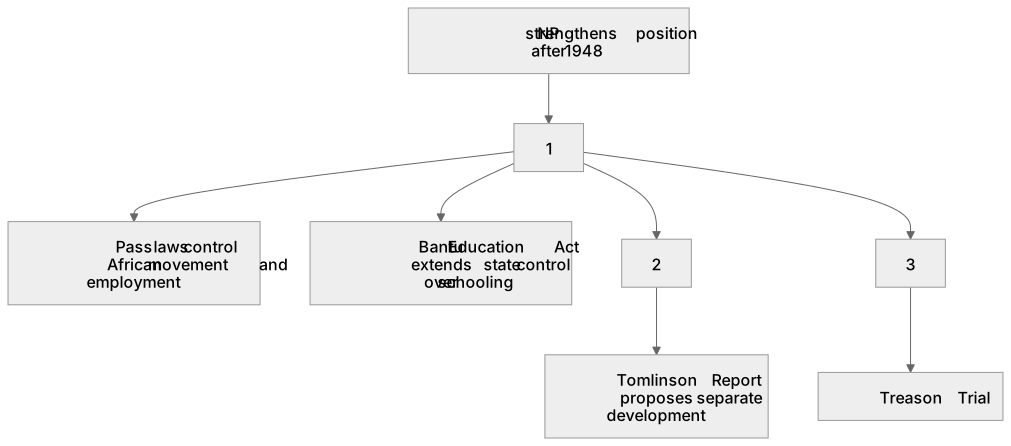
1Box 1
2Box 2
3Box 3
There is more to this lesson
The full lesson goes on to check your understanding and help you earn the marks. Create a free account to carry on, with your progress saved.
A week of Premium from your first lesson · Then the free plan continues · No card, no charge
Test your understanding of The response to apartheid, c1948–59: Codifying and implementing apartheid, 1948–59: strengthening the National Party; apartheid laws; pass laws and education; the Tomlinson Report and Bantustans; political suppression and the Treason Trial.
Active recall beats re-reading. Take an instant quiz now to test what you’ve learned and lock it into long-term memory.
A week of Premium from your first lesson · Then the free plan continues · No card, no charge