Pearson Edexcel · A-Level · History
Course version: 9HI0 · Version from Sept 2015
Life in South Africa c1948: race, segregation and discrimination;…
Full specification wording
The response to apartheid, c1948–59: Life in South Africa c1948: race, segregation and discrimination; urbanisation and industrialisation, including township life; rural society; Afrikaner culture and politics; the influence of Britain.
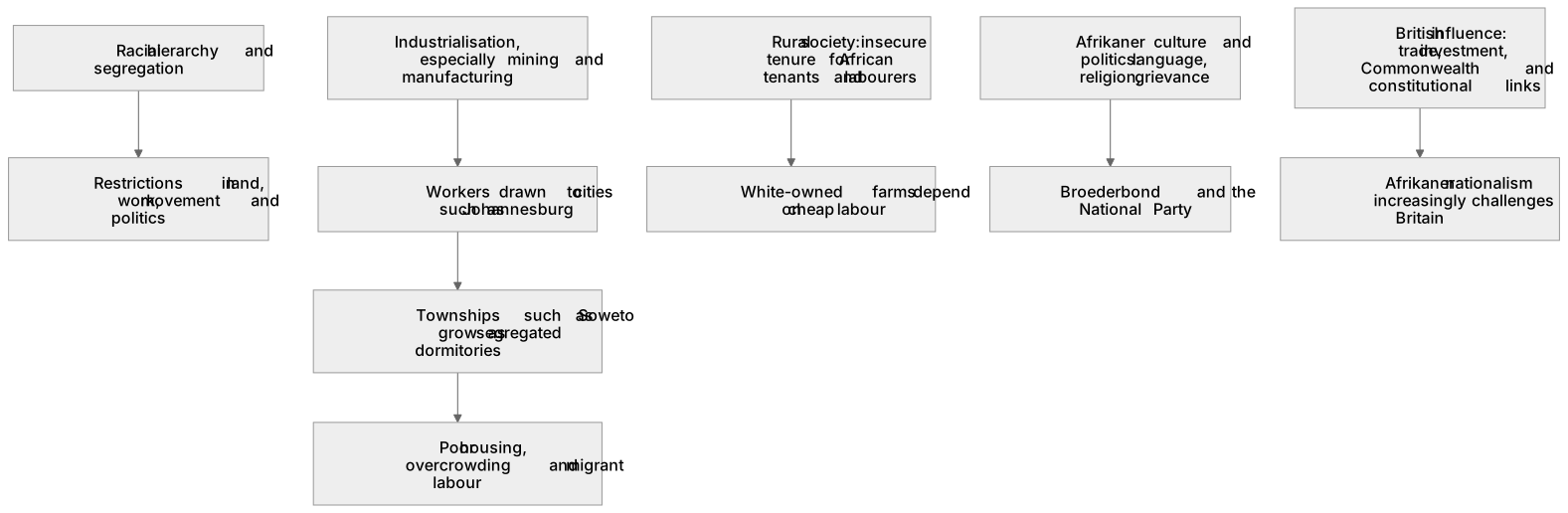
By 1948 South Africa was a society built on racial hierarchy: segregation laws and customs restricted Black, Coloured and Indian people in land, work, movement and politics.
Checked against the Pearson Edexcel 9HI0 specification (opens in a new tab) on .
- Point 1 of 4
- 4 key terms
Study notes
From the checked teaching notes for this specification point.
The idea
By 1948 South Africa was a society built on racial hierarchy: segregation laws and customs restricted Black, Coloured and Indian people in land, work, movement and politics. Industrialisation, especially mining and manufacturing, drew workers to cities such as Johannesburg, where townships like Soweto grew as segregated dormitories with poor housing, overcrowding and migrant labour. Rural life remained harsh: African tenant farmers and labourers faced insecure tenure, while white-owned farms depended on cheap labour. Afrikaner culture and politics centred on language, religion and a shared sense of grievance, expressed through bodies such as the Broederbond and the National Party. Britain's influence persisted through trade, investment, Commonwealth membership and constitutional links, though Afrikaner nationalism increasingly challenged it.
What earns the marks
- Explains how race shaped everyday life through segregation and discrimination in residence, education, employment and public facilities.
- Links urbanisation and industrialisation to the growth of townships and the experience of township life, including housing shortages and migrant labour.
- Describes rural society, including the position of African tenants, labourers and landless people on white-owned farms.
- Explains Afrikaner culture and politics, including language, religion, the Broederbond and the growth of Afrikaner nationalism.
- Assesses the influence of Britain through trade, investment, Commonwealth ties and constitutional arrangements.
- Uses specific examples, such as Johannesburg and its townships, to support general points about life in South Africa.
Common mistakes and how to put them right
Treating apartheid as beginning only in 1948.
Put it right: Recognise that segregation and discrimination were already entrenched before 1948, and 1948 marks a political turning point.
Describing townships only as places of poverty.
Put it right: Also note community life, churches, schools and informal economic activity.
Assuming Britain had no influence after 1948.
Put it right: Explain continuing economic, Commonwealth and constitutional links alongside growing Afrikaner nationalist pressure.
Exam tips
- Plan by theme: race, urban and industrial change, rural society, Afrikaner culture and politics, and British influence.
- Anchor each theme with a precise example, such as a named city, township or institution, rather than general assertion.
- When discussing Britain, distinguish economic, political and constitutional forms of influence and link each to South African responses.
Try the lesson
The start of the The response to apartheid, c1948–59: Life in South Africa c1948: race, segregation and discrimination; urbanisation and industrialisation, including township life; rural society; Afrikaner culture and politics; the influence of Britain. lesson, made from checked teaching notes for this specification point.
Have a go first
In South Africa c1948, which group made up the largest share of the population?
Listen
By 1948 South Africa was a society built on racial hierarchy: segregation laws and customs restricted Black, Coloured and Indian people in land, work, movement and politics. Industrialisation, especially mining and manufacturing, drew workers to cities such as Johannesburg, where townships like Soweto grew as segregated dormitories with poor housing, overcrowding and migrant labour. Rural life remained harsh: African tenant farmers and labourers faced insecure tenure, while white-owned farms depended on cheap labour. Afrikaner culture and politics centred on language, religion and a shared sense of grievance, expressed through bodies such as the Broederbond and the National Party. Britain's influence persisted through trade, investment, Commonwealth membership and constitutional links, though Afrikaner nationalism increasingly challenged it. A strong answer earns marks for these points. Explains how race shaped everyday life through segregation and discrimination in residence, education, employment and public facilities. Links urbanisation and industrialisation to the growth of townships and the experience of township life, including housing shortages and migrant labour. Describes rural society, including the position of African tenants, labourers and landless people on white-owned farms. Explains Afrikaner culture and politics, including language, religion, the Broederbond and the growth of Afrikaner nationalism. A common slip: Treating apartheid as beginning only in 1948. Instead, recognise that segregation and discrimination were already entrenched before 1948, and 1948 marks a political turning point. Exam tip: Plan by theme: race, urban and industrial change, rural society, Afrikaner culture and politics, and British influence.
See it
Key words
Say what each word means before you turn the card.
Racial segregation and discrimination
Try answering aloud or in your head before turning the card.
Urbanisation and industrialisation
Try answering aloud or in your head before turning the card.
Township life and migrant labour
Try answering aloud or in your head before turning the card.
Afrikaner culture and nationalism
Try answering aloud or in your head before turning the card.
See every definition
- Racial segregation and discrimination
- Segregation laws and customs restricted Black, Coloured and Indian people in land, work, movement and politics.
- Urbanisation and industrialisation
- Industrialisation, especially mining and manufacturing, drew workers to cities such as Johannesburg.
- Township life and migrant labour
- Townships like Soweto grew as segregated dormitories with poor housing, overcrowding and migrant labour.
- Afrikaner culture and nationalism
- Culture and politics centred on language, religion and a shared sense of grievance, expressed through the Broederbond and the National Party.
Label the diagram
Some boxes have lost their names. Pick the right name for each number.
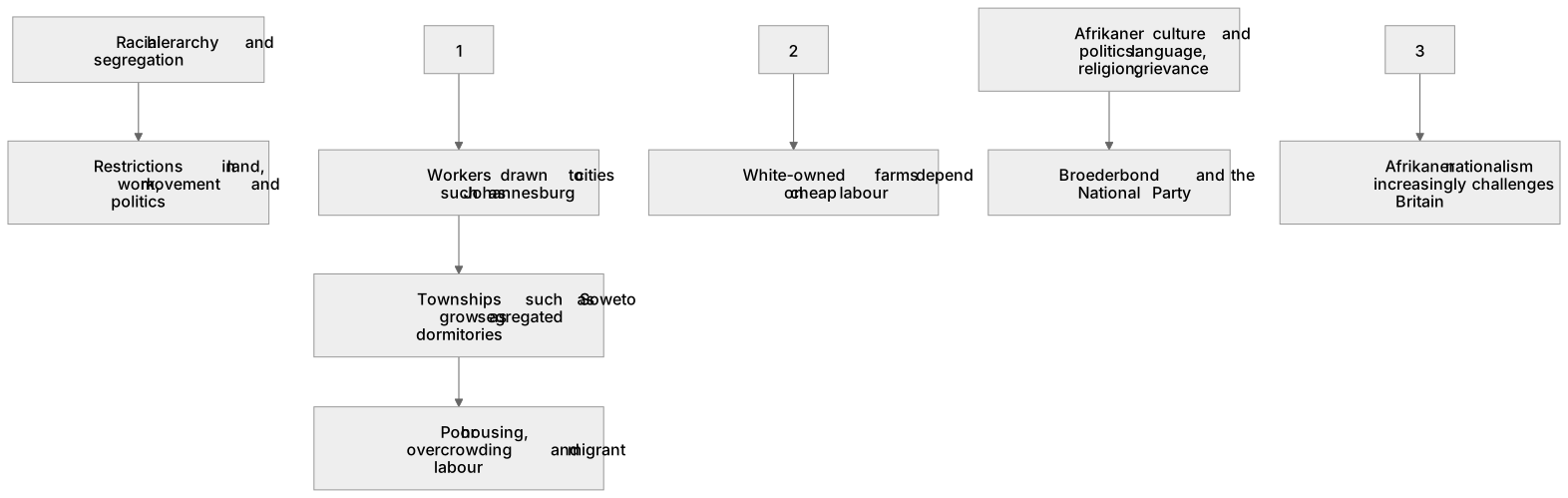
1Box 1
2Box 2
3Box 3
There is more to this lesson
The full lesson goes on to check your understanding and help you earn the marks. Create a free account to carry on, with your progress saved.
A week of Premium from your first lesson · Then the free plan continues · No card, no charge
Test your understanding of The response to apartheid, c1948–59: Life in South Africa c1948: race, segregation and discrimination; urbanisation and industrialisation, including township life; rural society; Afrikaner culture and politics; the influence of Britain.
Active recall beats re-reading. Take an instant quiz now to test what you’ve learned and lock it into long-term memory.
A week of Premium from your first lesson · Then the free plan continues · No card, no charge