Pearson Edexcel · A-Level · History
Course version: 9HI0 · Version from Sept 2015
Reasons for the National Party victory 1948, including the impact of the…
Full specification wording
The response to apartheid, c1948–59: Reasons for the National Party victory 1948, including the impact of the Second World War, the growth of Afrikaner nationalism, and international pressures for change.
The National Party won the 1948 election partly because the Second World War divided white opinion: Afrikaners resented South Africa's entry on Britain's side, wartime industrial growth changed…
Checked against the Pearson Edexcel 9HI0 specification (opens in a new tab) on .
- Point 2 of 4
- 4 key terms
Study notes
From the checked teaching notes for this specification point.
The idea
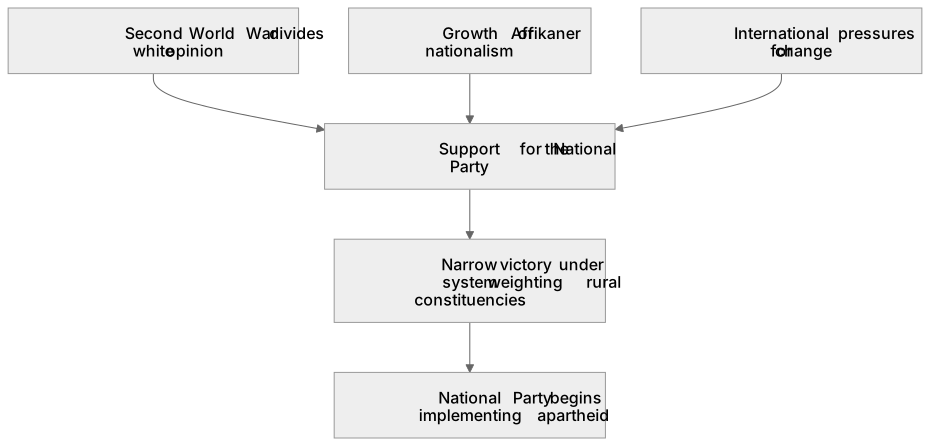
The National Party won the 1948 election partly because the Second World War divided white opinion: Afrikaners resented South Africa's entry on Britain's side, wartime industrial growth changed the labour market, and Black urbanisation raised white fears about jobs and social order. Afrikaner nationalism grew through language, religion, the Broederbond and organisations that mobilised a distinct identity and demanded political power. International pressures for change, including criticism of racial policies and the early years of the United Nations, made some white voters defensive and receptive to a party promising firm racial control. The result was a narrow victory under a system that weighted rural constituencies, allowing the National Party to begin implementing apartheid.
What earns the marks
- Explains how the Second World War divided white South African opinion and contributed to support for the National Party.
- Links wartime industrial growth and Black urbanisation to white anxieties about labour, housing and social order.
- Explains the growth of Afrikaner nationalism through language, religion, the Broederbond and political mobilisation.
- Assesses how international pressures for change, including United Nations criticism, affected white politics and the National Party's appeal.
- Explains how the electoral system, including rural weighting, helped convert minority support into a parliamentary majority.
- Reaches a judgement on the relative importance of wartime, nationalist and international factors in the 1948 victory.
Common mistakes and how to put them right
Claiming the National Party won a majority of votes.
Put it right: It won the most seats under a system that favoured rural constituencies, not a majority of the popular vote.
Treating Afrikaner nationalism as a single unified movement.
Put it right: Recognise different groups and tensions within Afrikaner politics.
Ignoring international factors; correction: explain how external criticism and the early United Nations shaped white defensiveness and National Party rhetoric.
Exam tips
- Organise the answer around the three named factors and reach a supported judgement on their relative weight.
- Use precise evidence, such as wartime divisions, the Broederbond or United Nations criticism, to support each factor.
- Explain the electoral system when discussing how the National Party turned support into power, rather than implying it won a popular majority.
Try the lesson
The start of the The response to apartheid, c1948–59: Reasons for the National Party victory 1948, including the impact of the Second World War, the growth of Afrikaner nationalism, and international pressures for change. lesson, made from checked teaching notes for this specification point.
Have a go first
How did the Second World War contribute to the National Party's election victory in 1948?
Listen
The National Party won the 1948 election partly because the Second World War divided white opinion: Afrikaners resented South Africa's entry on Britain's side, wartime industrial growth changed the labour market, and Black urbanisation raised white fears about jobs and social order. Afrikaner nationalism grew through language, religion, the Broederbond and organisations that mobilised a distinct identity and demanded political power. International pressures for change, including criticism of racial policies and the early years of the United Nations, made some white voters defensive and receptive to a party promising firm racial control. The result was a narrow victory under a system that weighted rural constituencies, allowing the National Party to begin implementing apartheid. A strong answer earns marks for these points. Explains how the Second World War divided white South African opinion and contributed to support for the National Party. Links wartime industrial growth and Black urbanisation to white anxieties about labour, housing and social order. Explains the growth of Afrikaner nationalism through language, religion, the Broederbond and political mobilisation. Assesses how international pressures for change, including United Nations criticism, affected white politics and the National Party's appeal. A common slip: Claiming the National Party won a majority of votes. Instead, it won the most seats under a system that favoured rural constituencies, not a majority of the popular vote. Exam tip: Organise the answer around the three named factors and reach a supported judgement on their relative weight.
See it
Key words
Say what each word means before you turn the card.
Impact of the Second World War
Try answering aloud or in your head before turning the card.
Growth of Afrikaner nationalism
Try answering aloud or in your head before turning the card.
International pressures for change
Try answering aloud or in your head before turning the card.
White politics and electoral system
Try answering aloud or in your head before turning the card.
See every definition
- Impact of the Second World War
- The war divided white opinion, as Afrikaners resented South Africa's entry on Britain's side, while wartime industrial growth changed the labour market.
- Growth of Afrikaner nationalism
- It grew through language, religion, the Broederbond and organisations that mobilised a distinct identity and demanded political power.
- International pressures for change
- Criticism of racial policies and the early years of the United Nations made some white voters defensive and receptive to a party promising firm racial control.
- White politics and electoral system
- A narrow victory came under a system that weighted rural constituencies, allowing the National Party to begin implementing apartheid.
Label the diagram
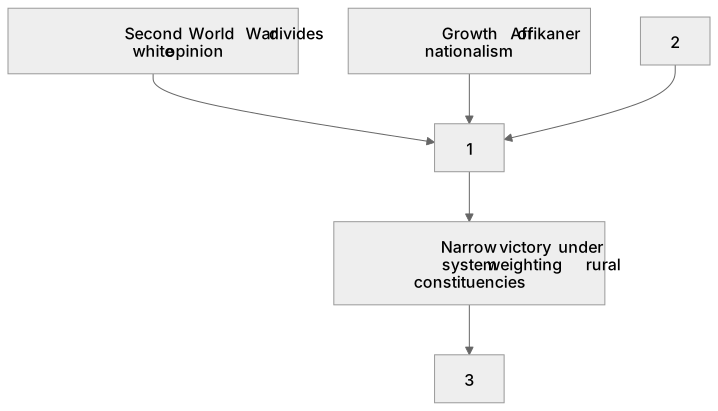
Some boxes have lost their names. Pick the right name for each number.
1Box 1
2Box 2
3Box 3
There is more to this lesson
The full lesson goes on to check your understanding and help you earn the marks. Create a free account to carry on, with your progress saved.
A week of Premium from your first lesson · Then the free plan continues · No card, no charge
Test your understanding of The response to apartheid, c1948–59: Reasons for the National Party victory 1948, including the impact of the Second World War, the growth of Afrikaner nationalism, and international pressures for change.
Active recall beats re-reading. Take an instant quiz now to test what you’ve learned and lock it into long-term memory.
A week of Premium from your first lesson · Then the free plan continues · No card, no charge