Pearson Edexcel · A-Level · History
Course version: 9HI0 · Version from Sept 2015
The course of the war: the main campaigns and stages of the Nationalist…
Full specification wording
The Spanish Civil War, 1936–39: The course of the war: the main campaigns and stages of the Nationalist advance; the impact of Republican political divisions; the impact of atrocities by both sides; the fall of Barcelona and Madrid in 1939.
The war moved through clear stages.
Checked against the Pearson Edexcel 9HI0 specification (opens in a new tab) on .
- Point 2 of 4
- 4 key terms
Study notes
From the checked teaching notes for this specification point.
The idea
The war moved through clear stages. In 1936 the Nationalists advanced from the south towards Madrid, failing to take the city, then shifted to the northern campaign, capturing the Basque country and Asturias in 1937. The 1938 Aragon offensive reached the Mediterranean, splitting Republican territory, and the Ebro offensive failed to restore the position. Republican political divisions between communists, socialists, anarchists and POUM weakened the war effort, culminating in the Barcelona May Days of 1937. Atrocities occurred on both sides, including the massacre at Badajoz and the bombing of Guernica, and Republican violence against clergy and Nationalist reprisals after capture. Barcelona fell in January 1939 and Madrid in March 1939, ending organised resistance.
What earns the marks
- Sequences the main campaigns: Madrid, the northern campaign, Aragon and the Ebro, showing how the Nationalist advance developed.
- Explains how Republican political divisions, including the Barcelona May Days, undermined unity and military effectiveness.
- Analyses atrocities by both sides, such as Badajoz and Guernica, and their impact on morale and international opinion.
- Explains the fall of Barcelona in January 1939 and Madrid in March 1939 as the end of organised Republican resistance.
- Links military stages to political and international factors rather than narrating events without analysis.
Common mistakes and how to put them right
Narrating campaigns without linking them to the Nationalist advance or Republican weakness.
Put it right by explaining consequences for each side.
Treating atrocities as one-sided.
Put it right by giving examples from both Nationalist and Republican zones and assessing their effects.
Confusing the dates of the fall of Barcelona and Madrid.
Put it right by placing Barcelona in January 1939 and Madrid in March 1939.
Exam tips
- Organise answers by stage or theme, such as advance, divisions, atrocities and final collapse, to keep chronology clear.
- Use specific campaigns and dates to support analysis of why the Nationalists gained the advantage.
- Balance military, political and humanitarian factors when judging the course of the war.
Try the lesson
The start of the The Spanish Civil War, 1936–39: The course of the war: the main campaigns and stages of the Nationalist advance; the impact of Republican political divisions; the impact of atrocities by both sides; the fall of Barcelona and Madrid in 1939. lesson, made from checked teaching notes for this specification point.
Have a go first
Which city fell to the Nationalists in January 1939, marking a decisive stage in the collapse of Republican resistance in Catalonia?
Listen
The war moved through clear stages. In 1936 the Nationalists advanced from the south towards Madrid, failing to take the city, then shifted to the northern campaign, capturing the Basque country and Asturias in 1937. The 1938 Aragon offensive reached the Mediterranean, splitting Republican territory, and the Ebro offensive failed to restore the position. Republican political divisions between communists, socialists, anarchists and POUM weakened the war effort, culminating in the Barcelona May Days of 1937. Atrocities occurred on both sides, including the massacre at Badajoz and the bombing of Guernica, and Republican violence against clergy and Nationalist reprisals after capture. Barcelona fell in January 1939 and Madrid in March 1939, ending organised resistance. A strong answer earns marks for these points. Sequences the main campaigns: Madrid, the northern campaign, Aragon and the Ebro, showing how the Nationalist advance developed. Explains how Republican political divisions, including the Barcelona May Days, undermined unity and military effectiveness. Analyses atrocities by both sides, such as Badajoz and Guernica, and their impact on morale and international opinion. Explains the fall of Barcelona in January 1939 and Madrid in March 1939 as the end of organised Republican resistance. A common slip: Narrating campaigns without linking them to the Nationalist advance or Republican weakness. Instead, explaining consequences for each side. Exam tip: Organise answers by stage or theme, such as advance, divisions, atrocities and final collapse, to keep chronology clear.
See it
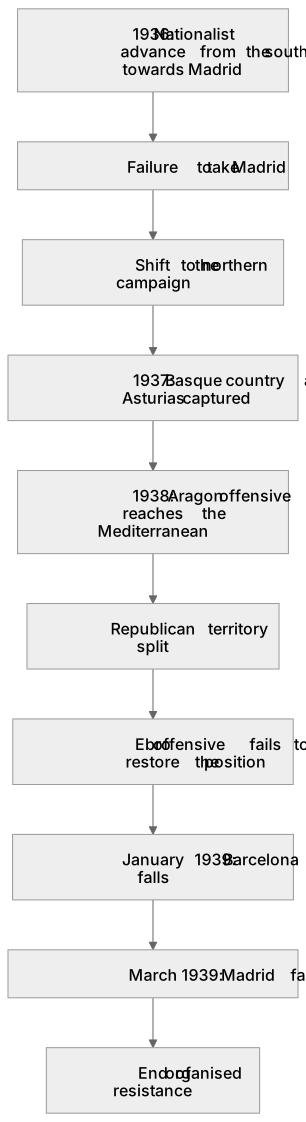
Put the events in order
Put these events in the order they happened, earliest first.
- 1. Nationalists advanced from the south towards Madrid
- 2. Aragon offensive reached the Mediterranean
- 3. Northern campaign captured the Basque country and Asturias
Key words
Say what each word means before you turn the card.
Military campaigns and strategy
Try answering aloud or in your head before turning the card.
Political division and unity
Try answering aloud or in your head before turning the card.
Atrocity and civilian experience
Try answering aloud or in your head before turning the card.
Nationalist victory and Republican collapse
Try answering aloud or in your head before turning the card.
See every definition
- Military campaigns and strategy
- The main campaigns and stages of the Nationalist advance, from the south towards Madrid, the northern campaign, the Aragon offensive and the Ebro offensive.
- Political division and unity
- Divisions between communists, socialists, anarchists and POUM that weakened the war effort, culminating in the Barcelona May Days of 1937.
- Atrocity and civilian experience
- Violence by both sides, including the massacre at Badajoz, the bombing of Guernica, Republican violence against clergy and Nationalist reprisals after capture.
- Nationalist victory and Republican collapse
- The fall of Barcelona in January 1939 and Madrid in March 1939, ending organised resistance.
Label the diagram
Some boxes have lost their names. Pick the right name for each number.
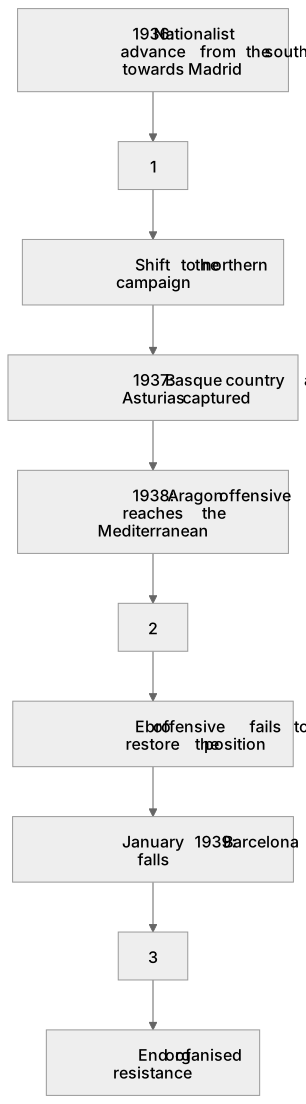
1Box 1
2Box 2
3Box 3
There is more to this lesson
The full lesson goes on to check your understanding and help you earn the marks. Create a free account to carry on, with your progress saved.
A week of Premium from your first lesson · Then the free plan continues · No card, no charge
Test your understanding of The Spanish Civil War, 1936–39: The course of the war: the main campaigns and stages of the Nationalist advance; the impact of Republican political divisions; the impact of atrocities by both sides; the fall of Barcelona and Madrid in 1939.
Active recall beats re-reading. Take an instant quiz now to test what you’ve learned and lock it into long-term memory.
A week of Premium from your first lesson · Then the free plan continues · No card, no charge