Pearson Edexcel · A-Level · History
Course version: 9HI0 · Version from Sept 2015
Charles V and Lutheranism: his conflicting priorities in Spain, France and…
Full specification wording
The spread and survival of Lutheranism, 1521–55: Charles V and Lutheranism: his conflicting priorities in Spain, France and against the Ottomans; limited support for Charles from the Catholic princes; the significance of the Schmalkaldic War; the Peace of Passau 1552; the Peace of Augsburg 1555.
Charles V ruled an empire stretching from Spain to the Netherlands and Austria, so Lutheranism was never his only problem.
Checked against the Pearson Edexcel 9HI0 specification (opens in a new tab) on .
- Point 3 of 4
- 4 key terms
Study notes
From the checked teaching notes for this specification point.
The idea
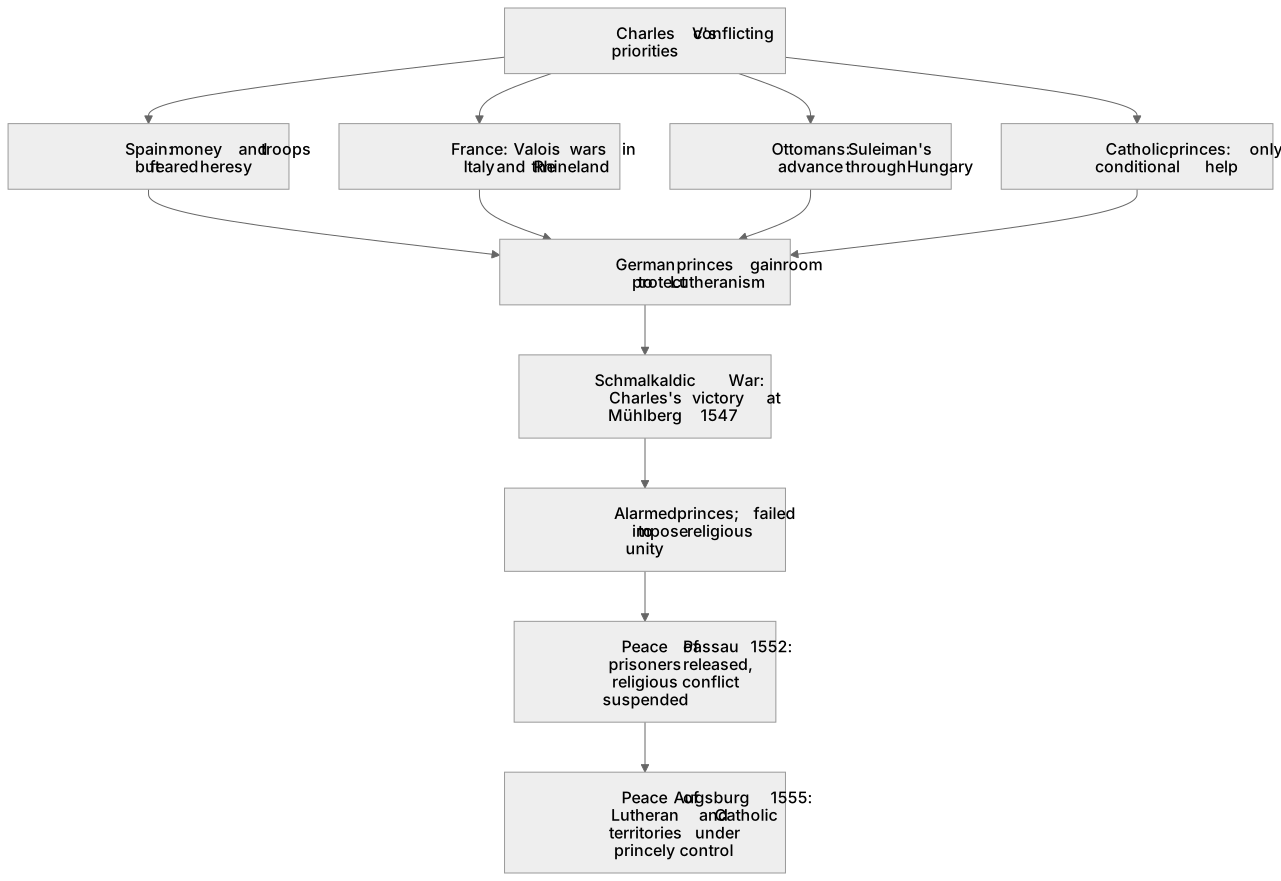
Charles V ruled an empire stretching from Spain to the Netherlands and Austria, so Lutheranism was never his only problem. Spain supplied money and troops but feared heresy; Valois France fought him in Italy and the Rhineland, even allying with the Ottomans; Suleiman's advance through Hungary forced Charles into a two-front war. German princes therefore gained room to protect Lutheranism. Catholic princes such as the Bavarian Wittelsbachs gave only conditional help, wanting concessions first. Charles's 1547 victory at Mühlberg in the Schmalkaldic War seemed decisive, yet it alarmed princes and failed to impose religious unity. The Peace of Passau 1552 released imprisoned Protestant leaders and suspended religious conflict, and the Peace of Augsburg 1555 accepted Lutheran and Catholic territories under princely control.
What earns the marks
- Explains that Charles V's scattered inheritance, especially Spain, the Netherlands, Austria and Italy, divided his attention and resources so he could not concentrate on suppressing Lutheranism.
- Analyses the French threat: the Habsburg-Valois wars, including Francis I's alliance with Suleiman, forced Charles to fight in Italy and the Rhineland rather than in Germany alone.
- Assesses the Ottoman advance under Suleiman after Mohács 1526, which drew Charles into Hungary and the Mediterranean and made German princes more valuable as allies.
- Evaluates the limited support from Catholic princes, such as the Bavarian Wittelsbachs, who demanded concessions and distrusted Habsburg power, weakening any unified Catholic front.
- Judges the Schmalkaldic War: Charles's victory at Mühlberg 1547 was significant but provoked fear of Habsburg dominance and did not destroy Lutheran organisation.
- Explains the Peace of Passau 1552 as a settlement forced by the princes' revolt under Maurice of Saxony, releasing Philip of Hesse and John Frederick and suspending religious war.
- Explains the Peace of Augsburg 1555 as a compromise recognising Lutheran and Catholic territorial churches under the principle later called cuius regio, eius religio, while excluding Calvinists.
- Weighs the overall significance: Charles's priorities and the princes' bargaining power allowed Lutheranism to survive politically, even though Charles never accepted it personally.
Common mistakes and how to put them right
Treating Charles V as an absolute ruler who could simply order Lutheranism's destruction.
Put it right: He depended on princes and estates for taxes and troops, so his power was negotiated.
Confusing the Peace of Passau 1552 with the Peace of Augsburg 1555.
Put it right: Passau suspended conflict and freed prisoners, while Augsburg gave a lasting legal framework.
Assuming the Schmalkaldic War ended Lutheranism.
Put it right: Charles won at Mühlberg in 1547, but the settlement of 1552 reversed his political gains.
Exam tips
- Link each priority, Spain, France and the Ottomans, to a concrete consequence for Charles's ability to act in Germany.
- Use the two peace treaties as a chronological spine: Passau 1552 as the immediate settlement, Augsburg 1555 as the lasting constitutional compromise.
- When discussing Catholic princes, distinguish loyalty to Rome from suspicion of Habsburg power, since both shaped their limited support.
Try the lesson
The start of the The spread and survival of Lutheranism, 1521–55: Charles V and Lutheranism: his conflicting priorities in Spain, France and against the Ottomans; limited support for Charles from the Catholic princes; the significance of the Schmalkaldic War; the Peace of Passau 1552; the Peace of Augsburg 1555. lesson, made from checked teaching notes for this specification point.
Have a go first
Which agreement of 1555 gave the rulers of the German states the right to decide whether Lutheranism or Catholicism would be followed in their own lands?
Listen
Charles V ruled an empire stretching from Spain to the Netherlands and Austria, so Lutheranism was never his only problem. Spain supplied money and troops but feared heresy; Valois France fought him in Italy and the Rhineland, even allying with the Ottomans; Suleiman's advance through Hungary forced Charles into a two-front war. German princes therefore gained room to protect Lutheranism. Catholic princes such as the Bavarian Wittelsbachs gave only conditional help, wanting concessions first. Charles's 1547 victory at Mühlberg in the Schmalkaldic War seemed decisive, yet it alarmed princes and failed to impose religious unity. The Peace of Passau 1552 released imprisoned Protestant leaders and suspended religious conflict, and the Peace of Augsburg 1555 accepted Lutheran and Catholic territories under princely control. A strong answer earns marks for these points. Explains that Charles V's scattered inheritance, especially Spain, the Netherlands, Austria and Italy, divided his attention and resources so he could not concentrate on suppressing Lutheranism. Analyses the French threat: the Habsburg-Valois wars, including Francis I's alliance with Suleiman, forced Charles to fight in Italy and the Rhineland rather than in Germany alone. Assesses the Ottoman advance under Suleiman after Mohács 1526, which drew Charles into Hungary and the Mediterranean and made German princes more valuable as allies. Evaluates the limited support from Catholic princes, such as the Bavarian Wittelsbachs, who demanded concessions and distrusted Habsburg power, weakening any unified Catholic front. A common slip: Treating Charles V as an absolute ruler who could simply order Lutheranism's destruction. Instead, he depended on princes and estates for taxes and troops, so his power was negotiated. Exam tip: Link each priority, Spain, France and the Ottomans, to a concrete consequence for Charles's ability to act in Germany.
See it
Put the events in order
Put these events in the order they happened, earliest first.
- 1. Peace of Augsburg accepted Lutheran and Catholic territories under princely control
- 2. Ottoman advance under Suleiman after Mohács drew Charles into Hungary
- 3. Peace of Passau released imprisoned Protestant leaders and suspended religious conflict
- 4. Charles's victory at Mühlberg in the Schmalkaldic War
Key words
Say what each word means before you turn the card.
Habsburg imperial overstretch
Try answering aloud or in your head before turning the card.
French and Ottoman pressure on Charles V
Try answering aloud or in your head before turning the card.
Princely power and religious protection
Try answering aloud or in your head before turning the card.
Political compromise and the survival of Lutheranism
Try answering aloud or in your head before turning the card.
See every definition
- Habsburg imperial overstretch
- Charles V ruled an empire stretching from Spain to the Netherlands and Austria, so Lutheranism was never his only problem.
- French and Ottoman pressure on Charles V
- Valois France fought him in Italy and the Rhineland, even allying with the Ottomans, while Suleiman's advance through Hungary forced a two-front war.
- Princely power and religious protection
- German princes gained room to protect Lutheranism, and Catholic princes such as the Bavarian Wittelsbachs gave only conditional help, wanting concessions first.
- Political compromise and the survival of Lutheranism
- The Peace of Passau 1552 suspended religious conflict, and the Peace of Augsburg 1555 accepted Lutheran and Catholic territories under princely control.
Label the diagram
Some boxes have lost their names. Pick the right name for each number.
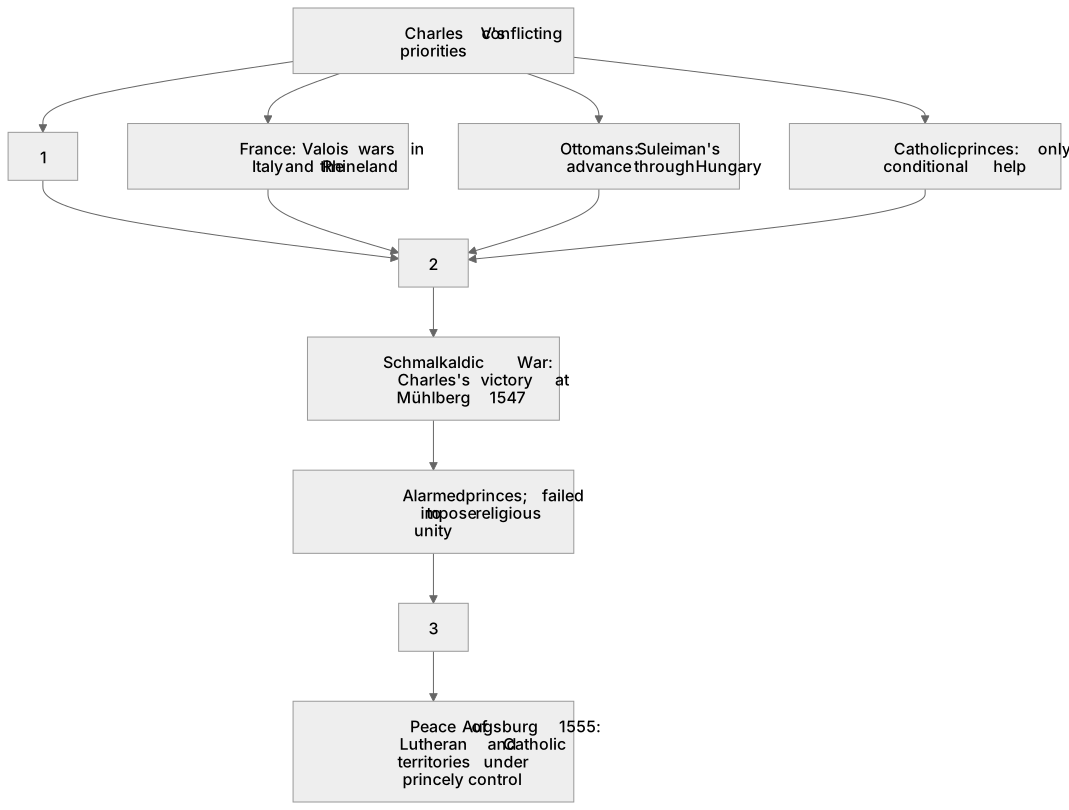
1Box 1
2Box 2
3Box 3
There is more to this lesson
The full lesson goes on to check your understanding and help you earn the marks. Create a free account to carry on, with your progress saved.
A week of Premium from your first lesson · Then the free plan continues · No card, no charge
Test your understanding of The spread and survival of Lutheranism, 1521–55: Charles V and Lutheranism: his conflicting priorities in Spain, France and against the Ottomans; limited support for Charles from the Catholic princes; the significance of the Schmalkaldic War; the Peace of Passau 1552; the Peace of Augsburg 1555.
Active recall beats re-reading. Take an instant quiz now to test what you’ve learned and lock it into long-term memory.
A week of Premium from your first lesson · Then the free plan continues · No card, no charge