Pearson Edexcel · A-Level · History
Course version: 9HI0 · Version from Sept 2015
The role of the German princes: Luther’s protection by Frederick the Wise;…
Full specification wording
The spread and survival of Lutheranism, 1521–55: The role of the German princes: Luther’s protection by Frederick the Wise; the significance of the conversion of Albrecht of Hohenzollern, Philip of Hesse and John of Saxony; formation of the Schmalkaldic League 1531; the League’s significance for the spread of Lutheranism.
German princes were crucial to Lutheranism's survival.
Checked against the Pearson Edexcel 9HI0 specification (opens in a new tab) on .
- Point 2 of 4
- 4 key terms
Study notes
From the checked teaching notes for this specification point.
The idea
German princes were crucial to Lutheranism's survival. Frederick the Wise, Elector of Saxony, protected Luther after the Edict of Worms, refusing to enforce it and providing safe haven at Wartburg. Conversions of key princes—Albrecht of Hohenzollern (Grand Master of the Teutonic Order, who secularised Prussia), Philip of Hesse (a leading political defender), and John of Saxony (who continued Frederick's policies)—gave Lutheranism territorial and military strength. In 1531, Philip of Hesse and John of Saxony formed the Schmalkaldic League, a defensive alliance that resisted Charles V and expanded Lutheran influence. The League's significance lies in its political and military support, which enabled the spread of Lutheranism despite imperial opposition.
What earns the marks
- Explains how Frederick the Wise protected Luther, including refusal to enforce the Edict of Worms and shelter at Wartburg.
- Analyses the significance of Albrecht of Hohenzollern's conversion, including the secularisation of Prussia and its impact on the spread of Lutheranism.
- Assesses the roles of Philip of Hesse and John of Saxony as political and military defenders of Lutheranism.
- Describes the formation of the Schmalkaldic League in 1531 by Philip of Hesse and John of Saxony, and its purpose as a defensive alliance.
- Evaluates the League's significance for the spread of Lutheranism, including its role in resisting imperial forces and supporting territorial churches.
Common mistakes and how to put them right
Underestimating Frederick the Wise's protection.
Put it right: His refusal to enforce the Edict of Worms was vital for Luther's survival and the early movement.
Confusing Albrecht of Hohenzollern with Albrecht of Mainz.
Put it right: Albrecht of Hohenzollern was the Grand Master who converted and secularised Prussia.
Assuming the Schmalkaldic League was solely religious.
Put it right: It was a political and military alliance with religious motivations, but also served princely interests.
Exam tips
- Name specific princes and their actions to demonstrate detailed knowledge.
- Link princely support to the broader survival and spread of Lutheranism, showing causation.
- Use the Schmalkaldic League as a case study of how political power protected religious reform.
Try the lesson
The start of the The spread and survival of Lutheranism, 1521–55: The role of the German princes: Luther’s protection by Frederick the Wise; the significance of the conversion of Albrecht of Hohenzollern, Philip of Hesse and John of Saxony; formation of the Schmalkaldic League 1531; the League’s significance for the spread of Lutheranism. lesson, made from checked teaching notes for this specification point.
Have a go first
Which German prince gave Luther shelter in the Wartburg castle after he was condemned at the Diet of Worms?
Listen
German princes were crucial to Lutheranism's survival. Frederick the Wise, Elector of Saxony, protected Luther after the Edict of Worms, refusing to enforce it and providing safe haven at Wartburg. Conversions of key princes—Albrecht of Hohenzollern (Grand Master of the Teutonic Order, who secularised Prussia), Philip of Hesse (a leading political defender), and John of Saxony (who continued Frederick's policies)—gave Lutheranism territorial and military strength. In 1531, Philip of Hesse and John of Saxony formed the Schmalkaldic League, a defensive alliance that resisted Charles V and expanded Lutheran influence. The League's significance lies in its political and military support, which enabled the spread of Lutheranism despite imperial opposition. A strong answer earns marks for these points. Explains how Frederick the Wise protected Luther, including refusal to enforce the Edict of Worms and shelter at Wartburg. Analyses the significance of Albrecht of Hohenzollern's conversion, including the secularisation of Prussia and its impact on the spread of Lutheranism. Assesses the roles of Philip of Hesse and John of Saxony as political and military defenders of Lutheranism. Describes the formation of the Schmalkaldic League in 1531 by Philip of Hesse and John of Saxony, and its purpose as a defensive alliance. A common slip: Underestimating Frederick the Wise's protection. Instead, his refusal to enforce the Edict of Worms was vital for Luther's survival and the early movement. Exam tip: Name specific princes and their actions to demonstrate detailed knowledge.
See it
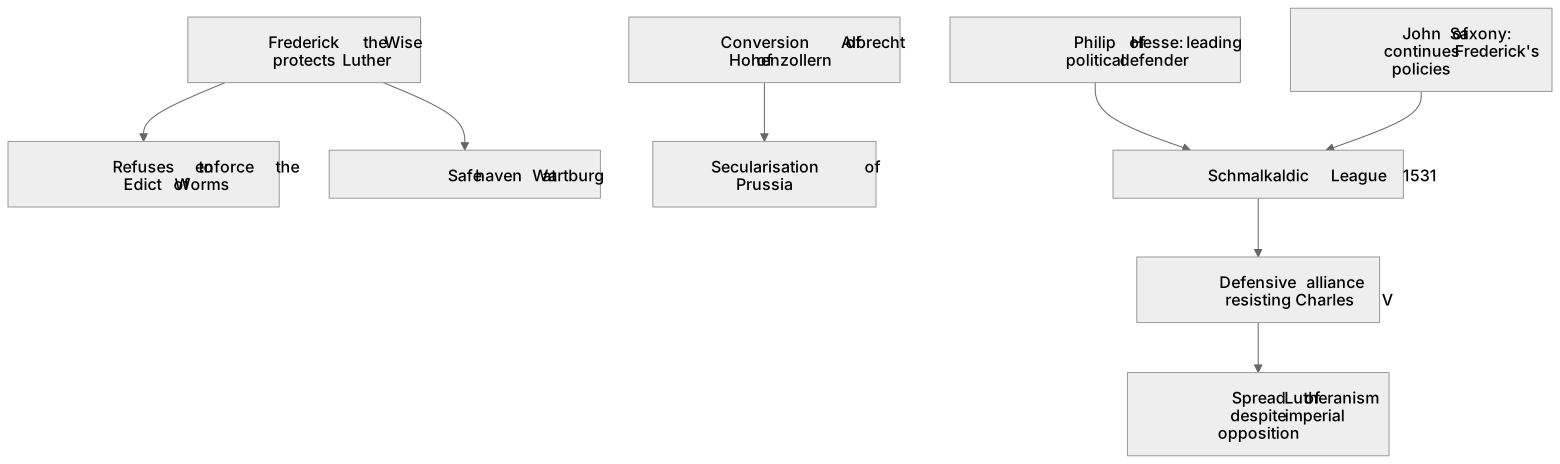
Key words
Say what each word means before you turn the card.
Princely protection and patronage
Try answering aloud or in your head before turning the card.
Conversion and territorial expansion
Try answering aloud or in your head before turning the card.
Political and military alliances
Try answering aloud or in your head before turning the card.
Resistance to imperial authority
Try answering aloud or in your head before turning the card.
See every definition
- Princely protection and patronage
- Support from German princes, such as Frederick the Wise sheltering Luther at Wartburg, was crucial to Lutheranism's survival.
- Conversion and territorial expansion
- The conversions of Albrecht of Hohenzollern, Philip of Hesse and John of Saxony gave Lutheranism territorial and military strength.
- Political and military alliances
- The Schmalkaldic League was a defensive alliance that resisted Charles V and expanded Lutheran influence.
- Resistance to imperial authority
- Frederick the Wise refused to enforce the Edict of Worms, and the League resisted imperial forces despite imperial opposition.
Label the diagram
Some boxes have lost their names. Pick the right name for each number.
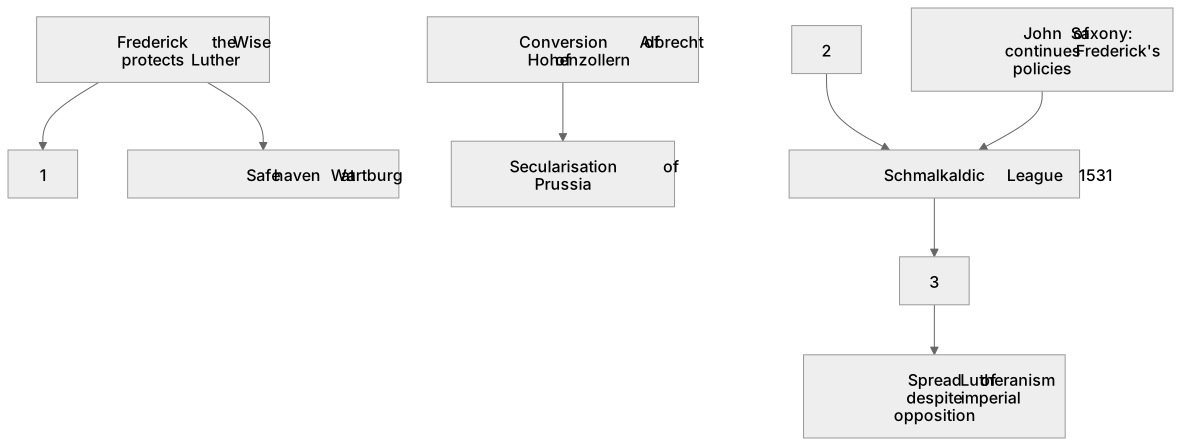
1Box 1
2Box 2
3Box 3
There is more to this lesson
The full lesson goes on to check your understanding and help you earn the marks. Create a free account to carry on, with your progress saved.
A week of Premium from your first lesson · Then the free plan continues · No card, no charge
Test your understanding of The spread and survival of Lutheranism, 1521–55: The role of the German princes: Luther’s protection by Frederick the Wise; the significance of the conversion of Albrecht of Hohenzollern, Philip of Hesse and John of Saxony; formation of the Schmalkaldic League 1531; the League’s significance for the spread of Lutheranism.
Active recall beats re-reading. Take an instant quiz now to test what you’ve learned and lock it into long-term memory.
A week of Premium from your first lesson · Then the free plan continues · No card, no charge