Pearson Edexcel · A-Level · History
Course version: 9HI0 · Version from Sept 2015
Economic transformation: changing employment opportunities; government…
Full specification wording
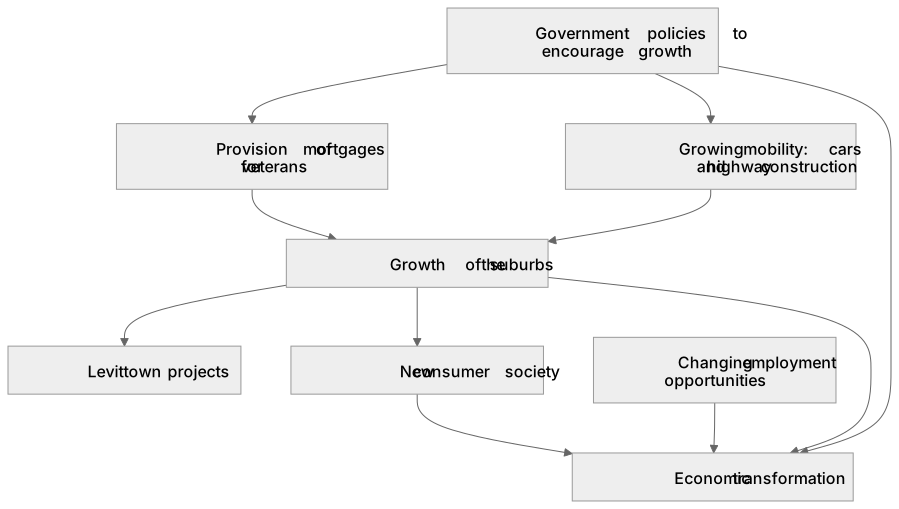
The transformation of the USA, 1945–55: Economic transformation: changing employment opportunities; government policies to encourage growth; the provision of mortgages for veterans; growing mobility, including cars and highway construction. The growth of the suburbs; Levittown projects; the new consumer society.
After 1945 the US economy shifted from wartime production to consumer-led growth.
Checked against the Pearson Edexcel 9HI0 specification (opens in a new tab) on .
- Point 1 of 4
- 3 key terms
Study notes
From the checked teaching notes for this specification point.
The idea
After 1945 the US economy shifted from wartime production to consumer-led growth. Employment moved from manufacturing to services and white-collar work, while government policies such as the GI Bill and federal spending encouraged growth. The GI Bill also provided low-cost mortgages for veterans, making home ownership affordable. Growing mobility came from mass car ownership and early highway construction. These factors drove suburban growth, exemplified by Levittown, where William Levitt used standardised methods to build thousands of affordable homes. A new consumer society emerged, fuelled by advertising, credit and television, transforming daily life and widening prosperity, though not for all.
What earns the marks
- Explains how employment opportunities changed after 1945, with a shift from manufacturing to service and white-collar jobs, and links this to economic transformation.
- Identifies specific government policies that encouraged growth, such as the GI Bill (Servicemen's Readjustment Act 1944), federal housing programmes, and defence spending, and explains their impact.
- Describes the provision of mortgages for veterans through the GI Bill and the Veterans Administration, including low interest rates and no down payment, and assesses how this expanded home ownership.
- Explains growing mobility by referencing the rise in car ownership and early highway construction, and connects this to suburban expansion.
- Analyses the growth of the suburbs, using Levittown as a concrete example, and explains how suburbanisation changed patterns of residence and consumption.
- Evaluates the concept of a new consumer society, including the role of advertising, credit, and television, and discusses both the benefits and the limitations of this prosperity.
Common mistakes and how to put them right
Stating that the GI Bill only provided education benefits.
Put it right: The GI Bill also offered low-cost mortgages and business loans, which were crucial for suburban growth.
Using the 1956 Interstate Highway Act as primary evidence for this period.
Put it right: It was passed in 1956, falling just outside the 1945–55 period; focus instead on earlier highway construction and the growing demand for cars.
Assuming that all Americans benefited equally from the consumer society.
Put it right: Many minority groups, especially African Americans, were excluded from suburban developments and faced discrimination in housing and employment.
Exam tips
- Use specific examples such as Levittown and the GI Bill to support your arguments and show detailed knowledge of the 1945-1955 period.
- When discussing government policies, distinguish between those aimed at veterans (e.g., mortgages) and those aimed at general economic growth (e.g., defence spending).
- Analyse both the positive and negative consequences of the economic transformation, such as increased prosperity versus persistent inequality, to reach higher levels.
Try the lesson
The start of the The transformation of the USA, 1945–55: Economic transformation: changing employment opportunities; government policies to encourage growth; the provision of mortgages for veterans; growing mobility, including cars and highway construction. The growth of the suburbs; Levittown projects; the new consumer society. lesson, made from checked teaching notes for this specification point.
Have a go first
Which government scheme provided mortgages for returning American veterans after 1945?
Listen
After 1945 the US economy shifted from wartime production to consumer-led growth. Employment moved from manufacturing to services and white-collar work, while government policies such as the GI Bill and federal spending encouraged growth. The GI Bill also provided low-cost mortgages for veterans, making home ownership affordable. Growing mobility came from mass car ownership and early highway construction. These factors drove suburban growth, exemplified by Levittown, where William Levitt used standardised methods to build thousands of affordable homes. A new consumer society emerged, fuelled by advertising, credit and television, transforming daily life and widening prosperity, though not for all. A strong answer earns marks for these points. Explains how employment opportunities changed after 1945, with a shift from manufacturing to service and white-collar jobs, and links this to economic transformation. Identifies specific government policies that encouraged growth, such as the GI Bill (Servicemen's Readjustment Act 1944), federal housing programmes, and defence spending, and explains their impact. Describes the provision of mortgages for veterans through the GI Bill and the Veterans Administration, including low interest rates and no down payment, and assesses how this expanded home ownership. Explains growing mobility by referencing the rise in car ownership and early highway construction, and connects this to suburban expansion. A common slip: stating that the GI Bill only provided education benefits. Instead, the GI Bill also offered low-cost mortgages and business loans, which were crucial for suburban growth. Exam tip: Use specific examples such as Levittown and the GI Bill to support your arguments and show detailed knowledge of the 1945-1955 period.
See it
Key words
Say what each word means before you turn the card.
Economic growth and government intervention
Try answering aloud or in your head before turning the card.
Consumer culture and mass consumption
Try answering aloud or in your head before turning the card.
Inequality and exclusion in the post-war boom
Try answering aloud or in your head before turning the card.
See every definition
- Economic growth and government intervention
- Government policies such as the GI Bill and federal spending encouraged growth as the economy shifted from wartime production to consumer-led growth.
- Consumer culture and mass consumption
- A new consumer society emerged, fuelled by advertising, credit and television, transforming daily life and widening prosperity.
- Inequality and exclusion in the post-war boom
- Prosperity widened but not for all, as many minority groups, especially African Americans, were excluded from suburban developments and faced discrimination in housing and employment.
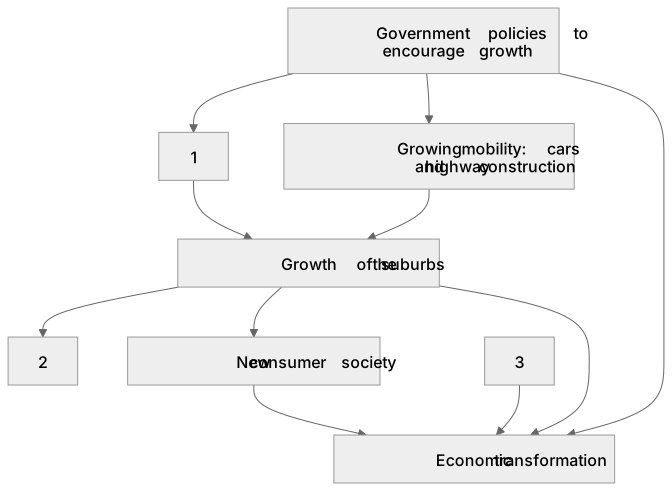
Label the diagram
Some boxes have lost their names. Pick the right name for each number.
1Box 1
2Box 2
3Box 3
There is more to this lesson
The full lesson goes on to check your understanding and help you earn the marks. Create a free account to carry on, with your progress saved.
A week of Premium from your first lesson · Then the free plan continues · No card, no charge
Test your understanding of The transformation of the USA, 1945–55: Economic transformation: changing employment opportunities; government policies to encourage growth; the provision of mortgages for veterans; growing mobility, including cars and highway construction. The growth of the suburbs; Levittown projects; the new consumer society.
Active recall beats re-reading. Take an instant quiz now to test what you’ve learned and lock it into long-term memory.
A week of Premium from your first lesson · Then the free plan continues · No card, no charge