Pearson Edexcel · A-Level · History
Course version: 9HI0 · Version from Sept 2015
The end of post-war euphoria: HUAC, McCarthyism and their impact;…
Full specification wording
The transformation of the USA, 1945–55: The end of post-war euphoria: HUAC, McCarthyism and their impact; anti-communism and the Cold War context; the reality of the nuclear age, including Ethel and Julius Rosenberg.
Post-war optimism faded as Cold War tensions fuelled anti-communist hysteria.
Checked against the Pearson Edexcel 9HI0 specification (opens in a new tab) on .
- Point 2 of 4
- 4 key terms
Study notes
From the checked teaching notes for this specification point.
The idea
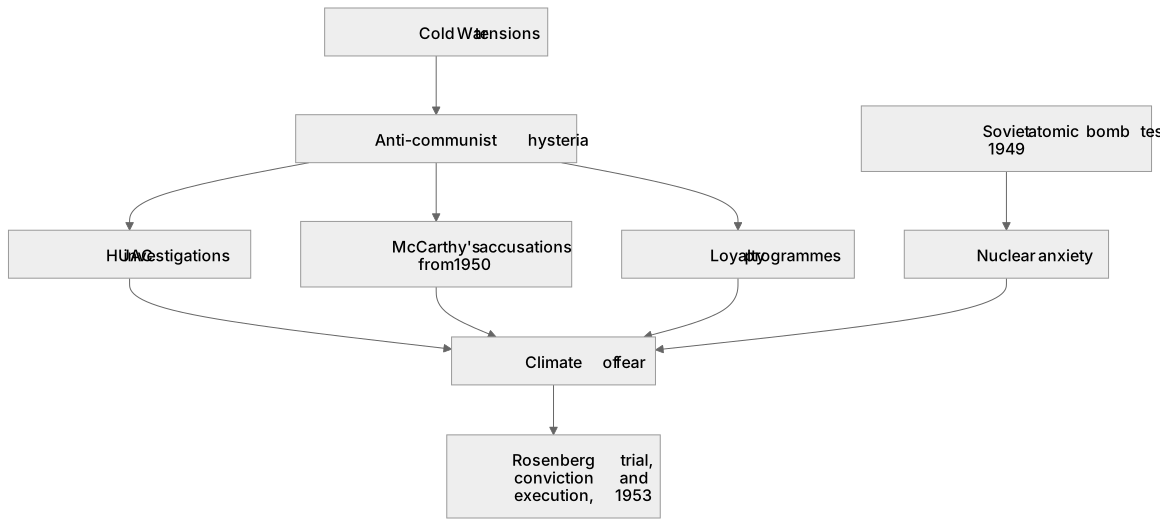
Post-war optimism faded as Cold War tensions fuelled anti-communist hysteria. The House Un-American Activities Committee (HUAC) investigated alleged subversion in government, Hollywood and unions, often using aggressive tactics. Senator Joseph McCarthy exploited fears from 1950, making unsubstantiated accusations of communist infiltration, which ruined careers and created a climate of fear. This McCarthyism was part of a broader anti-communist drive rooted in the Cold War, including the Truman Doctrine and loyalty programmes. The nuclear age added existential dread, especially after the USSR tested an atomic bomb in 1949. The Rosenberg case exemplified this: Julius and Ethel Rosenberg were convicted of passing atomic secrets to the Soviets and executed in 1953, despite protests. Their trial highlighted the intersection of espionage fears, nuclear anxiety and anti-communism.
What earns the marks
- Explains the role of HUAC in investigating communist influence, including its methods and targets, and assesses its impact on American society and politics.
- Defines McCarthyism and explains how McCarthy's accusations and tactics contributed to a climate of fear and repression, and evaluates the extent of his influence.
- Analyses the anti-communist and Cold War context, linking domestic fears to international tensions such as the Berlin Blockade, the Truman Doctrine, and the Korean War.
- Describes the reality of the nuclear age, including the Soviet atomic bomb test in 1949 and the resulting arms race, and explains how this heightened public anxiety.
- Uses the case of Ethel and Julius Rosenberg to illustrate the consequences of anti-communist hysteria, including their trial, conviction, and execution, and discusses the controversy surrounding their guilt and sentence.
- Evaluates the overall impact of HUAC, McCarthyism, and the nuclear age on American civil liberties and political culture in the early Cold War.
Common mistakes and how to put them right
Confusing HUAC with the Senate Permanent Subcommittee on Investigations.
Put it right: HUAC was a House committee, while McCarthy chaired a Senate committee; both investigated subversion but were distinct.
Claiming that McCarthy was censured before 1954.
Put it right: McCarthy was censured in December 1954, after the period of his greatest influence, and this marked the decline of McCarthyism.
Stating that the Rosenbergs were executed for spying for the USSR without acknowledging the controversy over the evidence.
Put it right: They were convicted under the Espionage Act, but the fairness of their trial and the severity of the sentence remain debated by historians.
Exam tips
- Use specific examples such as the Hollywood Ten, the Army-McCarthy hearings, and the Rosenberg trial to demonstrate detailed knowledge.
- When discussing McCarthyism, distinguish between McCarthy's personal actions and the broader anti-communist movement, and assess their relative impact.
- Link domestic anti-communism to the international Cold War context to show understanding of cause and consequence.
Try the lesson
The start of the The transformation of the USA, 1945–55: The end of post-war euphoria: HUAC, McCarthyism and their impact; anti-communism and the Cold War context; the reality of the nuclear age, including Ethel and Julius Rosenberg. lesson, made from checked teaching notes for this specification point.
Have a go first
Which congressional committee held highly publicised hearings to investigate suspected communist infiltration of the Hollywood motion picture industry during the early Cold War?
Listen
Post-war optimism faded as Cold War tensions fuelled anti-communist hysteria. The House Un-American Activities Committee (HUAC) investigated alleged subversion in government, Hollywood and unions, often using aggressive tactics. Senator Joseph McCarthy exploited fears from 1950, making unsubstantiated accusations of communist infiltration, which ruined careers and created a climate of fear. This McCarthyism was part of a broader anti-communist drive rooted in the Cold War, including the Truman Doctrine and loyalty programmes. The nuclear age added existential dread, especially after the USSR tested an atomic bomb in 1949. The Rosenberg case exemplified this: Julius and Ethel Rosenberg were convicted of passing atomic secrets to the Soviets and executed in 1953, despite protests. Their trial highlighted the intersection of espionage fears, nuclear anxiety and anti-communism. A strong answer earns marks for these points. Explains the role of HUAC in investigating communist influence, including its methods and targets, and assesses its impact on American society and politics. Defines McCarthyism and explains how McCarthy's accusations and tactics contributed to a climate of fear and repression, and evaluates the extent of his influence. Analyses the anti-communist and Cold War context, linking domestic fears to international tensions such as the Berlin Blockade, the Truman Doctrine, and the Korean War. Describes the reality of the nuclear age, including the Soviet atomic bomb test in 1949 and the resulting arms race, and explains how this heightened public anxiety. A common slip: confusing HUAC with the Senate Permanent Subcommittee on Investigations. Instead, HUAC was a House committee, while McCarthy chaired a Senate committee; both investigated subversion but were distinct. Exam tip: Use specific examples such as the Hollywood Ten, the Army-McCarthy hearings, and the Rosenberg trial to demonstrate detailed knowledge.
See it
Put the events in order
Put these events in the order they happened, earliest first.
- 1. McCarthy was censured
- 2. The USSR tested an atomic bomb
- 3. Julius and Ethel Rosenberg were executed
- 4. Senator Joseph McCarthy exploited fears of communist infiltration
Key words
Say what each word means before you turn the card.
HUAC
Try answering aloud or in your head before turning the card.
McCarthyism
Try answering aloud or in your head before turning the card.
anti-communism
Try answering aloud or in your head before turning the card.
Rosenberg case
Try answering aloud or in your head before turning the card.
See every definition
- HUAC
- A House committee that investigated alleged subversion in government, Hollywood and unions, often using aggressive tactics.
- McCarthyism
- A climate of fear created from 1950 when Senator Joseph McCarthy made unsubstantiated accusations of communist infiltration that ruined careers.
- anti-communism
- A broader drive rooted in the Cold War, including the Truman Doctrine and loyalty programmes, of which McCarthyism formed a part.
- Rosenberg case
- Julius and Ethel Rosenberg were convicted of passing atomic secrets to the Soviets and executed in 1953, despite protests.
Label the diagram
Some boxes have lost their names. Pick the right name for each number.
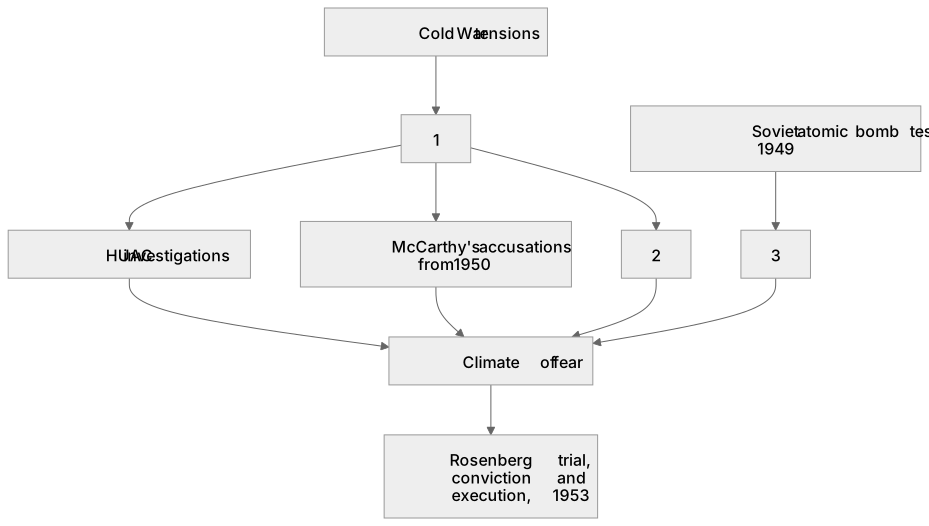
1Box 1
2Box 2
3Box 3
There is more to this lesson
The full lesson goes on to check your understanding and help you earn the marks. Create a free account to carry on, with your progress saved.
A week of Premium from your first lesson · Then the free plan continues · No card, no charge
Test your understanding of The transformation of the USA, 1945–55: The end of post-war euphoria: HUAC, McCarthyism and their impact; anti-communism and the Cold War context; the reality of the nuclear age, including Ethel and Julius Rosenberg.
Active recall beats re-reading. Take an instant quiz now to test what you’ve learned and lock it into long-term memory.
A week of Premium from your first lesson · Then the free plan continues · No card, no charge