Pearson Edexcel · A-Level · History
Course version: 9HI0 · Version from Sept 2015
The importance of growing conflicts with parliament and the session of 1601.
Full specification wording
Was there a general crisis of government in the last years of Elizabeth I’s reign, 1589–1603?: The importance of growing conflicts with parliament and the session of 1601.
Elizabeth I's later parliaments became arenas of friction, and the 1601 session shows why.
Checked against the Pearson Edexcel 9HI0 specification (opens in a new tab) on .
- Point 3 of 4
- 4 key terms
Study notes
From the checked teaching notes for this specification point.
The idea
Elizabeth I's later parliaments became arenas of friction, and the 1601 session shows why. Monopolies granted by royal patent raised prices and angered merchants and consumers; MPs drafted a bill to abolish them. The Queen's Golden Speech conceded the grievances while preserving the prerogative, so conflict was contained rather than resolved. Historians weigh how far this was principled opposition or a bargaining ritual. Assess importance by comparing 1601 with earlier sessions: taxation for war, religion and free speech were recurring flashpoints. Explain how the session ended, what it reveals about Crown–Commons relations, and whether it marks a step towards parliamentary assertiveness.
What earns the marks
- Explains the monopoly grievance: royal patents restricted trade and raised prices, prompting Commons complaints in 1601.
- Analyses the Golden Speech as a concession of specific abuses that defended the royal prerogative in principle.
- Compares 1601 with earlier sessions over taxation, religion and freedom of speech to judge relative importance.
- Evaluates whether the outcome shows growing parliamentary assertiveness or managed negotiation that preserved Crown authority.
- Uses contemporary evidence such as parliamentary diaries or the speech itself to support the judgement.
Common mistakes and how to put them right
Treating 1601 as a constitutional revolution.
Put it right by explaining that the prerogative survived and only particular monopolies were withdrawn.
Assuming all MPs opposed the Crown.
Put it right by noting that many sought redress of grievance while accepting royal authority.
Narrating the session without weighing importance.
Put it right by comparing it with earlier parliaments and reaching a supported judgement.
Exam tips
- Anchor each paragraph in a specific feature of the 1601 session, then link it to the wider theme of Crown–Parliament conflict.
- Use the wording of the question: address both growing conflicts and the session of 1601 explicitly.
- Reach a clear judgement about importance, supported by comparison with earlier sessions rather than assertion.
Try the lesson
The start of the Was there a general crisis of government in the last years of Elizabeth I’s reign, 1589–1603?: The importance of growing conflicts with parliament and the session of 1601. lesson, made from checked teaching notes for this specification point.
Have a go first
During the 1601 parliamentary session, which issue provoked the most significant and open conflict between the House of Commons and the Crown?
Listen
Elizabeth I's later parliaments became arenas of friction, and the 1601 session shows why. Monopolies granted by royal patent raised prices and angered merchants and consumers; MPs drafted a bill to abolish them. The Queen's Golden Speech conceded the grievances while preserving the prerogative, so conflict was contained rather than resolved. Historians weigh how far this was principled opposition or a bargaining ritual. Assess importance by comparing 1601 with earlier sessions: taxation for war, religion and free speech were recurring flashpoints. Explain how the session ended, what it reveals about Crown–Commons relations, and whether it marks a step towards parliamentary assertiveness. A strong answer earns marks for these points. Explains the monopoly grievance: royal patents restricted trade and raised prices, prompting Commons complaints in 1601. Analyses the Golden Speech as a concession of specific abuses that defended the royal prerogative in principle. Compares 1601 with earlier sessions over taxation, religion and freedom of speech to judge relative importance. Evaluates whether the outcome shows growing parliamentary assertiveness or managed negotiation that preserved Crown authority. A common slip: Treating 1601 as a constitutional revolution. Instead, explaining that the prerogative survived and only particular monopolies were withdrawn. Exam tip: Anchor each paragraph in a specific feature of the 1601 session, then link it to the wider theme of Crown–Parliament conflict.
See it
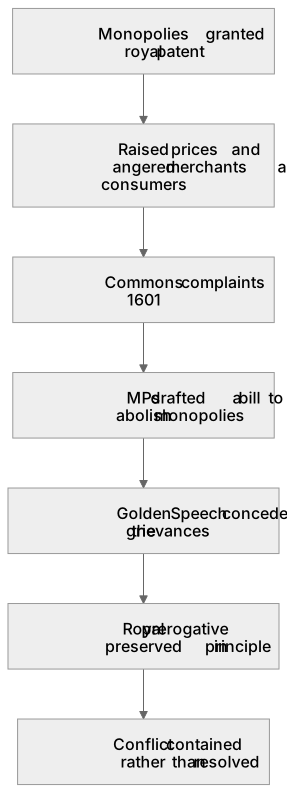
Put it in order
Put these steps in the order they happen.
- 1. Conflict contained rather than resolved
- 2. Royal prerogative preserved in principle
- 3. Commons complaints in 1601
- 4. Golden Speech conceded the grievances
- 5. Monopolies granted by royal patent
- 6. Raised prices and angered merchants and consumers
- 7. MPs drafted a bill to abolish monopolies
Key words
Say what each word means before you turn the card.
Crown–Parliament relations
Try answering aloud or in your head before turning the card.
Royal prerogative and monopolies
Try answering aloud or in your head before turning the card.
Taxation and war finance
Try answering aloud or in your head before turning the card.
Freedom of speech and privilege
Try answering aloud or in your head before turning the card.
See every definition
- Crown–Parliament relations
- The relationship between the monarch and parliament, which the note says the 1601 session reveals through friction that was contained rather than resolved.
- Royal prerogative and monopolies
- Monopolies granted by royal patent restricted trade and raised prices, angering merchants and consumers, while the Golden Speech defended the prerogative in principle.
- Taxation and war finance
- Taxation for war is described as a recurring flashpoint in earlier sessions, used to compare 1601 with earlier parliaments.
- Freedom of speech and privilege
- Free speech is described as a recurring flashpoint in earlier sessions, alongside taxation and religion, used to judge the importance of 1601.
Label the diagram
Some boxes have lost their names. Pick the right name for each number.
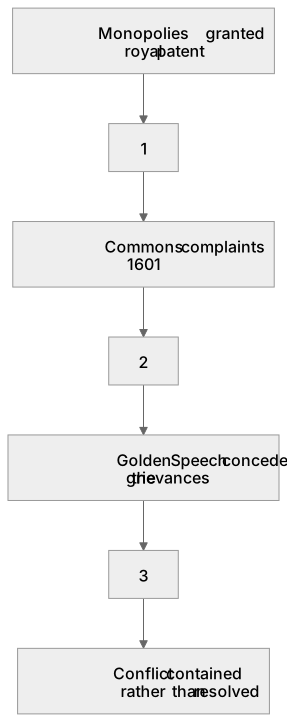
1Box 1
2Box 2
3Box 3
There is more to this lesson
The full lesson goes on to check your understanding and help you earn the marks. Create a free account to carry on, with your progress saved.
A week of Premium from your first lesson · Then the free plan continues · No card, no charge
Test your understanding of Was there a general crisis of government in the last years of Elizabeth I’s reign, 1589–1603?: The importance of growing conflicts with parliament and the session of 1601.
Active recall beats re-reading. Take an instant quiz now to test what you’ve learned and lock it into long-term memory.
A week of Premium from your first lesson · Then the free plan continues · No card, no charge