Pearson Edexcel · A-Level · History
Course version: 9HI0 · Version from Sept 2015
The importance of harvest failures in the 1590s and the growth of social…
Full specification wording
Was there a general crisis of government in the last years of Elizabeth I’s reign, 1589–1603?: The importance of harvest failures in the 1590s and the growth of social distress.
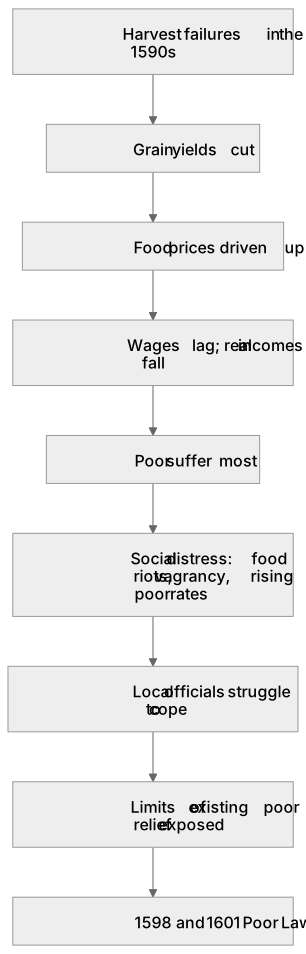
Harvest failures in the 1590s cut grain yields, driving up food prices while wages lagged.
Checked against the Pearson Edexcel 9HI0 specification (opens in a new tab) on .
- Point 4 of 4
- 4 key terms
Study notes
From the checked teaching notes for this specification point.
The idea
Harvest failures in the 1590s cut grain yields, driving up food prices while wages lagged. Real incomes fell, and the poor suffered most. Distress appeared as food riots, vagrancy and rising poor rates; local officials struggled to cope. The crisis exposed the limits of existing poor relief and helped prompt the 1598 and 1601 Poor Laws. Assess importance by comparing the 1590s with earlier dearth and by weighing short-term suffering against longer-term policy change. Explain the mechanisms linking harvest failure to prices, wages and distress, and judge how far the crisis reshaped attitudes to poverty and state responsibility.
What earns the marks
- Explains the link from harvest failure to higher grain prices and falling real wages.
- Describes social distress: food riots, vagrancy, hunger and pressure on local poor relief.
- Assesses the response, including the 1598 and 1601 Poor Laws and local enforcement.
- Compares the 1590s with earlier dearth to judge how far this crisis was distinctive.
- Weighs short-term suffering against longer-term change in poor relief policy.
Common mistakes and how to put them right
Treating harvest failure as the sole cause of distress.
Put it right by including wage stagnation, enclosure and population pressure.
Assuming the Poor Laws solved poverty.
Put it right by noting local variation and continuing hardship.
Describing events without judging importance.
Put it right by comparing with earlier crises and assessing consequences.
Exam tips
- Use precise causal chains: harvest failure, then prices, then real wages, then distress.
- Support claims about distress with named examples such as food riots or rising poor rates.
- Make importance explicit by comparing the 1590s with earlier dearth and by weighing short-term and long-term effects.
Try the lesson
The start of the Was there a general crisis of government in the last years of Elizabeth I’s reign, 1589–1603?: The importance of harvest failures in the 1590s and the growth of social distress. lesson, made from checked teaching notes for this specification point.
Have a go first
What was the most immediate effect of the harvest failures of the 1590s on ordinary people in England?
Listen
Harvest failures in the 1590s cut grain yields, driving up food prices while wages lagged. Real incomes fell, and the poor suffered most. Distress appeared as food riots, vagrancy and rising poor rates; local officials struggled to cope. The crisis exposed the limits of existing poor relief and helped prompt the 1598 and 1601 Poor Laws. Assess importance by comparing the 1590s with earlier dearth and by weighing short-term suffering against longer-term policy change. Explain the mechanisms linking harvest failure to prices, wages and distress, and judge how far the crisis reshaped attitudes to poverty and state responsibility. A strong answer earns marks for these points. Explains the link from harvest failure to higher grain prices and falling real wages. Describes social distress: food riots, vagrancy, hunger and pressure on local poor relief. Assesses the response, including the 1598 and 1601 Poor Laws and local enforcement. Compares the 1590s with earlier dearth to judge how far this crisis was distinctive. A common slip: Treating harvest failure as the sole cause of distress. Instead, including wage stagnation, enclosure and population pressure. Exam tip: Use precise causal chains: harvest failure, then prices, then real wages, then distress.
See it
Key words
Say what each word means before you turn the card.
Harvest failure and dearth
Try answering aloud or in your head before turning the card.
Poverty and vagrancy
Try answering aloud or in your head before turning the card.
Poor relief and the Poor Laws
Try answering aloud or in your head before turning the card.
Prices, wages and living standards
Try answering aloud or in your head before turning the card.
See every definition
- Harvest failure and dearth
- Harvest failures in the 1590s cut grain yields, driving up food prices while wages lagged.
- Poverty and vagrancy
- Distress appeared as food riots, vagrancy and rising poor rates, and the poor suffered most.
- Poor relief and the Poor Laws
- The crisis exposed the limits of existing poor relief and helped prompt the 1598 and 1601 Poor Laws.
- Prices, wages and living standards
- Rising grain prices with lagging wages meant real incomes fell, so living standards dropped.
Label the diagram
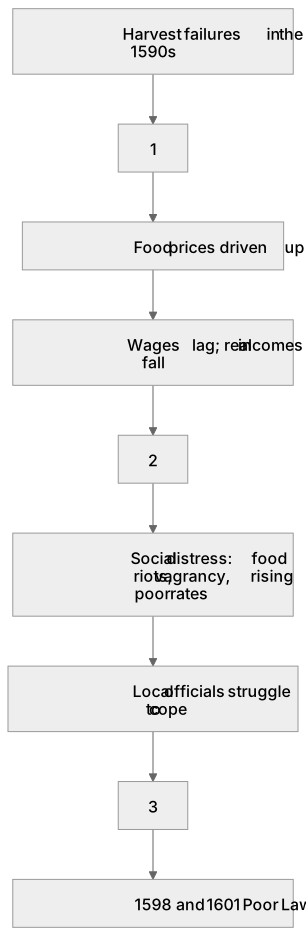
Some boxes have lost their names. Pick the right name for each number.
1Box 1
2Box 2
3Box 3
There is more to this lesson
The full lesson goes on to check your understanding and help you earn the marks. Create a free account to carry on, with your progress saved.
A week of Premium from your first lesson · Then the free plan continues · No card, no charge
Test your understanding of Was there a general crisis of government in the last years of Elizabeth I’s reign, 1589–1603?: The importance of harvest failures in the 1590s and the growth of social distress.
Active recall beats re-reading. Take an instant quiz now to test what you’ve learned and lock it into long-term memory.
A week of Premium from your first lesson · Then the free plan continues · No card, no charge