Pearson Edexcel · A-Level · History
Course version: 9HI0 · Version from Sept 2015
The effect of Reagan’s economic policies.
Full specification wording
What impact did the Reagan presidency (1981–89) have on the USA in the years 1981–96?: The effect of Reagan’s economic policies.
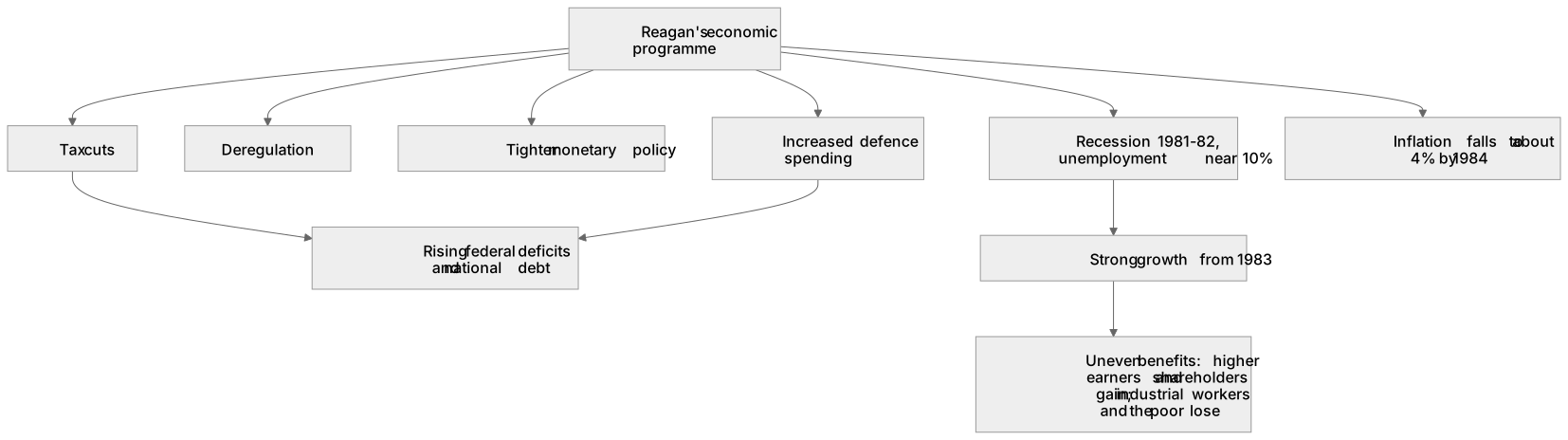
Reagan’s economic programme, often called supply-side or ‘Reaganomics’, combined large personal and corporate tax cuts, deregulation, tighter monetary policy and increased defence spending.
Checked against the Pearson Edexcel 9HI0 specification (opens in a new tab) on .
- Point 1 of 4
- 4 key terms
Study notes
From the checked teaching notes for this specification point.
The idea
Reagan’s economic programme, often called supply-side or ‘Reaganomics’, combined large personal and corporate tax cuts, deregulation, tighter monetary policy and increased defence spending. The immediate effect was a severe recession in 1981–82, with unemployment near 10%, followed by strong growth from 1983. Inflation fell from double digits to about 4% by 1984, but federal deficits and national debt rose sharply because spending was not cut in step with taxes. The benefits were uneven: higher earners and shareholders gained most, while industrial workers and the poor often lost welfare support.
What earns the marks
- Explains the main components of Reagan’s economic policy: tax cuts, deregulation, tighter money supply and higher defence spending.
- Uses specific evidence of effects, such as the 1981–82 recession, unemployment approaching 10%, inflation falling to around 4% by 1984 and sustained growth after 1983.
- Analyses the uneven distribution of gains, contrasting benefits for higher earners and investors with losses for industrial workers and welfare recipients.
- Evaluates the fiscal consequence of tax cuts combined with increased defence spending, including rising federal deficits and national debt.
- Reaches a supported judgement on the overall effect, balancing recovery and growth against recession, inequality and social cost.
Common mistakes and how to put them right
Treating Reaganomics as only tax cuts.
Put it right: Include deregulation, monetary tightening and defence spending as interacting parts of the policy mix.
Assuming all Americans benefited equally from recovery.
Put it right: Use evidence of regional and social differences, such as declining manufacturing employment alongside growth in services and finance.
Confusing the timing of effects.
Put it right: Distinguish the 1981–82 recession from the growth that followed from 1983, and link inflation reduction to Federal Reserve policy as well as Reagan’s programme.
Exam tips
- Plan around short-term versus long-term effects so the essay has a clear analytical structure.
- Integrate precise evidence, such as dates, approximate unemployment and inflation figures, and named policies, to support each claim.
- Keep the focus on ‘effect’ by explaining consequences for the economy and for different groups, not just listing what Reagan did.
Try the lesson
The start of the What impact did the Reagan presidency (1981–89) have on the USA in the years 1981–96?: The effect of Reagan’s economic policies. lesson, made from checked teaching notes for this specification point.
Have a go first
Which description best fits the economic approach that Reagan brought to federal government from 1981?
Listen
Reagan’s economic programme, often called supply-side or ‘Reaganomics’, combined large personal and corporate tax cuts, deregulation, tighter monetary policy and increased defence spending. The immediate effect was a severe recession in 1981–82, with unemployment near 10%, followed by strong growth from 1983. Inflation fell from double digits to about 4% by 1984, but federal deficits and national debt rose sharply because spending was not cut in step with taxes. The benefits were uneven: higher earners and shareholders gained most, while industrial workers and the poor often lost welfare support. A strong answer earns marks for these points. Explains the main components of Reagan’s economic policy: tax cuts, deregulation, tighter money supply and higher defence spending. Uses specific evidence of effects, such as the 1981–82 recession, unemployment approaching 10%, inflation falling to around 4% by 1984 and sustained growth after 1983. Analyses the uneven distribution of gains, contrasting benefits for higher earners and investors with losses for industrial workers and welfare recipients. Evaluates the fiscal consequence of tax cuts combined with increased defence spending, including rising federal deficits and national debt. A common slip: Treating Reaganomics as only tax cuts. Instead, include deregulation, monetary tightening and defence spending as interacting parts of the policy mix. Exam tip: Plan around short-term versus long-term effects so the essay has a clear analytical structure.
See it
Put the events in order
Put these events in the order they happened, earliest first.
- 1. Severe recession begins, with unemployment near ten per cent
- 2. Inflation falls to about four per cent
- 3. Strong economic growth begins after the recession
Key words
Say what each word means before you turn the card.
Supply-side economics and tax reduction
Try answering aloud or in your head before turning the card.
Inflation, recession and recovery
Try answering aloud or in your head before turning the card.
Deregulation and the role of the state
Try answering aloud or in your head before turning the card.
Inequality and regional economic change
Try answering aloud or in your head before turning the card.
See every definition
- Supply-side economics and tax reduction
- Reagan's economic programme combined large personal and corporate tax cuts with deregulation, tighter monetary policy and increased defence spending.
- Inflation, recession and recovery
- A severe recession in 1981–82 with unemployment near 10% was followed by strong growth from 1983, while inflation fell to about 4% by 1984.
- Deregulation and the role of the state
- Deregulation formed part of the policy mix, and spending was not cut in step with taxes, so federal deficits and national debt rose sharply.
- Inequality and regional economic change
- Benefits were uneven, with higher earners and shareholders gaining most while industrial workers and the poor often lost welfare support.
Label the diagram
Some boxes have lost their names. Pick the right name for each number.
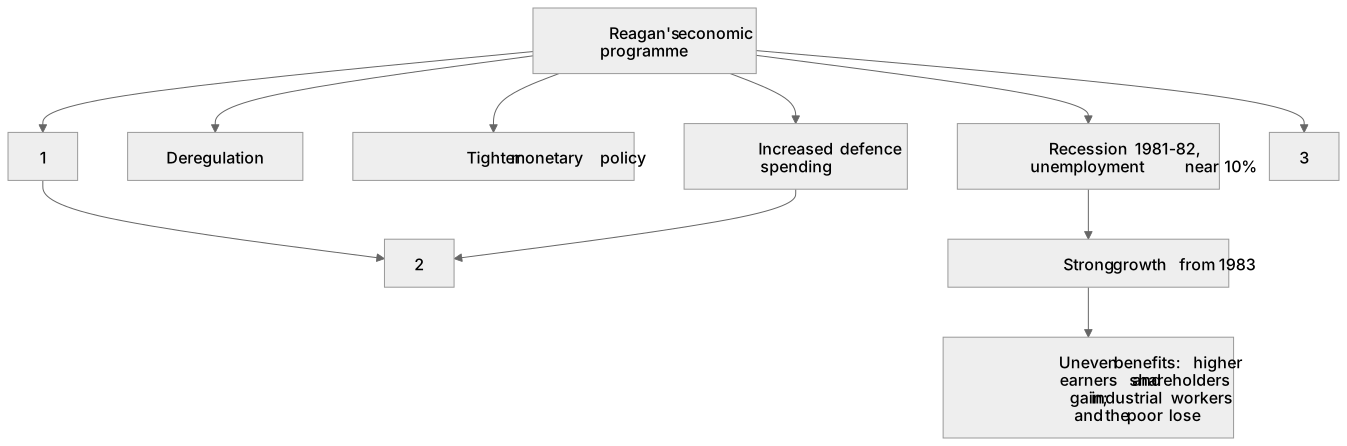
1Box 1
2Box 2
3Box 3
There is more to this lesson
The full lesson goes on to check your understanding and help you earn the marks. Create a free account to carry on, with your progress saved.
A week of Premium from your first lesson · Then the free plan continues · No card, no charge
Test your understanding of What impact did the Reagan presidency (1981–89) have on the USA in the years 1981–96?: The effect of Reagan’s economic policies.
Active recall beats re-reading. Take an instant quiz now to test what you’ve learned and lock it into long-term memory.
A week of Premium from your first lesson · Then the free plan continues · No card, no charge