Pearson Edexcel · A-Level · History
Course version: 9HI0 · Version from Sept 2015
The extent to which ‘big government’ was reduced.
Full specification wording
What impact did the Reagan presidency (1981–89) have on the USA in the years 1981–96?: The extent to which ‘big government’ was reduced.
‘Big government’ means extensive federal intervention in the economy and welfare.
Checked against the Pearson Edexcel 9HI0 specification (opens in a new tab) on .
- Point 2 of 4
- 4 key terms
Study notes
From the checked teaching notes for this specification point.
The idea
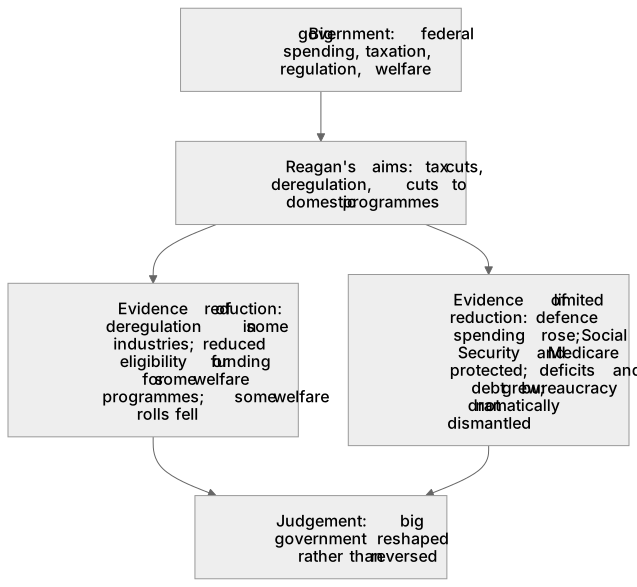
‘Big government’ means extensive federal intervention in the economy and welfare. Reagan promised to reduce it by cutting taxes, deregulating and shrinking domestic programmes. In practice, the extent was limited. Deregulation and tax cuts did reduce some federal reach, and some welfare rolls fell. However, defence spending rose, Social Security and Medicare were protected, and federal deficits and debt grew. The bureaucracy was not dramatically dismantled.
What earns the marks
- Defines ‘big government’ as federal spending, taxation, regulation and welfare provision, and uses that definition consistently.
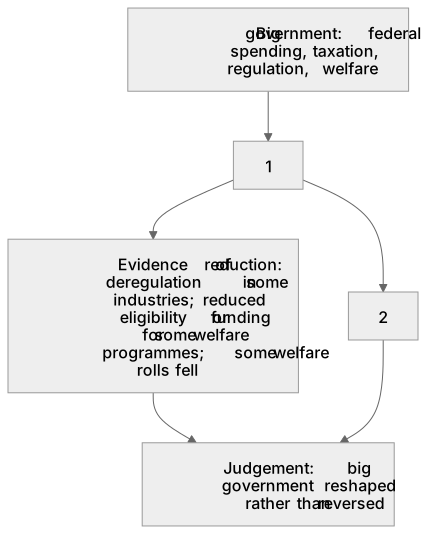
- Explains Reagan’s aims to reduce big government through tax cuts, deregulation and cuts to domestic programmes.
- Provides evidence of limited reduction, such as continued or increased defence spending, protection of Social Security and Medicare, and rising deficits and debt.
- Assesses areas where federal reach did shrink, such as deregulation in some industries and reduced eligibility or funding for some welfare programmes.
- Reaches a reasoned overall judgement on the extent of reduction, recognising continuity as well as change.
Common mistakes and how to put them right
Equating tax cuts with a smaller state.
Put it right: Examine spending, regulation and federal responsibilities as well, because deficits and debt can grow even when taxes fall.
Ignoring protected programmes; correction: note that Social Security and Medicare were politically difficult to cut and continued to consume large federal funds.
Treating ‘big government’ as only welfare.
Put it right: Include defence, taxation, regulation and the overall scale of federal activity in the assessment.
Exam tips
- Define ‘big government’ at the start so the extent of reduction can be measured against clear criteria.
- Use a balanced structure that examines evidence for reduction and evidence against it before reaching a judgement.
- Refer to specific policies and outcomes, such as deregulation, tax changes, defence budgets and entitlement spending, rather than general statements.
Try the lesson
The start of the What impact did the Reagan presidency (1981–89) have on the USA in the years 1981–96?: The extent to which ‘big government’ was reduced. lesson, made from checked teaching notes for this specification point.
Have a go first
Which statement describes Reagan's stated aim towards 'big government' when he took office in 1981?
Listen
Big government’ means extensive federal intervention in the economy and welfare. Reagan promised to reduce it by cutting taxes, deregulating and shrinking domestic programmes. In practice, the extent was limited. Deregulation and tax cuts did reduce some federal reach, and some welfare rolls fell. However, defence spending rose, Social Security and Medicare were protected, and federal deficits and debt grew. The bureaucracy was not dramatically dismantled. A strong answer earns marks for these points. Defines ‘big government’ as federal spending, taxation, regulation and welfare provision, and uses that definition consistently. Explains Reagan’s aims to reduce big government through tax cuts, deregulation and cuts to domestic programmes. Provides evidence of limited reduction, such as continued or increased defence spending, protection of Social Security and Medicare, and rising deficits and debt. Assesses areas where federal reach did shrink, such as deregulation in some industries and reduced eligibility or funding for some welfare programmes. A common slip: Equating tax cuts with a smaller state. Instead, examine spending, regulation and federal responsibilities as well, because deficits and debt can grow even when taxes fall. Exam tip: Define ‘big government’ at the start so the extent of reduction can be measured against clear criteria.
See it
Key words
Say what each word means before you turn the card.
Big government
Try answering aloud or in your head before turning the card.
Deregulation and the role of the state
Try answering aloud or in your head before turning the card.
Welfare and entitlement programmes
Try answering aloud or in your head before turning the card.
Deficits, debt and political limits
Try answering aloud or in your head before turning the card.
See every definition
- Big government
- Extensive federal intervention in the economy and welfare, measured by federal spending, taxation, regulation and welfare provision.
- Deregulation and the role of the state
- A means by which Reagan promised to reduce big government, and which did reduce some federal reach.
- Welfare and entitlement programmes
- Domestic programmes that Reagan promised to shrink, though some welfare rolls fell while Social Security and Medicare were protected.
- Deficits, debt and political limits
- Federal deficits and debt grew, showing the political limits on reducing big government, which was reshaped rather than reversed.
Label the diagram
Some boxes have lost their names. Pick the right name for each number.
1Box 1
2Box 2
There is more to this lesson
The full lesson goes on to check your understanding and help you earn the marks. Create a free account to carry on, with your progress saved.
A week of Premium from your first lesson · Then the free plan continues · No card, no charge
Test your understanding of What impact did the Reagan presidency (1981–89) have on the USA in the years 1981–96?: The extent to which ‘big government’ was reduced.
Active recall beats re-reading. Take an instant quiz now to test what you’ve learned and lock it into long-term memory.
A week of Premium from your first lesson · Then the free plan continues · No card, no charge