Pearson Edexcel · GCSE · History
Course version: 1HI0 · Version from Sept 2016
The historic environment - 2 Knowledge, selection and use of sources for…
Full specification wording
Option 10: The historic environment - 2 Knowledge, selection and use of sources for historical enquiries: Framing of questions relevant to the pursuit of a specific enquiry.
Framing effective questions is a crucial skill for pursuing a specific historical enquiry.
Checked against the Pearson Edexcel 1HI0 specification (opens in a new tab) on .
- Point 4 of 5
- 4 key terms
Study notes
From the checked teaching notes for this specification point.
The idea
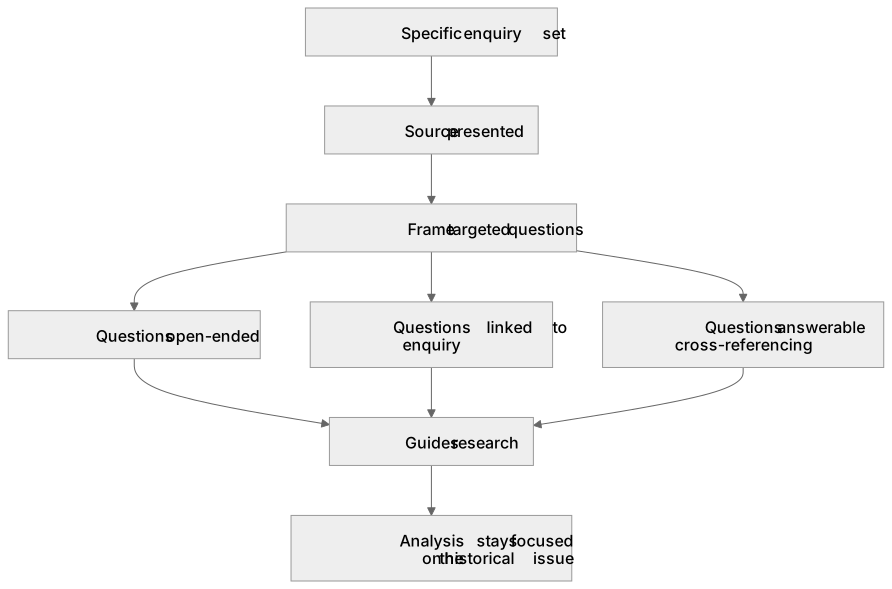
Framing effective questions is a crucial skill for pursuing a specific historical enquiry. When presented with a source, historians must ask targeted questions to extract meaningful information that addresses their investigation. For example, if the enquiry is about policing Whitechapel, and the source is a police memoir, a relevant question would be: 'What does this memoir reveal about the daily challenges officers faced in overcrowded slums?' Good questions should be open-ended, directly linked to the specific enquiry, and capable of being answered by cross-referencing the source with contextual knowledge or other evidence. This process guides research and ensures analysis remains focused on the historical issue at hand.
What earns the marks
- Formulate historical questions that are directly relevant to the specified enquiry.
- Ensure questions are open-ended to allow for detailed investigation rather than simple yes/no answers.
- Base the framed questions on the details or gaps identified within a specific historical source.
- Link the framed question to broader contextual knowledge of the period and issue.
- Explain how answering the framed question would advance the understanding of the specific enquiry.
Common mistakes and how to put them right
Asking closed questions that only require a yes or no answer.
Put it right: Frame open questions starting with 'How', 'Why', or 'To what extent' to prompt deeper historical investigation.
Framing questions that are irrelevant to the specific enquiry set in the task.
Put it right: Check that your proposed question directly addresses the core theme of the given enquiry.
Asking questions that cannot realistically be answered by historical sources.
Put it right: Ensure your questions are grounded in the types of evidence available from the period.
Exam tips
- When asked what you would want to find out next, clearly state a specific question that builds on what the current source lacks.
- Connect your proposed question to a specific type of source you would use to find the answer.
- Keep your questions focused on the historical environment, such as housing, crime, or policing methods.
Try the lesson
The start of the Option 10: The historic environment - 2 Knowledge, selection and use of sources for historical enquiries: Framing of questions relevant to the pursuit of a specific enquiry. lesson, made from checked teaching notes for this specification point.
Have a go first
A historian is looking at a local police record of arrests in Whitechapel. Which of the following would be the most relevant question to ask to pursue an enquiry into the types of crime committed?
Listen
Framing effective questions is a crucial skill for pursuing a specific historical enquiry. When presented with a source, historians must ask targeted questions to extract meaningful information that addresses their investigation. For example, if the enquiry is about policing Whitechapel, and the source is a police memoir, a relevant question would be: 'What does this memoir reveal about the daily challenges officers faced in overcrowded slums? Good questions should be open-ended, directly linked to the specific enquiry, and capable of being answered by cross-referencing the source with contextual knowledge or other evidence. This process guides research and ensures analysis remains focused on the historical issue at hand. A strong answer earns marks for these points. Formulate historical questions that are directly relevant to the specified enquiry. Ensure questions are open-ended to allow for detailed investigation rather than simple yes/no answers. Base the framed questions on the details or gaps identified within a specific historical source. Link the framed question to broader contextual knowledge of the period and issue. A common slip: Asking closed questions that only require a yes or no answer. Instead, Frame open questions starting with 'How', 'Why', or 'To what extent' to prompt deeper historical investigation. Exam tip: When asked what you would want to find out next, clearly state a specific question that builds on what the current source lacks.
See it
Key words
Say what each word means before you turn the card.
Historical enquiry
Try answering aloud or in your head before turning the card.
Open-ended questions
Try answering aloud or in your head before turning the card.
Source analysis
Try answering aloud or in your head before turning the card.
Contextual knowledge
Try answering aloud or in your head before turning the card.
See every definition
- Historical enquiry
- The pursuit of a specific investigation through the framing of questions relevant to it.
- Open-ended questions
- Questions that allow for detailed investigation rather than simple yes or no answers.
- Source analysis
- Extracting meaningful information from a source by asking targeted questions that address the investigation.
- Contextual knowledge
- Broader knowledge of the period and issue to which a framed question is linked.
Label the diagram
Some boxes have lost their names. Pick the right name for each number.
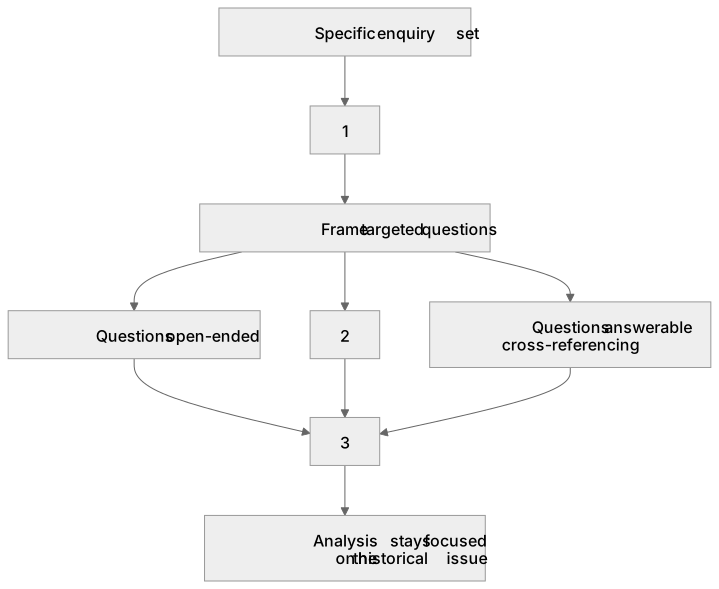
1Box 1
2Box 2
3Box 3
There is more to this lesson
The full lesson goes on to check your understanding and help you earn the marks. Create a free account to carry on, with your progress saved.
A week of Premium from your first lesson · Then the free plan continues · No card, no charge
Test your understanding of Option 10: The historic environment - 2 Knowledge, selection and use of sources for historical enquiries: Framing of questions relevant to the pursuit of a specific enquiry.
Active recall beats re-reading. Take an instant quiz now to test what you’ve learned and lock it into long-term memory.
A week of Premium from your first lesson · Then the free plan continues · No card, no charge