Pearson Edexcel · GCSE · History
Course version: 1HI0 · Version from Sept 2016
The historic environment - 2 Knowledge, selection and use of sources for…
Full specification wording
Option 10: The historic environment - 2 Knowledge, selection and use of sources for historical enquiries: Selection of appropriate sources for specific investigations.
This involves considering the nature, origin, and purpose of a source.
Checked against the Pearson Edexcel 1HI0 specification (opens in a new tab) on .
- Point 5 of 5
- 4 key terms
Study notes
From the checked teaching notes for this specification point.
The idea
This involves considering the nature, origin, and purpose of a source.
For example: If investigating the treatment of wounded soldiers in the trenches, a medical officer's diary (a primary, personal account) might provide detailed, candid insights into daily challenges, whereas an official government report might offer statistical data but lack emotional reality or be censored for morale.
What earns the marks
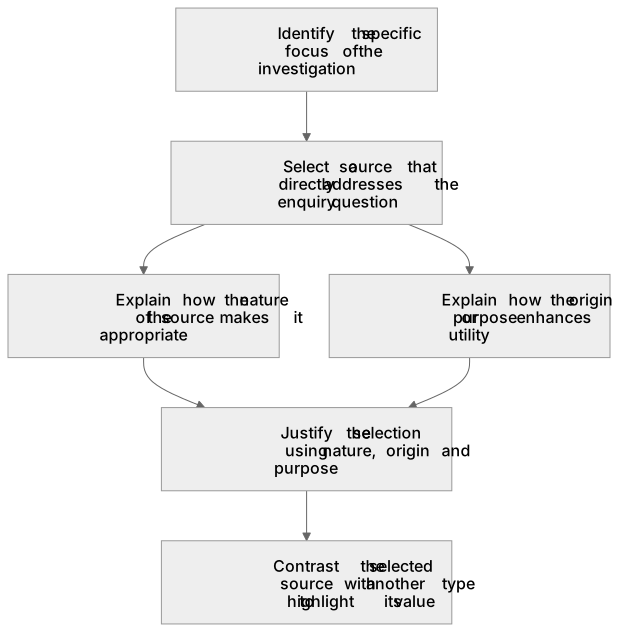
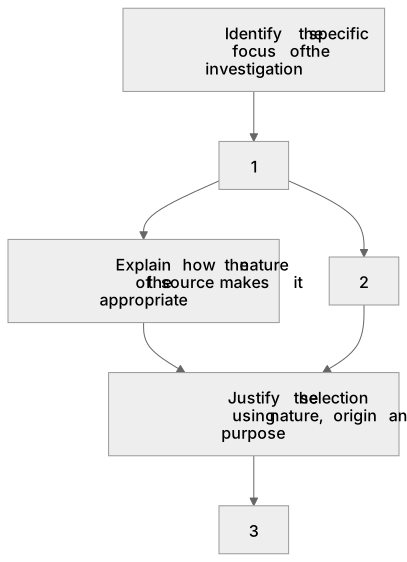
- Identify the specific focus of the historical investigation.
- Select a source that directly addresses the enquiry question.
- Explain how the nature (what it is) of the source makes it appropriate for the investigation.
- Explain how the origin (who, when, where) or purpose (why it was made) enhances its utility for the specific enquiry.
- Contrast the selected source with another type to highlight its specific value.
Common mistakes and how to put them right
Selecting a source based on general usefulness rather than the specific investigation.
Put it right: Link the source's utility directly to the specific enquiry question asked.
Dismissing a source entirely because it is biased.
Put it right: Recognise that biased sources are highly appropriate for investigating attitudes, propaganda, or opinions.
Describing the content of the source without explaining why it is an appropriate choice.
Put it right: Focus on how the source's provenance and nature make it suitable for the specific investigation.
Exam tips
- Always read the specific enquiry question carefully before evaluating which source is most appropriate.
- Use the formula 'Nature, Origin, Purpose' (NOP) to structure your explanation of why a source is selected.
- Provide a concrete example of what the selected source might reveal that another source type might miss.
Try the lesson
The start of the Option 10: The historic environment - 2 Knowledge, selection and use of sources for historical enquiries: Selection of appropriate sources for specific investigations. lesson, made from checked teaching notes for this specification point.
Have a go first
A historian is investigating the types of wounds suffered by soldiers on the Western Front. Which source would be most appropriate for this specific enquiry?
Listen
This involves considering the nature, origin, and purpose of a source. For example, if investigating the treatment of wounded soldiers in the trenches, a medical officer's diary (a primary, personal account) might provide detailed, candid insights into daily challenges, whereas an official government report might offer statistical data but lack emotional reality or be censored for morale. A strong answer earns marks for these points. Identify the specific focus of the historical investigation. Select a source that directly addresses the enquiry question. Explain how the nature (what it is) of the source makes it appropriate for the investigation. Explain how the origin (who, when, where) or purpose (why it was made) enhances its utility for the specific enquiry. A common slip: Selecting a source based on general usefulness rather than the specific investigation. Instead, link the source's utility directly to the specific enquiry question asked. Exam tip: Always read the specific enquiry question carefully before evaluating which source is most appropriate.
See it
Key words
Say what each word means before you turn the card.
Historical enquiry
Try answering aloud or in your head before turning the card.
Provenance (Nature, Origin, Purpose)
Try answering aloud or in your head before turning the card.
Source evaluation
Try answering aloud or in your head before turning the card.
Evidence selection
Try answering aloud or in your head before turning the card.
See every definition
- Historical enquiry
- A specific historical investigation with a particular focus that a source must directly address.
- Provenance (Nature, Origin, Purpose)
- The nature of a source, meaning what it is, and its origin and purpose, which explain why it is appropriate for an investigation.
- Source evaluation
- Considering the nature, origin and purpose of a source to judge how useful different types of evidence are for answering an enquiry question.
- Evidence selection
- Matching a source's strengths to the specific focus of the investigation and explaining why its characteristics make it relevant and valuable.
Label the diagram
Some boxes have lost their names. Pick the right name for each number.
1Box 1
2Box 2
3Box 3
There is more to this lesson
The full lesson goes on to check your understanding and help you earn the marks. Create a free account to carry on, with your progress saved.
A week of Premium from your first lesson · Then the free plan continues · No card, no charge
Test your understanding of Option 10: The historic environment - 2 Knowledge, selection and use of sources for historical enquiries: Selection of appropriate sources for specific investigations.
Active recall beats re-reading. Take an instant quiz now to test what you’ve learned and lock it into long-term memory.
A week of Premium from your first lesson · Then the free plan continues · No card, no charge