Pearson Edexcel · GCSE · History
Course version: 1HI0 · Version from Sept 2016
C1250–c1500: Medicine in medieval England - 1 Ideas about the cause of…
Full specification wording
Option 11: c1250–c1500: Medicine in medieval England - 1 Ideas about the cause of disease and illness: Rational explanations: the Theory of the Four Humours and the miasma theory; the continuing influence in England of Galen.
Medieval medicine also relied on rational explanations, primarily the Theory of the Four Humours and miasma theory.
Checked against the Pearson Edexcel 1HI0 specification (opens in a new tab) on .
- Point 2 of 2
- 4 key terms
Study notes
From the checked teaching notes for this specification point.
The idea
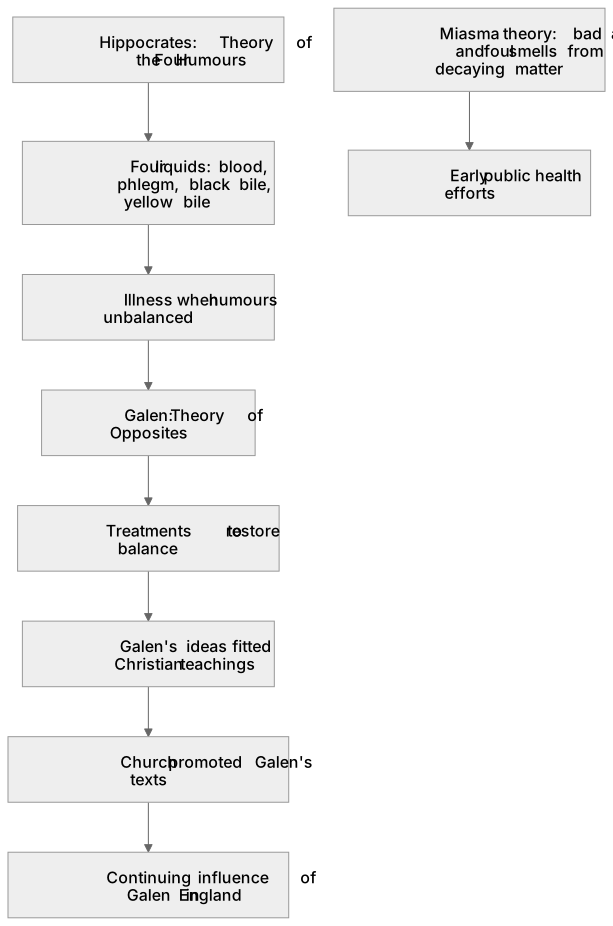
Medieval medicine also relied on rational explanations, primarily the Theory of the Four Humours and miasma theory. Developed by Hippocrates, the humoral theory posited that the body contained four liquids (blood, phlegm, black bile, yellow bile); illness occurred when these were unbalanced. Galen expanded this with his 'Theory of Opposites', suggesting treatments to restore balance, like using a cold remedy for a fever. Galen's continuing influence in England was immense because his design-focused ideas fitted Christian teachings, leading the Church to promote his texts. Additionally, the miasma theory explained disease as being caused by 'bad air' filled with harmful smells from decaying matter, prompting early public health efforts.
What earns the marks
- Define the Theory of the Four Humours (blood, phlegm, black bile, yellow bile) and the concept of imbalance causing disease.
- Explain the miasma theory as the belief that disease was transmitted by bad air or foul smells.
- Describe Galen's contribution, specifically the Theory of Opposites used to treat humoral imbalances.
- Explain why Galen's influence continued in England, focusing on the Church's endorsement of his ideas.
- Recognise that these 'rational' theories were logical based on the observations of the time, despite being scientifically incorrect.
Common mistakes and how to put them right
Attributing the original Theory of the Four Humours to Galen.
Put it right: State that Hippocrates created the Theory of the Four Humours, while Galen developed the Theory of Opposites.
Treating miasma as a supernatural belief.
Put it right: Categorise miasma as a rational explanation, as it relied on physical observation of smells and dirt.
Stating Galen was English.
Put it right: Clarify that Galen was a Roman physician whose texts had a continuing influence in medieval England.
Exam tips
- Use the term 'rational' to describe theories based on observation and logic, contrasting them with supernatural beliefs.
- When explaining Galen's influence, always link it to the power of the Catholic Church and its control over education.
- Be prepared to explain how the Theory of the Four Humours linked to the seasons and elements.
Try the lesson
The start of the Option 11: c1250–c1500: Medicine in medieval England - 1 Ideas about the cause of disease and illness: Rational explanations: the Theory of the Four Humours and the miasma theory; the continuing influence in England of Galen. lesson, made from checked teaching notes for this specification point.
Have a go first
According to the Theory of the Four Humours, what caused a person to become ill?
Listen
Medieval medicine also relied on rational explanations, primarily the Theory of the Four Humours and miasma theory. Developed by Hippocrates, the humoral theory posited that the body contained four liquids (blood, phlegm, black bile, yellow bile); illness occurred when these were unbalanced. Galen expanded this with his 'Theory of Opposites', suggesting treatments to restore balance, like using a cold remedy for a fever. Galen's continuing influence in England was immense because his design-focused ideas fitted Christian teachings, leading the Church to promote his texts. Additionally, the miasma theory explained disease as being caused by 'bad air' filled with harmful smells from decaying matter, prompting early public health efforts. A strong answer earns marks for these points. Define the Theory of the Four Humours (blood, phlegm, black bile, yellow bile) and the concept of imbalance causing disease. Explain the miasma theory as the belief that disease was transmitted by bad air or foul smells. Describe Galen's contribution, specifically the Theory of Opposites used to treat humoral imbalances. Explain why Galen's influence continued in England, focusing on the Church's endorsement of his ideas. A common slip: Attributing the original Theory of the Four Humours to Galen. Instead, State that Hippocrates created the Theory of the Four Humours, while Galen developed the Theory of Opposites. Exam tip: Use the term 'rational' to describe theories based on observation and logic, contrasting them with supernatural beliefs.
See it
Key words
Say what each word means before you turn the card.
Rational medicine
Try answering aloud or in your head before turning the card.
Theory of the Four Humours
Try answering aloud or in your head before turning the card.
Miasma theory
Try answering aloud or in your head before turning the card.
Theory of Opposites
Try answering aloud or in your head before turning the card.
See every definition
- Rational medicine
- Explanations based on observation and logic, contrasting with supernatural beliefs.
- Theory of the Four Humours
- Developed by Hippocrates, it posited that the body contained four liquids and that illness occurred when these were unbalanced.
- Miasma theory
- Explained disease as being caused by bad air filled with harmful smells from decaying matter, prompting early public health efforts.
- Theory of Opposites
- Galen expanded the humoral theory with this, suggesting treatments to restore balance, like using a cold remedy for a fever.
Label the diagram
Some boxes have lost their names. Pick the right name for each number.
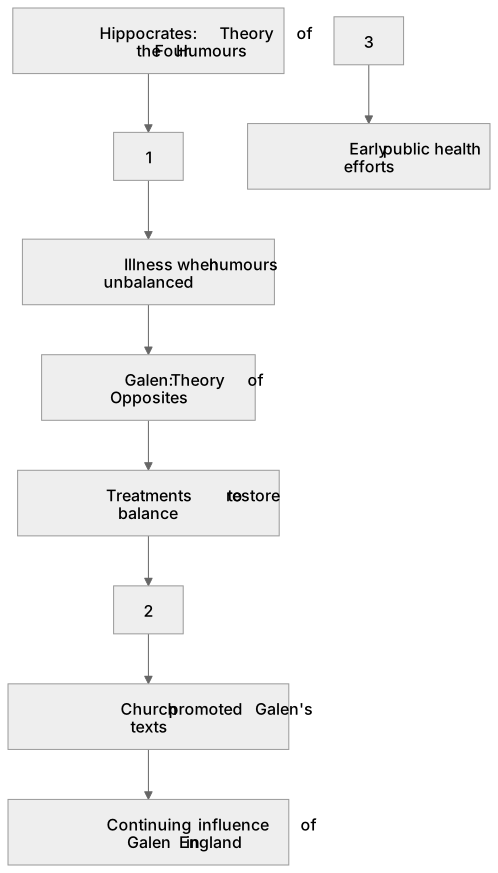
1Box 1
2Box 2
3Box 3
There is more to this lesson
The full lesson goes on to check your understanding and help you earn the marks. Create a free account to carry on, with your progress saved.
A week of Premium from your first lesson · Then the free plan continues · No card, no charge
Test your understanding of Option 11: c1250–c1500: Medicine in medieval England - 1 Ideas about the cause of disease and illness: Rational explanations: the Theory of the Four Humours and the miasma theory; the continuing influence in England of Galen.
Active recall beats re-reading. Take an instant quiz now to test what you’ve learned and lock it into long-term memory.
A week of Premium from your first lesson · Then the free plan continues · No card, no charge