Pearson Edexcel · GCSE · History
Course version: 1HI0 · Version from Sept 2016
C1900–present: Medicine in modern Britain - 2 Approaches to prevention and…
Full specification wording
Option 11: c1900–present: Medicine in modern Britain - 2 Approaches to prevention and treatment: New approaches to prevention: mass vaccinations and government lifestyle campaigns.
In the twentieth and twenty-first centuries, the government took an active role in preventing disease, shifting from laissez-faire to direct intervention.
Checked against the Pearson Edexcel 1HI0 specification (opens in a new tab) on .
- Point 2 of 2
- 3 key terms
Study notes
From the checked teaching notes for this specification point.
The idea
In the twentieth and twenty-first centuries, the government took an active role in preventing disease, shifting from laissez-faire to direct intervention. Mass vaccination campaigns became a cornerstone of public health, starting with the national diphtheria campaign in 1942, followed by polio in the 1950s, drastically reducing childhood mortality. Alongside vaccinations, the government launched lifestyle campaigns to educate the public on healthy choices. Examples include the Change4Life campaign to combat obesity and various anti-smoking initiatives. These approaches demonstrate a modern understanding of disease transmission and the impact of lifestyle factors on health, showing a proactive rather than reactive approach to medicine.
What earns the marks
- Identify specific mass vaccination campaigns, such as diphtheria (1942) or polio (1956).
- Explain how government lifestyle campaigns aim to prevent illness by changing public behaviour (e.g., anti-smoking, Change4Life).
- Contrast modern government intervention with the laissez-faire attitude of the 19th century.
- Evaluate the impact of these preventative measures on public health and life expectancy.
Common mistakes and how to put them right
Confusing 19th-century smallpox vaccination with 20th-century mass vaccination campaigns.
Put it right: Ensure you focus on 20th-century examples like diphtheria and polio.
Stating that the government only treated diseases.
Put it right by emphasising the shift towards prevention through lifestyle campaigns.
Vaguely referring to 'health campaigns' without specific examples.
Put it right: Cite specific initiatives like Change4Life or Stoptober.
Exam tips
- Use specific examples of both a vaccination campaign and a lifestyle campaign to support your answers.
- Link the introduction of these campaigns to the broader theme of increased government responsibility for public health.
- When evaluating significance, discuss the reduction in mortality rates for diseases like diphtheria or polio.
Try the lesson
The start of the Option 11: c1900–present: Medicine in modern Britain - 2 Approaches to prevention and treatment: New approaches to prevention: mass vaccinations and government lifestyle campaigns. lesson, made from checked teaching notes for this specification point.
Have a go first
Which of the following was a major government lifestyle campaign introduced in the twenty-first century to prevent obesity and related illnesses?
Listen
In the twentieth and twenty-first centuries, the government took an active role in preventing disease, shifting from laissez-faire to direct intervention. Mass vaccination campaigns became a cornerstone of public health, starting with the national diphtheria campaign in 1942, followed by polio in the 1950s, drastically reducing childhood mortality. Alongside vaccinations, the government launched lifestyle campaigns to educate the public on healthy choices. Examples include the Change4Life campaign to combat obesity and various anti-smoking initiatives. These approaches demonstrate a modern understanding of disease transmission and the impact of lifestyle factors on health, showing a proactive rather than reactive approach to medicine. A strong answer earns marks for these points. Identify specific mass vaccination campaigns, such as diphtheria (1942) or polio (1956). Explain how government lifestyle campaigns aim to prevent illness by changing public behaviour (e.g., anti-smoking, Change4Life). Contrast modern government intervention with the laissez-faire attitude of the 19th century. Evaluate the impact of these preventative measures on public health and life expectancy. A common slip: Stating that the government only treated diseases. Instead, emphasising the shift towards prevention through lifestyle campaigns. Exam tip: Use specific examples of both a vaccination campaign and a lifestyle campaign to support your answers.
See it
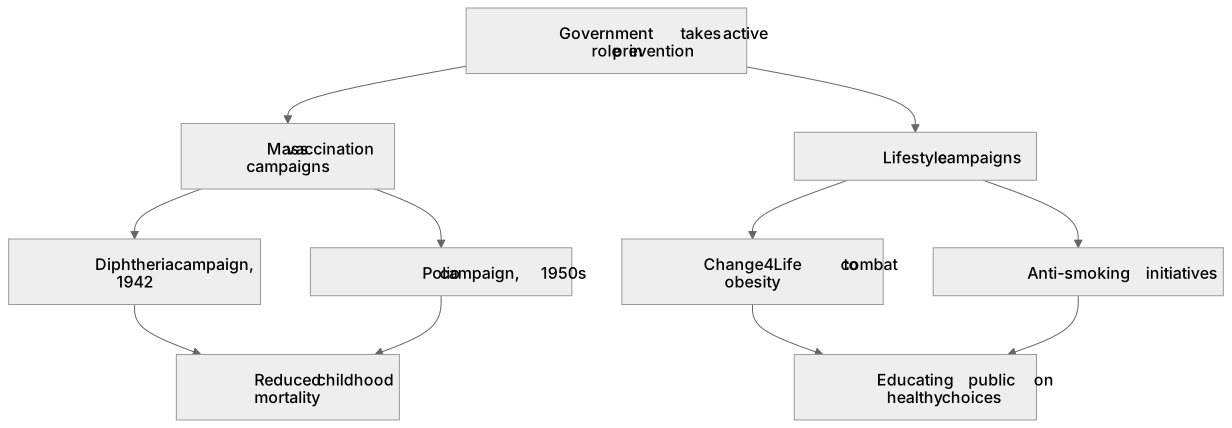
Key words
Say what each word means before you turn the card.
Government intervention
Try answering aloud or in your head before turning the card.
Preventative medicine
Try answering aloud or in your head before turning the card.
Mass vaccinations
Try answering aloud or in your head before turning the card.
See every definition
- Government intervention
- The government taking an active role in preventing disease, shifting from laissez-faire to direct intervention.
- Preventative medicine
- A proactive rather than reactive approach to medicine, shown by modern understanding of disease transmission and lifestyle factors.
- Mass vaccinations
- Campaigns such as the national diphtheria campaign in 1942 and polio in the 1950s, which drastically reduced childhood mortality.
Label the diagram
Some boxes have lost their names. Pick the right name for each number.
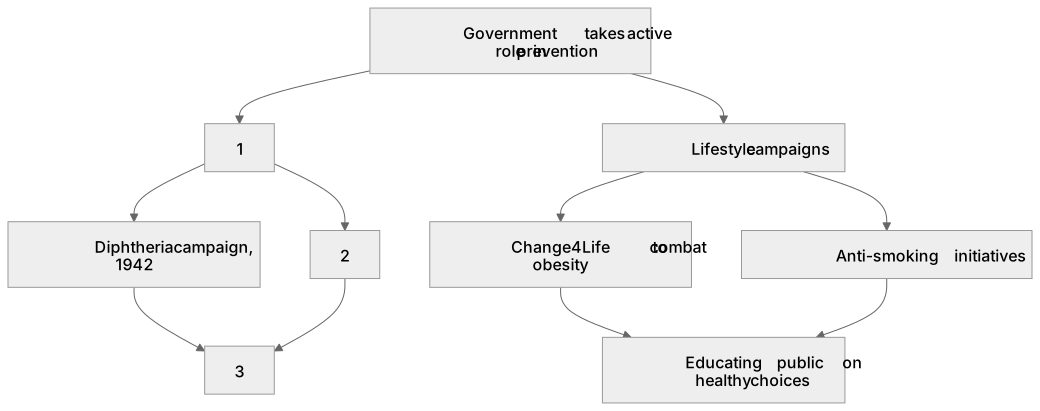
1Box 1
2Box 2
3Box 3
There is more to this lesson
The full lesson goes on to check your understanding and help you earn the marks. Create a free account to carry on, with your progress saved.
A week of Premium from your first lesson · Then the free plan continues · No card, no charge
Test your understanding of Option 11: c1900–present: Medicine in modern Britain - 2 Approaches to prevention and treatment: New approaches to prevention: mass vaccinations and government lifestyle campaigns.
Active recall beats re-reading. Take an instant quiz now to test what you’ve learned and lock it into long-term memory.
A week of Premium from your first lesson · Then the free plan continues · No card, no charge