Pearson Edexcel · GCSE · History
Course version: 1HI0 · Version from Sept 2016
The historic environment - 1 The British sector of the Western Front,…
Full specification wording
Option 11: The historic environment - 1 The British sector of the Western Front, 1914–18: injuries, treatment and the trenches: The historical context of medicine in the early twentieth century: the understanding of infection and moves towards aseptic surgery; the development of x-rays; blood transfusions and developments in the storage of blood.
Understanding the historical context of early twentieth-century medicine is crucial.
Checked against the Pearson Edexcel 1HI0 specification (opens in a new tab) on .
- Point 5 of 5
- 4 key terms
Study notes
From the checked teaching notes for this specification point.
The idea
Understanding the historical context of early twentieth-century medicine is crucial. By 1914, the understanding of infection had advanced, leading to moves towards aseptic surgery, where operating theatres and instruments were sterilised to prevent bacteria entering wounds. The development of x-rays following Wilhelm Röntgen's 1895 discovery allowed doctors to diagnose internal injuries without invasive surgery, though early machines were fragile. Blood transfusions were also evolving; Karl Landsteiner's discovery of blood groups in 1901 made transfusions safer. Subsequent developments in the storage of blood, such as adding sodium citrate to prevent clotting, paved the way for indirect transfusions during the war.
What earns the marks
- Describe the shift from antiseptic to aseptic surgery in the early twentieth century.
- Explain how the discovery of x-rays improved diagnostic medicine before the First World War.
- Identify the discovery of blood groups as a key turning point in making blood transfusions safer.
- Explain how the use of sodium citrate allowed blood to be stored, transforming transfusion methods.
Common mistakes and how to put them right
Confusing antiseptic and aseptic surgery.
Put it right: Antiseptic surgery kills germs already present in a wound, whereas aseptic surgery aims to create a completely germ-free environment before surgery begins.
Believing x-rays were invented during the First World War.
Put it right: X-rays were discovered by Röntgen in 1895 and were already being used in hospitals before the war started.
Stating that blood could be stored indefinitely in the early 1900s.
Put it right: Blood could only be stored for a few days using sodium citrate, and refrigeration was required to extend this to a few weeks.
Exam tips
- Use the context of pre-war medicine to explain why certain medical problems on the Western Front were so challenging to solve.
- Clearly distinguish between the discovery of blood groups (1901) and the later ability to store blood using sodium citrate (1915).
- Mention that while aseptic surgery was the pre-war ideal, the muddy conditions of the trenches often forced surgeons to revert to chemical antiseptics.
Try the lesson
The start of the Option 11: The historic environment - 1 The British sector of the Western Front, 1914–18: injuries, treatment and the trenches: The historical context of medicine in the early twentieth century: the understanding of infection and moves towards aseptic surgery; the development of x-rays; blood transfusions and developments in the storage of blood. lesson, made from checked teaching notes for this specification point.
Have a go first
Which of the following practices was a key feature of the move towards aseptic surgery in the early twentieth century?
Listen
Understanding the historical context of early twentieth-century medicine is crucial. By 1914, the understanding of infection had advanced, leading to moves towards aseptic surgery, where operating theatres and instruments were sterilised to prevent bacteria entering wounds. The development of x-rays following Wilhelm Röntgen's 1895 discovery allowed doctors to diagnose internal injuries without invasive surgery, though early machines were fragile. Blood transfusions were also evolving; Karl Landsteiner's discovery of blood groups in 1901 made transfusions safer. Subsequent developments in the storage of blood, such as adding sodium citrate to prevent clotting, paved the way for indirect transfusions during the war. A strong answer earns marks for these points. Describe the shift from antiseptic to aseptic surgery in the early twentieth century. Explain how the discovery of x-rays improved diagnostic medicine before the First World War. Identify the discovery of blood groups as a key turning point in making blood transfusions safer. Explain how the use of sodium citrate allowed blood to be stored, transforming transfusion methods. A common slip: Confusing antiseptic and aseptic surgery. Instead, Antiseptic surgery kills germs already present in a wound, whereas aseptic surgery aims to create a completely germ-free environment before surgery begins. Exam tip: Use the context of pre-war medicine to explain why certain medical problems on the Western Front were so challenging to solve.
See it
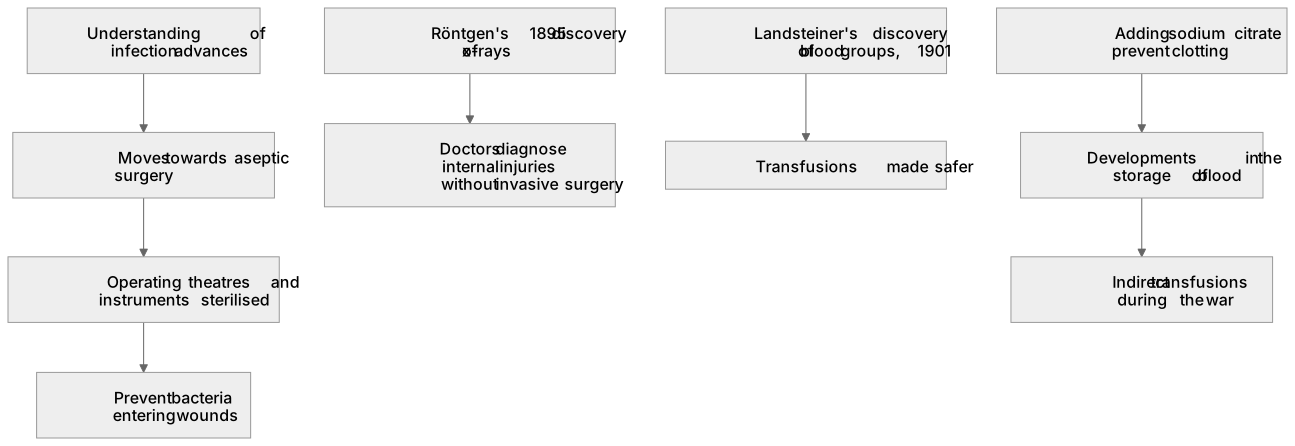
Put the events in order
Put these events in the order they happened, earliest first.
- 1. Röntgen discovered x-rays, allowing doctors to diagnose internal injuries
- 2. Sodium citrate was used to store blood
- 3. Karl Landsteiner discovered blood groups, making transfusions safer
Key words
Say what each word means before you turn the card.
Aseptic surgery
Try answering aloud or in your head before turning the card.
X-rays
Try answering aloud or in your head before turning the card.
Blood groups
Try answering aloud or in your head before turning the card.
Storage of blood
Try answering aloud or in your head before turning the card.
See every definition
- Aseptic surgery
- A move in which operating theatres and instruments were sterilised to prevent bacteria entering wounds.
- X-rays
- A development following Wilhelm Röntgen's 1895 discovery which allowed doctors to diagnose internal injuries without invasive surgery, though early machines were fragile.
- Blood groups
- Karl Landsteiner's 1901 discovery, which made transfusions safer.
- Storage of blood
- Developments such as adding sodium citrate to prevent clotting, which paved the way for indirect transfusions during the war.
Label the diagram
Some boxes have lost their names. Pick the right name for each number.
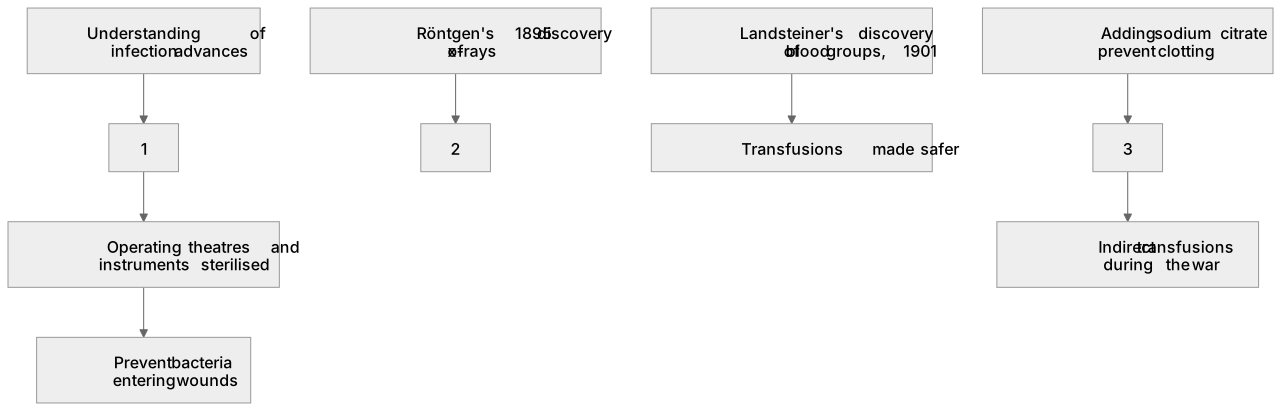
1Box 1
2Box 2
3Box 3
There is more to this lesson
The full lesson goes on to check your understanding and help you earn the marks. Create a free account to carry on, with your progress saved.
A week of Premium from your first lesson · Then the free plan continues · No card, no charge
Test your understanding of Option 11: The historic environment - 1 The British sector of the Western Front, 1914–18: injuries, treatment and the trenches: The historical context of medicine in the early twentieth century: the understanding of infection and moves towards aseptic surgery; the development of x-rays; blood transfusions and developments in the storage of blood.
Active recall beats re-reading. Take an instant quiz now to test what you’ve learned and lock it into long-term memory.
A week of Premium from your first lesson · Then the free plan continues · No card, no charge