Pearson Edexcel · GCSE · History
Course version: 1HI0 · Version from Sept 2016
The historic environment - 1 The British sector of the Western Front,…
Full specification wording
Option 11: The historic environment - 1 The British sector of the Western Front, 1914–18: injuries, treatment and the trenches: The significance of the Western Front for experiments in surgery and medicine: new techniques in the treatment of wounds and infection, the Thomas splint, the use of mobile x-ray units, the creation of a blood bank for the Battle of Cambrai.
The Western Front drove significant experiments in surgery and medicine due to the unprecedented scale of casualties.
Checked against the Pearson Edexcel 1HI0 specification (opens in a new tab) on .
- Point 4 of 5
Study notes
From the checked teaching notes for this specification point.
The idea
The Western Front drove significant experiments in surgery and medicine due to the unprecedented scale of casualties. To combat severe wound infections like gas gangrene, new techniques such as the Carrel-Dakin method and wound excision (debridement) were developed. The introduction of the Thomas splint drastically reduced the mortality rate of compound femur fractures by keeping the leg rigid during transport. Diagnostic capabilities improved with the deployment of mobile x-ray units, allowing surgeons to locate shrapnel closer to the frontline. Furthermore, the pioneering creation of a blood bank by Oswald Robertson for the Battle of Cambrai in 1917 demonstrated how stored blood could be used for life-saving transfusions on the battlefield.
What earns the marks
- Explain how the Carrel-Dakin method and debridement were used to treat infected wounds.
- Describe the impact of the Thomas splint on survival rates for soldiers with fractured femurs.
- Assess the importance of mobile x-ray units in locating shrapnel and bullets before surgery.
- Detail the significance of the blood bank created for the Battle of Cambrai in advancing transfusion practices.
Common mistakes and how to put them right
Stating that antibiotics like penicillin were used to treat infections.
Put it right: Antibiotics were not available during the First World War; infections were treated using chemical solutions and debridement.
Claiming the Thomas splint was a new surgical operation.
Put it right: The Thomas splint was a device used to immobilise a fractured leg during transport, preventing further internal damage and blood loss.
Assuming blood transfusions were entirely new to the First World War.
Put it right: Transfusions existed before the war, but the innovation at Cambrai was the storage of blood (a blood bank) using sodium citrate.
Exam tips
- Always link a medical innovation to the specific problem it solved, such as the Thomas splint solving the high death rate from femur fractures.
- Use the Battle of Cambrai as a specific case study when discussing the development of blood storage and transfusions.
- Remember that mobile x-ray units had limitations, such as overheating and requiring the engine to run to generate power.
Try the lesson
The start of the Option 11: The historic environment - 1 The British sector of the Western Front, 1914–18: injuries, treatment and the trenches: The significance of the Western Front for experiments in surgery and medicine: new techniques in the treatment of wounds and infection, the Thomas splint, the use of mobile x-ray units, the creation of a blood bank for the Battle of Cambrai. lesson, made from checked teaching notes for this specification point.
Have a go first
What was the primary medical purpose of the Thomas splint when it was introduced on the Western Front?
Listen
The Western Front drove significant experiments in surgery and medicine due to the unprecedented scale of casualties. To combat severe wound infections like gas gangrene, new techniques such as the Carrel-Dakin method and wound excision (debridement) were developed. The introduction of the Thomas splint drastically reduced the mortality rate of compound femur fractures by keeping the leg rigid during transport. Diagnostic capabilities improved with the deployment of mobile x-ray units, allowing surgeons to locate shrapnel closer to the frontline. Furthermore, the pioneering creation of a blood bank by Oswald Robertson for the Battle of Cambrai in 1917 demonstrated how stored blood could be used for life-saving transfusions on the battlefield. A strong answer earns marks for these points. Explain how the Carrel-Dakin method and debridement were used to treat infected wounds. Describe the impact of the Thomas splint on survival rates for soldiers with fractured femurs. Assess the importance of mobile x-ray units in locating shrapnel and bullets before surgery. Detail the significance of the blood bank created for the Battle of Cambrai in advancing transfusion practices. A common slip: Stating that antibiotics like penicillin were used to treat infections. Instead, Antibiotics were not available during the First World War; infections were treated using chemical solutions and debridement. Exam tip: Always link a medical innovation to the specific problem it solved, such as the Thomas splint solving the high death rate from femur fractures.
See it
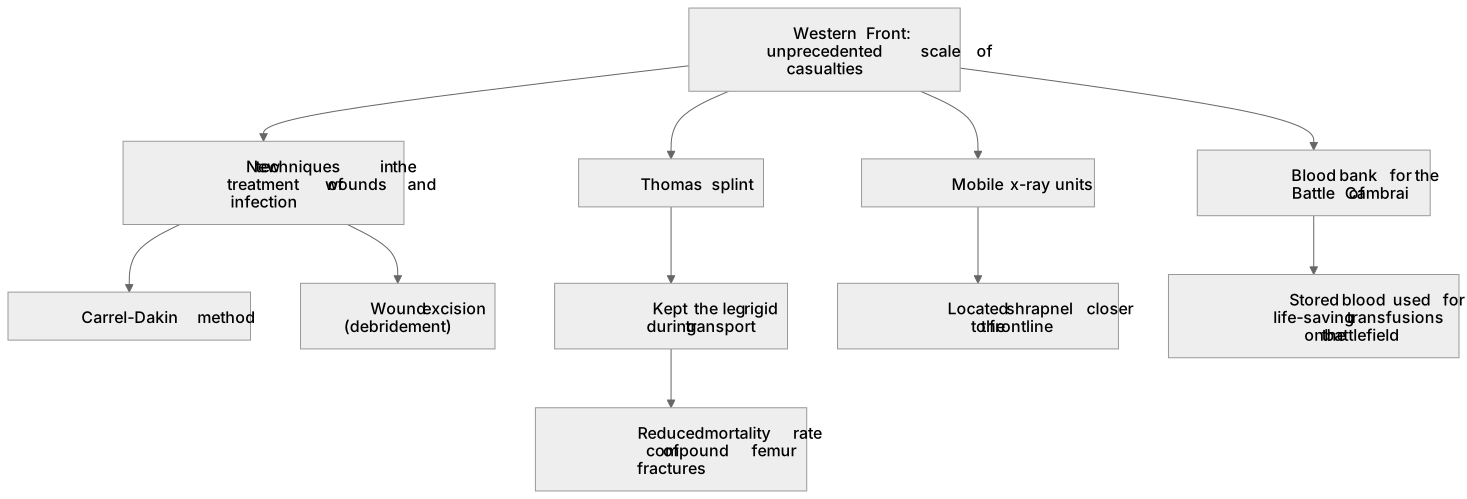
Label the diagram
Some boxes have lost their names. Pick the right name for each number.
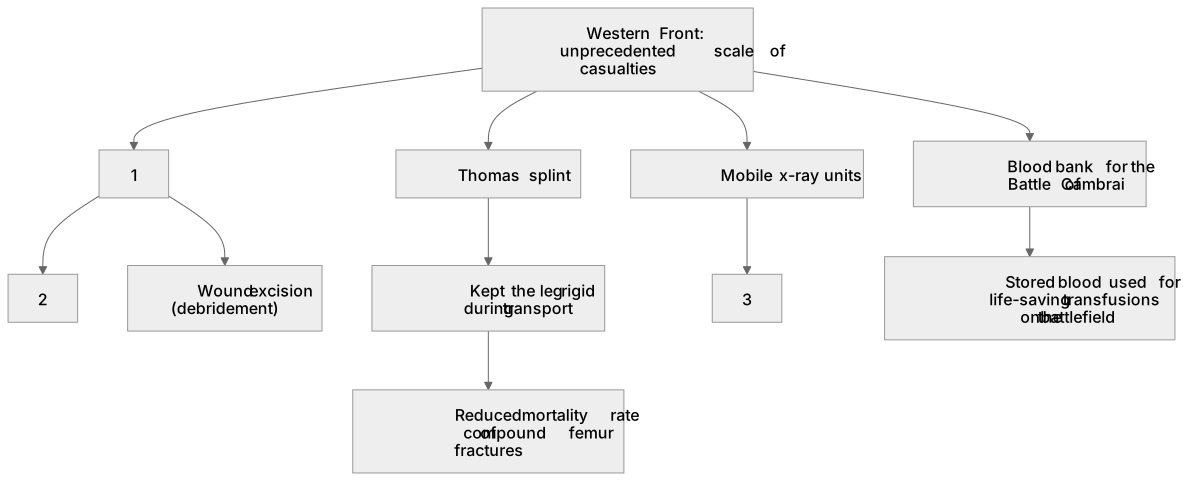
1Box 1
2Box 2
3Box 3
There is more to this lesson
The full lesson goes on to check your understanding and help you earn the marks. Create a free account to carry on, with your progress saved.
A week of Premium from your first lesson · Then the free plan continues · No card, no charge
Test your understanding of Option 11: The historic environment - 1 The British sector of the Western Front, 1914–18: injuries, treatment and the trenches: The significance of the Western Front for experiments in surgery and medicine: new techniques in the treatment of wounds and infection, the Thomas splint, the use of mobile x-ray units, the creation of a blood bank for the Battle of Cambrai.
Active recall beats re-reading. Take an instant quiz now to test what you’ve learned and lock it into long-term memory.
A week of Premium from your first lesson · Then the free plan continues · No card, no charge