Pearson Edexcel · GCSE · History
Course version: 1HI0 · Version from Sept 2016
The historic environment - 2 Knowledge, selection and use of sources for…
Full specification wording
Option 11: The historic environment - 2 Knowledge, selection and use of sources for historical enquiries: Knowledge of local sources relevant to the period and issue, e.g. personal accounts, photographs, hospital records, army statistics.
To investigate the historic environment effectively, historians rely on diverse local materials that provide specific details about the period and issue.
Checked against the Pearson Edexcel 1HI0 specification (opens in a new tab) on .
- Point 2 of 5
Study notes
From the checked teaching notes for this specification point.
The idea
To investigate the historic environment effectively, historians rely on diverse local materials that provide specific details about the period and issue. Personal accounts, such as diaries, offer subjective insights into individual experiences. Photographs capture visual evidence of conditions, though they may be framed selectively. Hospital records supply clinical data on injuries, treatments, and patient outcomes, while army statistics deliver quantitative overviews of casualty rates or troop movements. By combining these materials, students can build a comprehensive picture of the local context, cross-referencing qualitative personal stories with quantitative official data to form robust historical conclusions.
What earns the marks
- Identify specific types of local evidence applicable to the historical enquiry.
- Explain how personal accounts provide insight into individual attitudes and experiences.
- Analyse photographs for visual details regarding the physical environment or conditions.
- Utilise hospital records and army statistics to extract factual, quantitative data.
- Demonstrate how combining different types of evidence creates a more accurate historical picture.
Common mistakes and how to put them right
Treating photographs as objective, unquestionable truth.
Put it right: Consider the photographer's purpose and what might be excluded from the frame.
Dismissing personal accounts as entirely unreliable due to bias.
Put it right: Recognise that subjective views are valuable for understanding contemporary attitudes and morale.
Using army statistics without considering their context or potential for manipulation.
Put it right: Evaluate who compiled the statistics and for what purpose before drawing conclusions.
Exam tips
- When asked to follow up a source, explicitly name a specific type of local record (e.g., 'hospital admission registers') rather than just saying 'more records'.
- Explain exactly what information you would expect to find in the chosen local material and how it helps answer your enquiry.
- Remember that official statistics and personal diaries serve different purposes; contrast them to show a deep understanding of evidence.
Try the lesson
The start of the Option 11: The historic environment - 2 Knowledge, selection and use of sources for historical enquiries: Knowledge of local sources relevant to the period and issue, e.g. personal accounts, photographs, hospital records, army statistics. lesson, made from checked teaching notes for this specification point.
Have a go first
Which of the following is an example of a local source that could provide direct information about medical treatments on the Western Front?
Listen
To investigate the historic environment effectively, historians rely on diverse local materials that provide specific details about the period and issue. Personal accounts, such as diaries, offer subjective insights into individual experiences. Photographs capture visual evidence of conditions, though they may be framed selectively. Hospital records supply clinical data on injuries, treatments, and patient outcomes, while army statistics deliver quantitative overviews of casualty rates or troop movements. By combining these materials, students can build a comprehensive picture of the local context, cross-referencing qualitative personal stories with quantitative official data to form robust historical conclusions. A strong answer earns marks for these points. Identify specific types of local evidence applicable to the historical enquiry. Explain how personal accounts provide insight into individual attitudes and experiences. Analyse photographs for visual details regarding the physical environment or conditions. Utilise hospital records and army statistics to extract factual, quantitative data. A common slip: Treating photographs as objective, unquestionable truth. Instead, consider the photographer's purpose and what might be excluded from the frame. Exam tip: When asked to follow up a source, explicitly name a specific type of local record (e.g., 'hospital admission registers') rather than just saying 'more records'.
See it
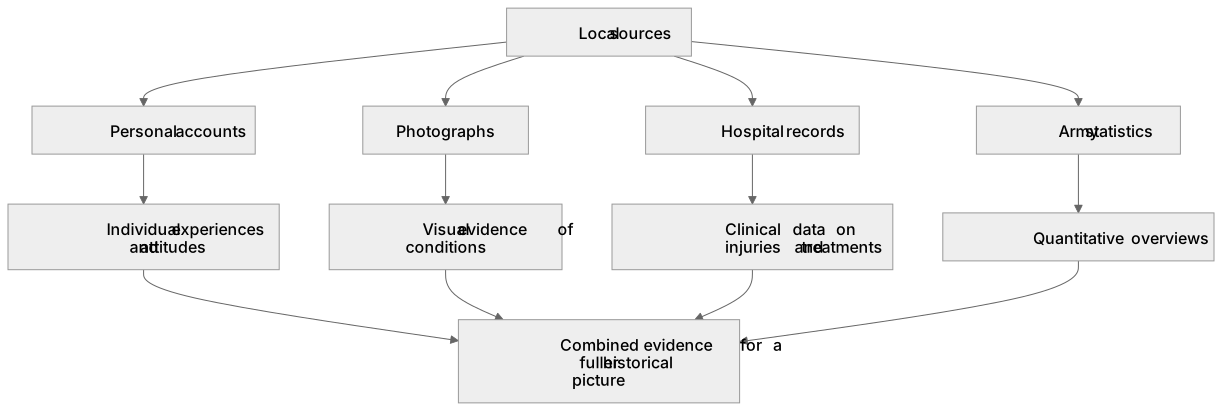
Label the diagram
Some boxes have lost their names. Pick the right name for each number.
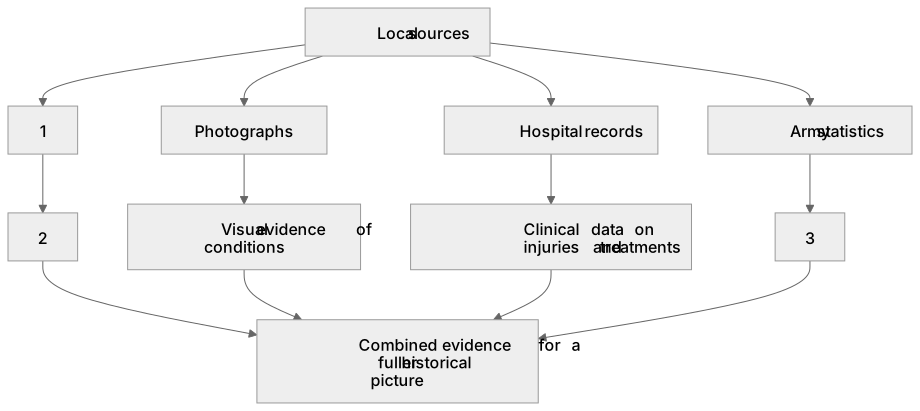
1Box 1
2Box 2
3Box 3
There is more to this lesson
The full lesson goes on to check your understanding and help you earn the marks. Create a free account to carry on, with your progress saved.
A week of Premium from your first lesson · Then the free plan continues · No card, no charge
Test your understanding of Option 11: The historic environment - 2 Knowledge, selection and use of sources for historical enquiries: Knowledge of local sources relevant to the period and issue, e.g. personal accounts, photographs, hospital records, army statistics.
Active recall beats re-reading. Take an instant quiz now to test what you’ve learned and lock it into long-term memory.
A week of Premium from your first lesson · Then the free plan continues · No card, no charge