Pearson Edexcel · GCSE · History
Course version: 1HI0 · Version from Sept 2016
The historic environment - 2 Knowledge, selection and use of sources for…
Full specification wording
Option 11: The historic environment - 2 Knowledge, selection and use of sources for historical enquiries: Recognition of the strengths and weaknesses of different types of source for specific enquiries.
Evaluating historical evidence requires a clear understanding of the inherent strengths and weaknesses of different types of material when applied to specific enquiries.
Checked against the Pearson Edexcel 1HI0 specification (opens in a new tab) on .
- Point 3 of 5
- 2 key terms
Study notes
From the checked teaching notes for this specification point.
The idea
Evaluating historical evidence requires a clear understanding of the inherent strengths and weaknesses of different types of material when applied to specific enquiries. A government report might offer excellent statistical breadth (a strength) but lack insight into the daily suffering of individuals (a weakness). Conversely, a soldier's diary provides deep personal perspective but cannot represent the experiences of an entire army. By weighing these factors, historians determine whether a piece of evidence is reliable and relevant enough to support a specific historical claim or if it requires corroboration.
What earns the marks
- Identify the specific type of evidence being analysed (e.g., official report, personal letter).
- Articulate at least one inherent strength of the material type in relation to the specific enquiry.
- Articulate at least one inherent weakness or limitation of the material type for the specific enquiry.
- Explain how the origin and purpose of the document influence its overall utility.
- Suggest how the weaknesses of one piece of evidence can be mitigated by cross-referencing with another.
Common mistakes and how to put them right
Stating a document is useless simply because it is biased.
Put it right: Explain how the bias itself provides useful evidence about the author's motives or contemporary attitudes.
Providing generic strengths and weaknesses that do not relate to the specific enquiry.
Put it right: Link the evaluation directly to the question being asked.
Assuming primary evidence is always more reliable than secondary evidence.
Put it right: Evaluate each item on its own merits, considering factors like hindsight and access to official records.
Exam tips
- Use the specific details of the enquiry to frame your evaluation of the evidence's utility.
- Avoid generic phrases like 'it is biased so it is unreliable'; instead, explain exactly how the author's viewpoint affects the information provided.
- Consider what is missing from the evidence as a key weakness, and suggest what other material could fill that gap.
Try the lesson
The start of the Option 11: The historic environment - 2 Knowledge, selection and use of sources for historical enquiries: Recognition of the strengths and weaknesses of different types of source for specific enquiries. lesson, made from checked teaching notes for this specification point.
Have a go first
What is a common weakness of using a single soldier's diary to understand the overall success of a major battle?
Listen
Evaluating historical evidence requires a clear understanding of the inherent strengths and weaknesses of different types of material when applied to specific enquiries. A government report might offer excellent statistical breadth (a strength) but lack insight into the daily suffering of individuals (a weakness). Conversely, a soldier's diary provides deep personal perspective but cannot represent the experiences of an entire army. By weighing these factors, historians determine whether a piece of evidence is reliable and relevant enough to support a specific historical claim or if it requires corroboration. A strong answer earns marks for these points. Identify the specific type of evidence being analysed (e.g., official report, personal letter). Articulate at least one inherent strength of the material type in relation to the specific enquiry. Articulate at least one inherent weakness or limitation of the material type for the specific enquiry. Explain how the origin and purpose of the document influence its overall utility. A common slip: Stating a document is useless simply because it is biased. Instead, Explain how the bias itself provides useful evidence about the author's motives or contemporary attitudes. Exam tip: Use the specific details of the enquiry to frame your evaluation of the evidence's utility.
See it
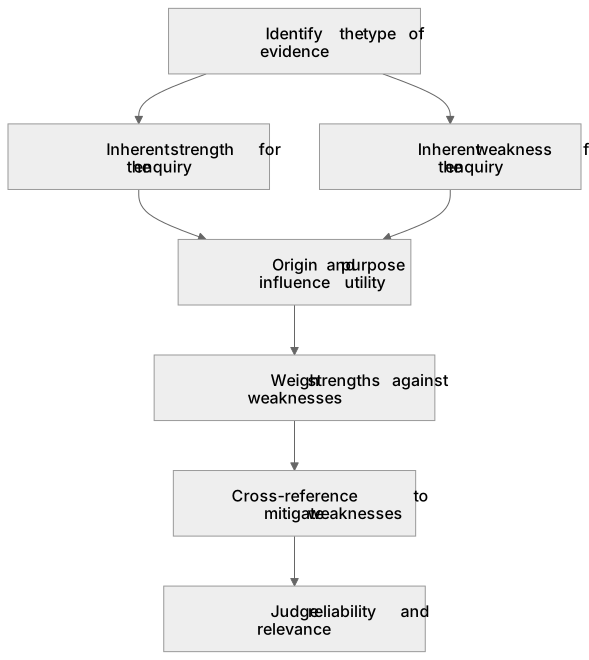
Key words
Say what each word means before you turn the card.
Source evaluation
Try answering aloud or in your head before turning the card.
Nature, origin, and purpose
Try answering aloud or in your head before turning the card.
See every definition
- Source evaluation
- Recognition of the strengths and weaknesses of different types of source for specific enquiries.
- Nature, origin, and purpose
- Factors of a document that students must assess to determine how they affect its utility for a particular question.
Label the diagram
Some boxes have lost their names. Pick the right name for each number.
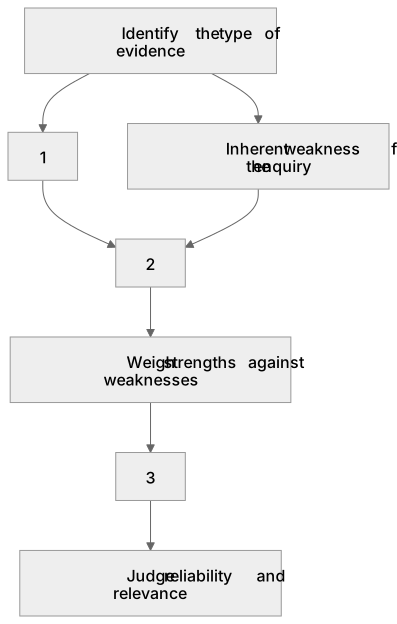
1Box 1
2Box 2
3Box 3
There is more to this lesson
The full lesson goes on to check your understanding and help you earn the marks. Create a free account to carry on, with your progress saved.
A week of Premium from your first lesson · Then the free plan continues · No card, no charge
Test your understanding of Option 11: The historic environment - 2 Knowledge, selection and use of sources for historical enquiries: Recognition of the strengths and weaknesses of different types of source for specific enquiries.
Active recall beats re-reading. Take an instant quiz now to test what you’ve learned and lock it into long-term memory.
A week of Premium from your first lesson · Then the free plan continues · No card, no charge