Pearson Edexcel · GCSE · History
Course version: 1HI0 · Version from Sept 2016
The historic environment - 2 Knowledge, selection and use of sources for…
Full specification wording
Option 11: The historic environment - 2 Knowledge, selection and use of sources for historical enquiries: Selection of appropriate sources for specific investigations.
The selection of appropriate sources is fundamental to conducting specific historical investigations.
Checked against the Pearson Edexcel 1HI0 specification (opens in a new tab) on .
- Point 5 of 5
- 2 key terms
Study notes
From the checked teaching notes for this specification point.
The idea
The selection of appropriate sources is fundamental to conducting specific historical investigations. Historians must match the type of evidence to the precise nature of their enquiry. If investigating the daily diet of soldiers, a quartermaster's supply log or a personal diary would be highly appropriate, whereas a general's strategic map would be irrelevant. This involves understanding the typical contents of various historical documents and justifying why a particular type of record is the most suitable choice for uncovering the desired information in a specific context.
What earns the marks
- Identify the specific information required to answer the historical investigation.
- Select a type of historical record that is highly likely to contain the required information.
- Justify the selection by explaining the typical contents and purpose of the chosen record.
- Differentiate between records that offer qualitative insights versus those providing quantitative data.
- Explain why alternative types of evidence might be less appropriate for the specific investigation.
Common mistakes and how to put them right
Suggesting a generic source like 'a history book' or 'the internet'.
Put it right: Specify a primary historical record relevant to the period, such as 'trench maps' or 'medical officer reports'.
Selecting a source that is irrelevant to the specific detail being investigated.
Put it right: Ensure a direct logical link between the question asked and the type of document chosen.
Failing to explain why the chosen source is appropriate.
Put it right: Provide a justification detailing what specific information the source is expected to yield.
Exam tips
- Memorise specific examples of records relevant to the historic environment (e.g., RAMC records, service records, national newspaper archives).
- When proposing a source for a follow-up enquiry, explicitly state what you expect to find in it and how it answers your question.
- Be as specific as possible; instead of 'government records', use 'Ministry of Munitions employment statistics'.
Try the lesson
The start of the Option 11: The historic environment - 2 Knowledge, selection and use of sources for historical enquiries: Selection of appropriate sources for specific investigations. lesson, made from checked teaching notes for this specification point.
Have a go first
Which source would be most appropriate for an investigation into the layout and structure of a trench system?
Listen
The selection of appropriate sources is fundamental to conducting specific historical investigations. Historians must match the type of evidence to the precise nature of their enquiry. If investigating the daily diet of soldiers, a quartermaster's supply log or a personal diary would be highly appropriate, whereas a general's strategic map would be irrelevant. This involves understanding the typical contents of various historical documents and justifying why a particular type of record is the most suitable choice for uncovering the desired information in a specific context. A strong answer earns marks for these points. Identify the specific information required to answer the historical investigation. Select a type of historical record that is highly likely to contain the required information. Justify the selection by explaining the typical contents and purpose of the chosen record. Differentiate between records that offer qualitative insights versus those providing quantitative data. A common slip: Suggesting a generic source like 'a history book' or 'the internet'. Instead, specify a primary historical record relevant to the period, such as 'trench maps' or 'medical officer reports'. Exam tip: Memorise specific examples of records relevant to the historic environment (e.g., RAMC records, service records, national newspaper archives).
See it
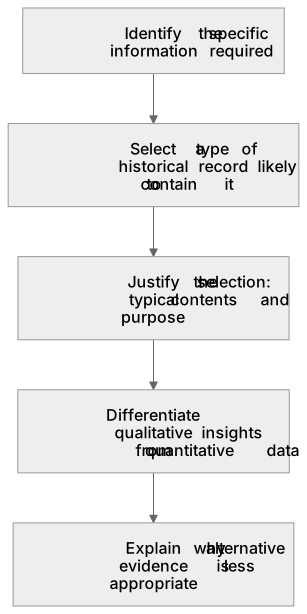
Put it in order
Put these steps in the order they happen.
- 1. Select a type of historical record likely to contain it
- 2. Justify the selection: typical contents and purpose
- 3. Identify the specific information required
- 4. Explain why alternative evidence is less appropriate
- 5. Differentiate qualitative insights from quantitative data
Key words
Say what each word means before you turn the card.
Source selection
Try answering aloud or in your head before turning the card.
Evidence matching
Try answering aloud or in your head before turning the card.
See every definition
- Source selection
- Choosing appropriate sources for specific investigations by matching the type of evidence to the precise nature of the enquiry.
- Evidence matching
- Matching the type of evidence to the precise nature of the enquiry, ensuring a direct logical link between the question asked and the type of document chosen.
Label the diagram
Some boxes have lost their names. Pick the right name for each number.
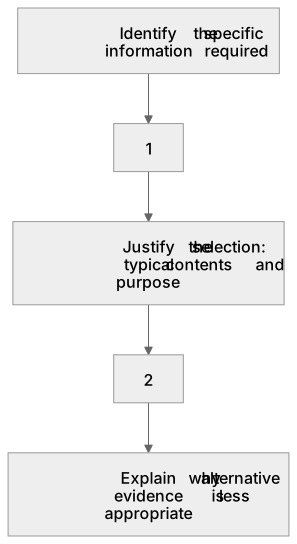
1Box 1
2Box 2
There is more to this lesson
The full lesson goes on to check your understanding and help you earn the marks. Create a free account to carry on, with your progress saved.
A week of Premium from your first lesson · Then the free plan continues · No card, no charge
Test your understanding of Option 11: The historic environment - 2 Knowledge, selection and use of sources for historical enquiries: Selection of appropriate sources for specific investigations.
Active recall beats re-reading. Take an instant quiz now to test what you’ve learned and lock it into long-term memory.
A week of Premium from your first lesson · Then the free plan continues · No card, no charge