Pearson Edexcel · GCSE · History
Course version: 1HI0 · Version from Sept 2016
The historic environment - 2 Knowledge, selection and use of sources for…
Full specification wording
Option 11: The historic environment - 2 Knowledge, selection and use of sources for historical enquiries: Framing of questions relevant to the pursuit of a specific enquiry.
A crucial skill in historical investigation is the framing of precise questions that drive a specific enquiry forward.
Checked against the Pearson Edexcel 1HI0 specification (opens in a new tab) on .
- Point 4 of 5
- 3 key terms
Study notes
From the checked teaching notes for this specification point.
The idea
A crucial skill in historical investigation is the framing of precise questions that drive a specific enquiry forward. When examining a piece of evidence, historians must identify gaps in their knowledge and formulate targeted questions to uncover missing information. For example, if a photograph shows injured soldiers, a relevant question might be 'What specific medical treatments were administered to these men?' rather than a vague query like 'What happened next?'. Effective questions are focused, directly related to the overarching enquiry, and capable of being answered by consulting further historical records. This process demonstrates an active engagement with the evidence and a clear understanding of the research objective.
What earns the marks
- Identify a specific detail within the provided evidence that prompts further investigation.
- Formulate a clear, focused question that directly addresses a gap in knowledge.
- Ensure the framed question is highly relevant to the broader historical enquiry.
- Avoid vague or closed questions that only require a yes/no answer.
- Explain how answering the framed question would advance the understanding of the specific topic.
Common mistakes and how to put them right
Asking a question that is already answered by the provided evidence.
Put it right: Carefully read the material and ensure the question seeks new, supplementary information.
Framing a question that is too broad or unrelated to the specific enquiry.
Put it right: Keep the question tightly focused on the specific historical context and the detail identified in the evidence.
Asking a question that cannot realistically be answered by historical records.
Put it right: Formulate questions that point towards specific types of available archival material.
Exam tips
- When asked to suggest a follow-up question, base it directly on a specific quote or detail from the provided material.
- Ensure your question begins with 'How', 'Why', or 'What' to encourage a detailed historical investigation.
- Clearly state how finding the answer to your question will help you understand the specific enquiry better.
Try the lesson
The start of the Option 11: The historic environment - 2 Knowledge, selection and use of sources for historical enquiries: Framing of questions relevant to the pursuit of a specific enquiry. lesson, made from checked teaching notes for this specification point.
Have a go first
A historian is investigating how successfully the Royal Army Medical Corps treated femur fractures on the Western Front. Which question is most relevant to framing this specific enquiry?
Listen
A crucial skill in historical investigation is the framing of precise questions that drive a specific enquiry forward. When examining a piece of evidence, historians must identify gaps in their knowledge and formulate targeted questions to uncover missing information. For example, if a photograph shows injured soldiers, a relevant question might be 'What specific medical treatments were administered to these men?' rather than a vague query like 'What happened next? Effective questions are focused, directly related to the overarching enquiry, and capable of being answered by consulting further historical records. This process demonstrates an active engagement with the evidence and a clear understanding of the research objective. A strong answer earns marks for these points. Identify a specific detail within the provided evidence that prompts further investigation. Formulate a clear, focused question that directly addresses a gap in knowledge. Ensure the framed question is highly relevant to the broader historical enquiry. Avoid vague or closed questions that only require a yes/no answer. A common slip: Asking a question that is already answered by the provided evidence. Instead, Carefully read the material and ensure the question seeks new, supplementary information. Exam tip: When asked to suggest a follow-up question, base it directly on a specific quote or detail from the provided material.
See it
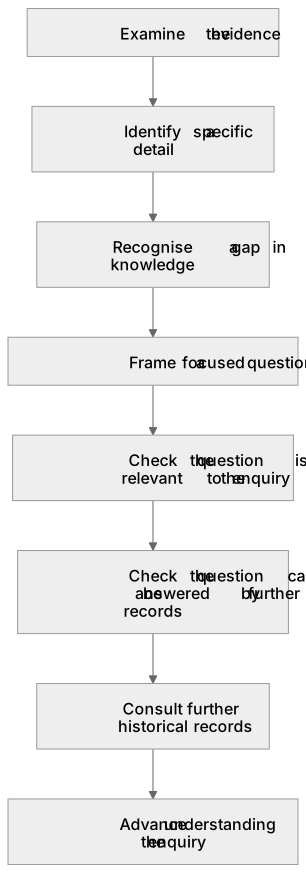
Put it in order
Put these steps in the order they happen.
- 1. Check the question is relevant to the enquiry
- 2. Advance understanding of the enquiry
- 3. Check the question can be answered by further records
- 4. Examine the evidence
- 5. Identify a specific detail
- 6. Consult further historical records
- 7. Recognise a gap in knowledge
- 8. Frame a focused question
Key words
Say what each word means before you turn the card.
Historical enquiry
Try answering aloud or in your head before turning the card.
Question formulation
Try answering aloud or in your head before turning the card.
Evidence analysis
Try answering aloud or in your head before turning the card.
See every definition
- Historical enquiry
- A specific investigation that precise questions drive forward, requiring active engagement with the evidence and a clear understanding of the research objective.
- Question formulation
- The framing of precise, focused questions that directly address a gap in knowledge and are highly relevant to the broader enquiry.
- Evidence analysis
- Examining a piece of evidence to identify gaps in knowledge and formulate targeted questions to uncover missing information.
Label the diagram
Some boxes have lost their names. Pick the right name for each number.
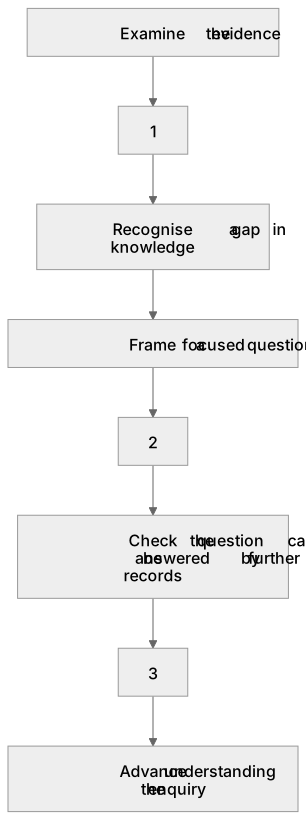
1Box 1
2Box 2
3Box 3
There is more to this lesson
The full lesson goes on to check your understanding and help you earn the marks. Create a free account to carry on, with your progress saved.
A week of Premium from your first lesson · Then the free plan continues · No card, no charge
Test your understanding of Option 11: The historic environment - 2 Knowledge, selection and use of sources for historical enquiries: Framing of questions relevant to the pursuit of a specific enquiry.
Active recall beats re-reading. Take an instant quiz now to test what you’ve learned and lock it into long-term memory.
A week of Premium from your first lesson · Then the free plan continues · No card, no charge