Pearson Edexcel · GCSE · History
Course version: 1HI0 · Version from Sept 2016
C1250–c1500: Medieval warfare and English society - 1 The nature of…
Full specification wording
Option 12: c1250–c1500: Medieval warfare and English society - 1 The nature of warfare: The composition of the army, including the roles of the infantry, archer and the mounted knight. The link between social structure and army command.
The medieval army's composition reflected the rigid social hierarchy of the era.
Checked against the Pearson Edexcel 1HI0 specification (opens in a new tab) on .
- Point 1 of 2
- 3 key terms
Study notes
From the checked teaching notes for this specification point.
The idea
The medieval army's composition reflected the rigid social hierarchy of the era. The infantry, primarily drawn from the lower classes, fought on foot using polearms and swords, forming the bulk of the army. Archers, often skilled commoners, provided crucial ranged support, increasingly dominating battlefields. The mounted knight, drawn from the nobility and wealthy elite, served as the elite shock cavalry, heavily armoured and highly trained. Army command was inextricably linked to social structure; kings and high-ranking nobles automatically assumed leadership roles regardless of military competence, while lower-ranking knights commanded smaller retinues. This meant that social status, rather than tactical ability, dictated the chain of command, ensuring the aristocracy maintained control over military power.
What earns the marks
- Identify the three main components of the medieval army: infantry, archers, and mounted knights.
- Describe the specific roles of each component, such as knights for shock charges and archers for ranged attacks.
- Explain how social class determined a soldier's role and equipment in the army.
- Analyse the relationship between the feudal hierarchy and military command structures.
Common mistakes and how to put them right
Assuming knights were the most numerous troops.
Put it right: State that infantry and archers made up the vast majority of the army's numbers.
Believing commanders were chosen for their tactical skill.
Put it right: Explain that command was determined by social rank and land ownership, not military merit.
Confusing the roles of infantry and archers.
Put it right: Distinguish between the hand-to-hand combat role of the infantry and the ranged support role of the archers.
Exam tips
- Use specific examples of social ranks, such as earls or barons, when discussing army command.
- Link the cost of equipment, like plate armour and warhorses, to the social status of the mounted knight.
- When evaluating army effectiveness, consider how the socially determined command structure might lead to poor tactical decisions.
Try the lesson
The start of the Option 12: c1250–c1500: Medieval warfare and English society - 1 The nature of warfare: The composition of the army, including the roles of the infantry, archer and the mounted knight. The link between social structure and army command. lesson, made from checked teaching notes for this specification point.
Have a go first
What was the primary role of the mounted knight in a medieval army during the period c1250–c1500?
Listen
The medieval army's composition reflected the rigid social hierarchy of the era. The infantry, primarily drawn from the lower classes, fought on foot using polearms and swords, forming the bulk of the army. Archers, often skilled commoners, provided crucial ranged support, increasingly dominating battlefields. The mounted knight, drawn from the nobility and wealthy elite, served as the elite shock cavalry, heavily armoured and highly trained. Army command was inextricably linked to social structure; kings and high-ranking nobles automatically assumed leadership roles regardless of military competence, while lower-ranking knights commanded smaller retinues. This meant that social status, rather than tactical ability, dictated the chain of command, ensuring the aristocracy maintained control over military power. A strong answer earns marks for these points. Identify the three main components of the medieval army: infantry, archers, and mounted knights. Describe the specific roles of each component, such as knights for shock charges and archers for ranged attacks. Explain how social class determined a soldier's role and equipment in the army. Analyse the relationship between the feudal hierarchy and military command structures. A common slip: Assuming knights were the most numerous troops. Instead, State that infantry and archers made up the vast majority of the army's numbers. Exam tip: Use specific examples of social ranks, such as earls or barons, when discussing army command.
See it
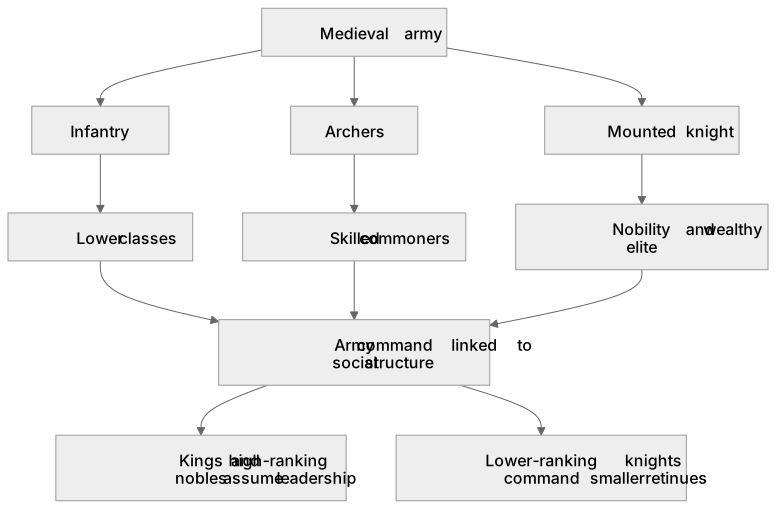
Key words
Say what each word means before you turn the card.
Social hierarchy
Try answering aloud or in your head before turning the card.
Military organisation
Try answering aloud or in your head before turning the card.
Leadership and command
Try answering aloud or in your head before turning the card.
See every definition
- Social hierarchy
- The rigid social structure of the era, which the composition of the medieval army reflected.
- Military organisation
- The composition of the army, including the roles of the infantry, archer and the mounted knight.
- Leadership and command
- Army command was inextricably linked to social structure, with kings and high-ranking nobles automatically assuming leadership roles regardless of military competence.
Label the diagram
Some boxes have lost their names. Pick the right name for each number.
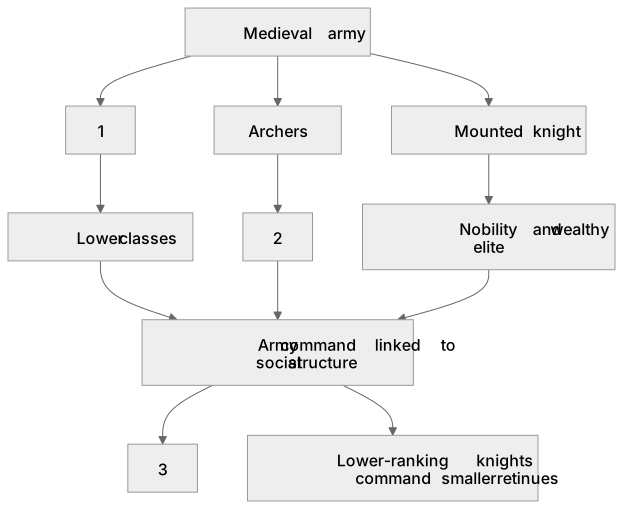
1Box 1
2Box 2
3Box 3
There is more to this lesson
The full lesson goes on to check your understanding and help you earn the marks. Create a free account to carry on, with your progress saved.
A week of Premium from your first lesson · Then the free plan continues · No card, no charge
Test your understanding of Option 12: c1250–c1500: Medieval warfare and English society - 1 The nature of warfare: The composition of the army, including the roles of the infantry, archer and the mounted knight. The link between social structure and army command.
Active recall beats re-reading. Take an instant quiz now to test what you’ve learned and lock it into long-term memory.
A week of Premium from your first lesson · Then the free plan continues · No card, no charge