Pearson Edexcel · GCSE · History
Course version: 1HI0 · Version from Sept 2016
C1250–c1500: Medieval warfare and English society - 1 The nature of…
Full specification wording
Option 12: c1250–c1500: Medieval warfare and English society - 1 The nature of warfare: The impact on warfare (strategy, tactics and combat) of new weapons and formations, including the longbow and schiltrons. The importance of gunpowder and the development of cannon. The decline of the mounted knight.
Between 1250 and 1500, warfare was transformed by new weapons and formations that altered strategy, tactics, and combat.
Checked against the Pearson Edexcel 1HI0 specification (opens in a new tab) on .
- Point 2 of 2
- 4 key terms
Study notes
From the checked teaching notes for this specification point.
The idea
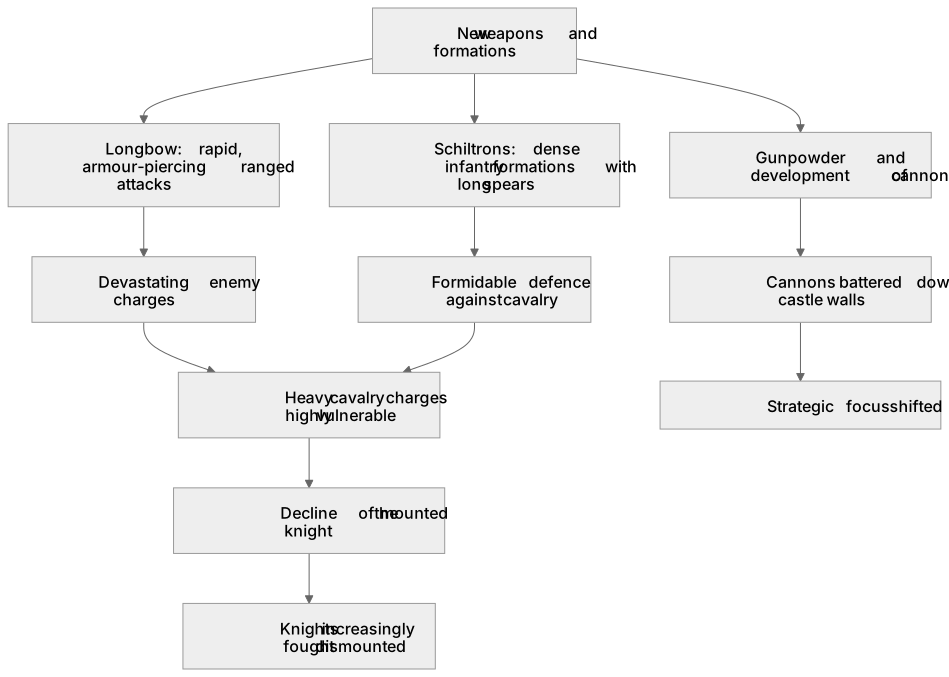
Between 1250 and 1500, warfare was transformed by new weapons and formations that altered strategy, tactics, and combat. The English longbow allowed rapid, armour-piercing ranged attacks, devastating enemy charges. Scottish schiltrons—dense formations of infantry wielding long spears—provided a formidable defence against cavalry. These innovations, alongside the introduction of gunpowder and early cannons for siege warfare, fundamentally changed battlefield dynamics. Cannons battered down castle walls, shifting strategic focus. Consequently, the dominance of the mounted knight declined; heavy cavalry charges became highly vulnerable to disciplined pikemen and massed archery, forcing knights to increasingly fight dismounted.
What earns the marks
- Explain how the longbow changed combat tactics by providing rapid, long-range firepower.
- Describe the schiltron formation and its tactical use in defending against cavalry charges.
- Assess the strategic impact of gunpowder and cannons, particularly in reducing the effectiveness of castles.
- Analyse the reasons for the decline of the mounted knight, linking it to the rise of infantry formations and new weaponry.
Common mistakes and how to put them right
Stating that cannons were primarily used as field artillery in this period.
Put it right: Clarify that early cannons were heavy, slow, and mainly used for siege warfare against fortifications.
Claiming the mounted knight disappeared completely.
Put it right: Explain that their dominance declined and they adapted by fighting on foot, rather than vanishing entirely.
Confusing strategy and tactics.
Put it right: Use 'strategy' for overall campaign goals, such as capturing castles, and 'tactics' for battlefield manoeuvres, such as deploying schiltrons.
Exam tips
- Use the Battle of Falkirk or Agincourt as concrete examples of how longbows and schiltrons impacted combat.
- Explicitly connect the introduction of new weapons to the decline of the mounted knight to show complex causation.
- Ensure you address all three aspects: strategy, tactics, and combat when discussing the impact of new weapons.
Try the lesson
The start of the Option 12: c1250–c1500: Medieval warfare and English society - 1 The nature of warfare: The impact on warfare (strategy, tactics and combat) of new weapons and formations, including the longbow and schiltrons. The importance of gunpowder and the development of cannon. The decline of the mounted knight. lesson, made from checked teaching notes for this specification point.
Have a go first
What was the main tactical advantage of the schiltron formation used by Scottish armies?
Listen
Between 1250 and 1500, warfare was transformed by new weapons and formations that altered strategy, tactics, and combat. The English longbow allowed rapid, armour-piercing ranged attacks, devastating enemy charges. Scottish schiltrons—dense formations of infantry wielding long spears—provided a formidable defence against cavalry. These innovations, alongside the introduction of gunpowder and early cannons for siege warfare, fundamentally changed battlefield dynamics. Cannons battered down castle walls, shifting strategic focus. Consequently, the dominance of the mounted knight declined; heavy cavalry charges became highly vulnerable to disciplined pikemen and massed archery, forcing knights to increasingly fight dismounted. A strong answer earns marks for these points. Explain how the longbow changed combat tactics by providing rapid, long-range firepower. Describe the schiltron formation and its tactical use in defending against cavalry charges. Assess the strategic impact of gunpowder and cannons, particularly in reducing the effectiveness of castles. Analyse the reasons for the decline of the mounted knight, linking it to the rise of infantry formations and new weaponry. A common slip: Stating that cannons were primarily used as field artillery in this period. Instead, Clarify that early cannons were heavy, slow, and mainly used for siege warfare against fortifications. Exam tip: Use the Battle of Falkirk or Agincourt as concrete examples of how longbows and schiltrons impacted combat.
See it
Key words
Say what each word means before you turn the card.
Technological change
Try answering aloud or in your head before turning the card.
Tactical innovation
Try answering aloud or in your head before turning the card.
Decline of cavalry
Try answering aloud or in your head before turning the card.
Siege warfare
Try answering aloud or in your head before turning the card.
See every definition
- Technological change
- New weapons and formations, including the longbow, schiltrons, gunpowder and cannon, transformed strategy, tactics and combat between 1250 and 1500.
- Tactical innovation
- The longbow provided rapid, armour-piercing ranged attacks, while schiltrons were dense formations of infantry wielding long spears.
- Decline of cavalry
- Heavy cavalry charges became highly vulnerable to disciplined pikemen and massed archery, forcing knights to increasingly fight dismounted.
- Siege warfare
- Early cannons were heavy and slow and were mainly used against fortifications, battering down castle walls and shifting strategic focus.
Label the diagram
Some boxes have lost their names. Pick the right name for each number.
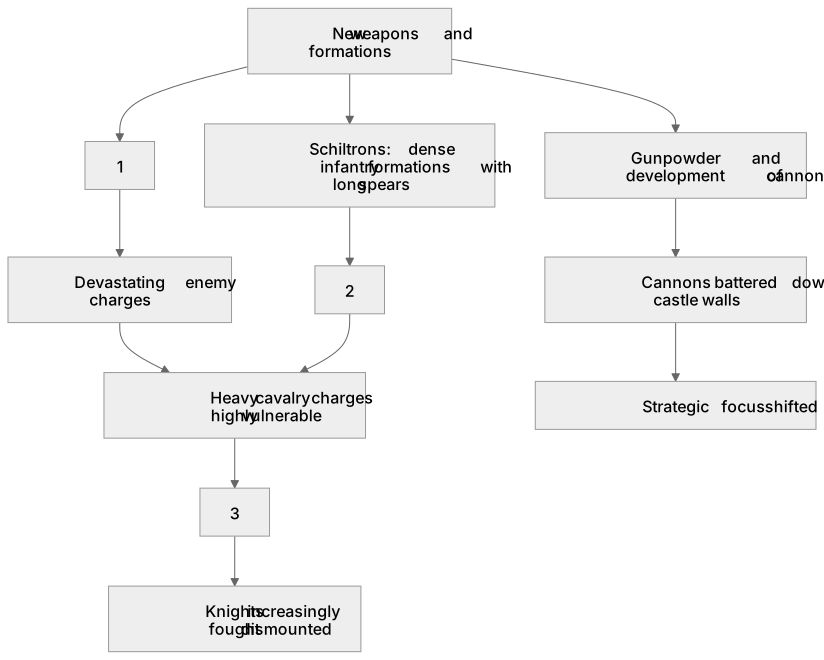
1Box 1
2Box 2
3Box 3
There is more to this lesson
The full lesson goes on to check your understanding and help you earn the marks. Create a free account to carry on, with your progress saved.
A week of Premium from your first lesson · Then the free plan continues · No card, no charge
Test your understanding of Option 12: c1250–c1500: Medieval warfare and English society - 1 The nature of warfare: The impact on warfare (strategy, tactics and combat) of new weapons and formations, including the longbow and schiltrons. The importance of gunpowder and the development of cannon. The decline of the mounted knight.
Active recall beats re-reading. Take an instant quiz now to test what you’ve learned and lock it into long-term memory.
A week of Premium from your first lesson · Then the free plan continues · No card, no charge