Pearson Edexcel · GCSE · History
Course version: 1HI0 · Version from Sept 2016
C1250–c1500: Medieval warfare and English society - 2 The experience of…
Full specification wording
Option 12: c1250–c1500: Medieval warfare and English society - 2 The experience of war: The impact of war on civilians, including the impact of feudal duties and army plunder on civilian lives.
Warfare had a profound and often devastating impact on medieval civilians.
Checked against the Pearson Edexcel 1HI0 specification (opens in a new tab) on .
- Point 2 of 2
- 4 key terms
Study notes
From the checked teaching notes for this specification point.
The idea
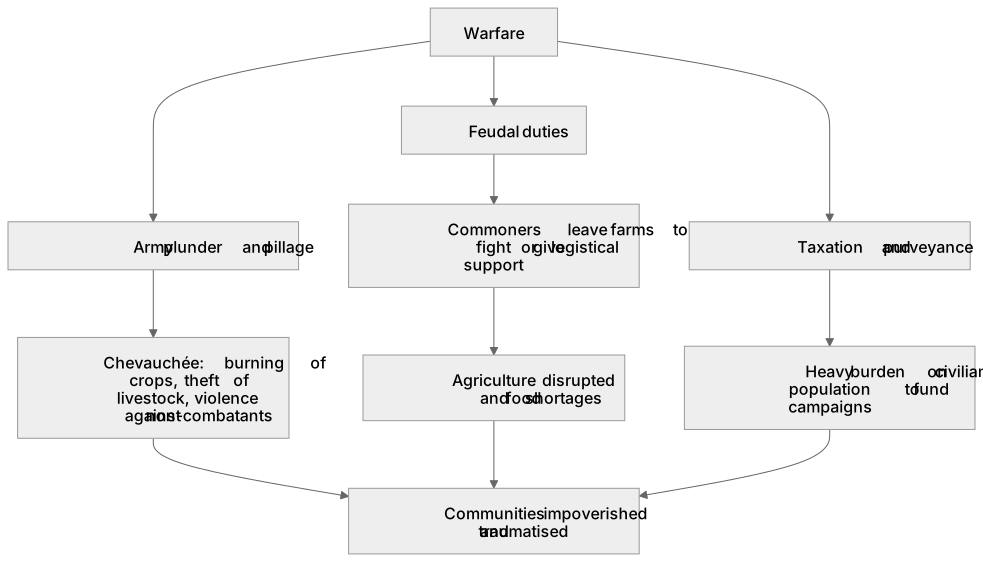
Warfare had a profound and often devastating impact on medieval civilians. Feudal duties required commoners to leave their farms to fight or provide logistical support, disrupting agriculture and leading to food shortages. Taxation, such as purveyance (the forced sale of goods to the crown at low prices), heavily burdened the civilian population to fund campaigns. Furthermore, armies frequently resorted to plunder and pillage to sustain themselves, deliberately destroying enemy territory to undermine morale and economic stability. This practice, known as chevauchée, resulted in the burning of crops, theft of livestock, and widespread violence against non-combatants, leaving communities impoverished and traumatised long after the armies had moved on.
What earns the marks
- Explain how feudal military duties disrupted civilian life and agricultural production.
- Describe the financial burden of war on civilians, including taxation and purveyance.
- Analyse the devastating effects of army plunder and the tactic of chevauchée on local populations.
- Evaluate the long-term economic and social consequences of warfare on civilian communities.
Common mistakes and how to put them right
Believing civilians were largely unaffected by battles fought away from their homes.
Put it right: Explain that taxation, purveyance, and the loss of manpower affected civilians even if the fighting was distant.
Assuming armies always carried enough supplies.
Put it right: Highlight that armies relied heavily on plundering local resources to survive, devastating civilian food supplies.
Confusing purveyance with regular taxation.
Put it right: Define purveyance specifically as the crown's right to buy goods at a fixed, often unfair, price for the army.
Exam tips
- Use the term 'chevauchée' to demonstrate specific knowledge of destructive raiding tactics used during the Hundred Years' War.
- Link the absence of male workers due to feudal duties directly to the risk of famine and economic hardship.
- Consider both the direct impacts, such as plunder and violence, and indirect impacts, such as taxation and purveyance, of war on civilians.
Try the lesson
The start of the Option 12: c1250–c1500: Medieval warfare and English society - 2 The experience of war: The impact of war on civilians, including the impact of feudal duties and army plunder on civilian lives. lesson, made from checked teaching notes for this specification point.
Have a go first
How did the practice of army plunder most directly affect civilians during medieval warfare?
Listen
Warfare had a profound and often devastating impact on medieval civilians. Feudal duties required commoners to leave their farms to fight or provide logistical support, disrupting agriculture and leading to food shortages. Taxation, such as purveyance (the forced sale of goods to the crown at low prices), heavily burdened the civilian population to fund campaigns. Furthermore, armies frequently resorted to plunder and pillage to sustain themselves, deliberately destroying enemy territory to undermine morale and economic stability. This practice, known as chevauchée, resulted in the burning of crops, theft of livestock, and widespread violence against non-combatants, leaving communities impoverished and traumatised long after the armies had moved on. A strong answer earns marks for these points. Explain how feudal military duties disrupted civilian life and agricultural production. Describe the financial burden of war on civilians, including taxation and purveyance. Analyse the devastating effects of army plunder and the tactic of chevauchée on local populations. Evaluate the long-term economic and social consequences of warfare on civilian communities. A common slip: Believing civilians were largely unaffected by battles fought away from their homes. Instead, Explain that taxation, purveyance, and the loss of manpower affected civilians even if the fighting was distant. Exam tip: Use the term 'chevauchée' to demonstrate specific knowledge of destructive raiding tactics used during the Hundred Years' War.
See it
Key words
Say what each word means before you turn the card.
Purveyance
Try answering aloud or in your head before turning the card.
Chevauchée
Try answering aloud or in your head before turning the card.
Feudal duties
Try answering aloud or in your head before turning the card.
Plunder and pillage
Try answering aloud or in your head before turning the card.
See every definition
- Purveyance
- The forced sale of goods to the crown at low prices, which heavily burdened the civilian population to fund campaigns.
- Chevauchée
- A practice of plunder and pillage in which armies deliberately destroyed enemy territory to undermine morale and economic stability.
- Feudal duties
- Obligations that required commoners to leave their farms to fight or provide logistical support, disrupting agriculture and leading to food shortages.
- Plunder and pillage
- The means by which armies sustained themselves, resulting in the burning of crops, theft of livestock and widespread violence against non-combatants.
Label the diagram
Some boxes have lost their names. Pick the right name for each number.
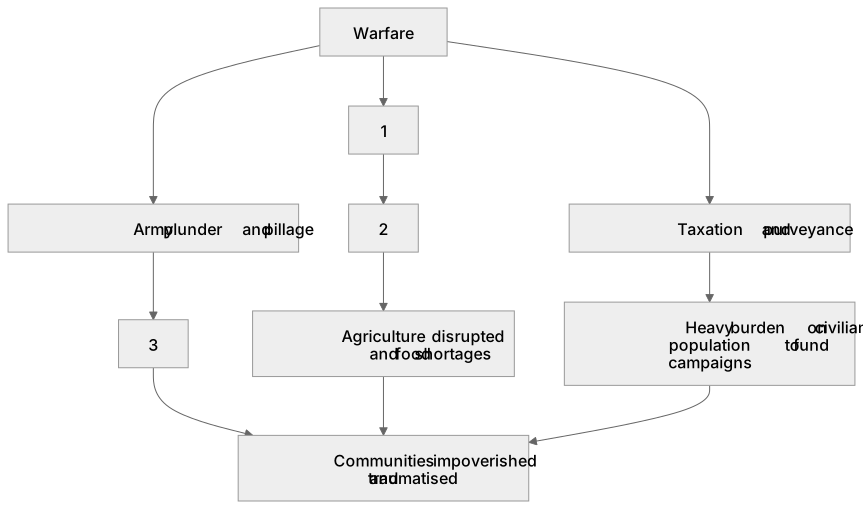
1Box 1
2Box 2
3Box 3
There is more to this lesson
The full lesson goes on to check your understanding and help you earn the marks. Create a free account to carry on, with your progress saved.
A week of Premium from your first lesson · Then the free plan continues · No card, no charge
Test your understanding of Option 12: c1250–c1500: Medieval warfare and English society - 2 The experience of war: The impact of war on civilians, including the impact of feudal duties and army plunder on civilian lives.
Active recall beats re-reading. Take an instant quiz now to test what you’ve learned and lock it into long-term memory.
A week of Premium from your first lesson · Then the free plan continues · No card, no charge