Pearson Edexcel · GCSE · History
Course version: 1HI0 · Version from Sept 2016
C1250–c1500: Medieval warfare and English society - 2 The experience of…
Full specification wording
Option 12: c1250–c1500: Medieval warfare and English society - 2 The experience of war: The recruitment and training of combatants in the medieval feudal army.
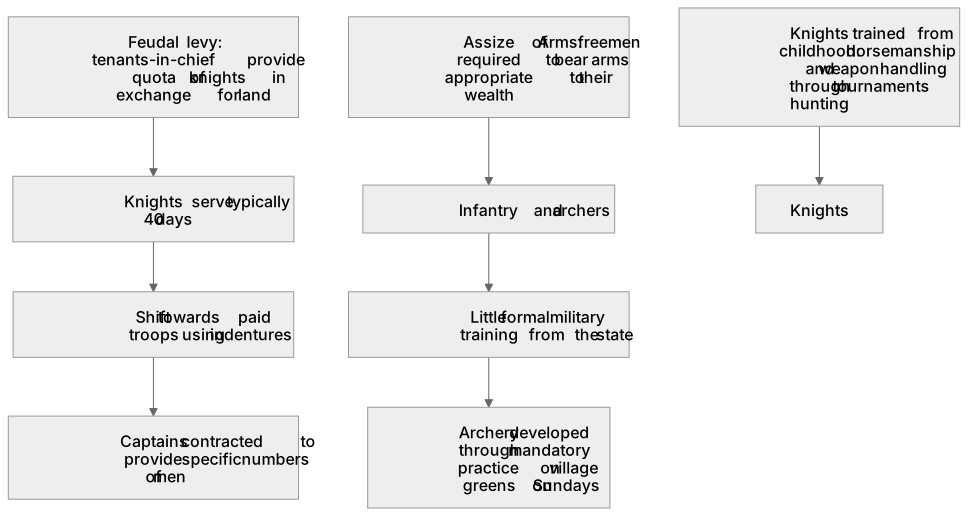
Recruitment in the medieval feudal army relied heavily on the feudal levy, where tenants-in-chief provided a quota of knights to the king in exchange for land, typically serving for 40 days.
Checked against the Pearson Edexcel 1HI0 specification (opens in a new tab) on .
- Point 1 of 2
- 3 key terms
Study notes
From the checked teaching notes for this specification point.
The idea
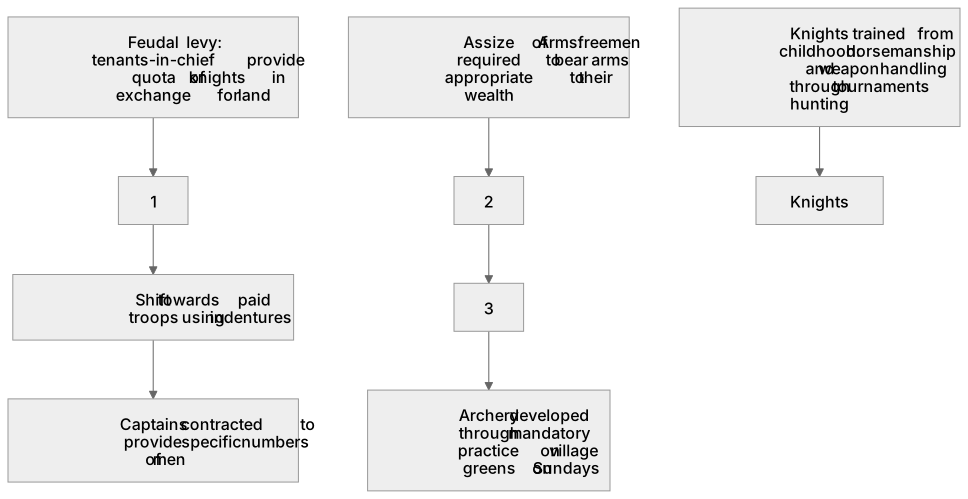
Recruitment in the medieval feudal army relied heavily on the feudal levy, where tenants-in-chief provided a quota of knights to the king in exchange for land, typically serving for 40 days. The Assize of Arms also required freemen to bear arms appropriate to their wealth. Over time, this shifted towards paid troops using indentures, where captains were contracted to provide specific numbers of men. Training varied significantly by class. Knights trained from childhood in horsemanship and weapon handling through tournaments and hunting. Conversely, infantry and archers received little formal military training from the state; instead, skills like archery were developed through mandatory practice on village greens on Sundays, ensuring a baseline of competence.
What earns the marks
- Describe the feudal levy and the obligation of landholders to provide military service for 40 days.
- Explain the transition from feudal obligations to paid service through the indenture system.
- Contrast the lifelong, specialised training of knights with the informal training of infantry.
- Identify the role of the Assize of Arms and mandatory archery practice in preparing commoners for war.
Common mistakes and how to put them right
Assuming all soldiers were highly trained professionals.
Put it right: Emphasise that most infantry were ordinary civilians with minimal formal military training.
Confusing the feudal levy with a modern conscript army.
Put it right: Explain that the levy was based on land tenure and specific obligations, not universal national conscription.
Stating that the Assize of Arms required 40 days of service.
Put it right: Clarify that the 40-day limit applied to the feudal levy for knights, whereas the Assize of Arms dictated the weapons freemen had to own.
Exam tips
- Clearly distinguish between the recruitment methods for knights, such as feudal duty, and commoners, such as the Assize of Arms.
- Use the term 'indenture' correctly to describe the contract between the king and a captain for paid troops.
- Discuss how the 40-day limit on feudal service drove the need for paid, contracted armies for longer campaigns.
Try the lesson
The start of the Option 12: c1250–c1500: Medieval warfare and English society - 2 The experience of war: The recruitment and training of combatants in the medieval feudal army. lesson, made from checked teaching notes for this specification point.
Have a go first
Under the feudal system, how were knights primarily recruited for the king's army?
Listen
Recruitment in the medieval feudal army relied heavily on the feudal levy, where tenants-in-chief provided a quota of knights to the king in exchange for land, typically serving for 40 days. The Assize of Arms also required freemen to bear arms appropriate to their wealth. Over time, this shifted towards paid troops using indentures, where captains were contracted to provide specific numbers of men. Training varied significantly by class. Knights trained from childhood in horsemanship and weapon handling through tournaments and hunting. Conversely, infantry and archers received little formal military training from the state; instead, skills like archery were developed through mandatory practice on village greens on Sundays, ensuring a baseline of competence. A strong answer earns marks for these points. Describe the feudal levy and the obligation of landholders to provide military service for 40 days. Explain the transition from feudal obligations to paid service through the indenture system. Contrast the lifelong, specialised training of knights with the informal training of infantry. Identify the role of the Assize of Arms and mandatory archery practice in preparing commoners for war. A common slip: Assuming all soldiers were highly trained professionals. Instead, Emphasise that most infantry were ordinary civilians with minimal formal military training. Exam tip: Clearly distinguish between the recruitment methods for knights, such as feudal duty, and commoners, such as the Assize of Arms.
See it
Key words
Say what each word means before you turn the card.
Feudal levy
Try answering aloud or in your head before turning the card.
Assize of Arms
Try answering aloud or in your head before turning the card.
Indentures
Try answering aloud or in your head before turning the card.
See every definition
- Feudal levy
- The system where tenants-in-chief provided a quota of knights to the king in exchange for land, typically serving for 40 days.
- Assize of Arms
- A requirement that freemen bear arms appropriate to their wealth.
- Indentures
- Contracts by which captains were contracted to provide specific numbers of men, marking a shift towards paid troops.
Label the diagram
Some boxes have lost their names. Pick the right name for each number.
1Box 1
2Box 2
3Box 3
There is more to this lesson
The full lesson goes on to check your understanding and help you earn the marks. Create a free account to carry on, with your progress saved.
A week of Premium from your first lesson · Then the free plan continues · No card, no charge
Test your understanding of Option 12: c1250–c1500: Medieval warfare and English society - 2 The experience of war: The recruitment and training of combatants in the medieval feudal army.
Active recall beats re-reading. Take an instant quiz now to test what you’ve learned and lock it into long-term memory.
A week of Premium from your first lesson · Then the free plan continues · No card, no charge