Pearson Edexcel · GCSE · History
Course version: 1HI0 · Version from Sept 2016
C1500–c1700: Warfare and English society in the early modern period - 1…
Full specification wording
Option 12: c1500–c1700: Warfare and English society in the early modern period - 1 The nature of warfare: The impact on warfare of developments in weaponry, including new muskets and pistols.
Developments in weaponry between 1500 and 1700 profoundly impacted the nature of warfare.
Checked against the Pearson Edexcel 1HI0 specification (opens in a new tab) on .
- Point 1 of 2
- 4 key terms
Study notes
From the checked teaching notes for this specification point.
The idea
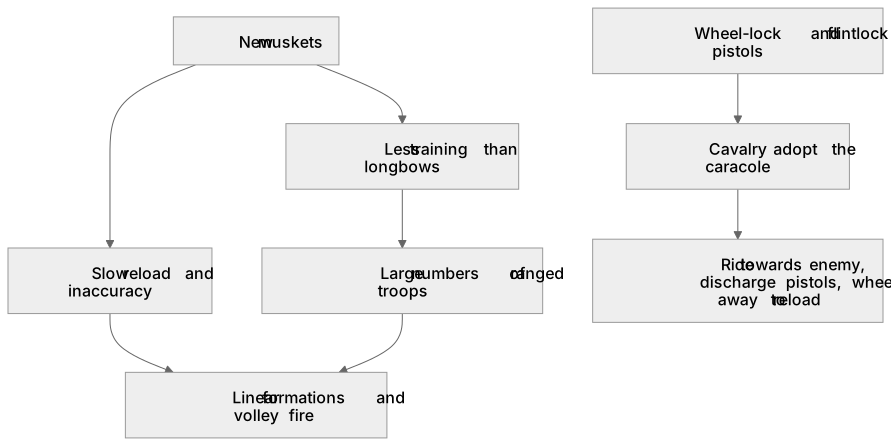
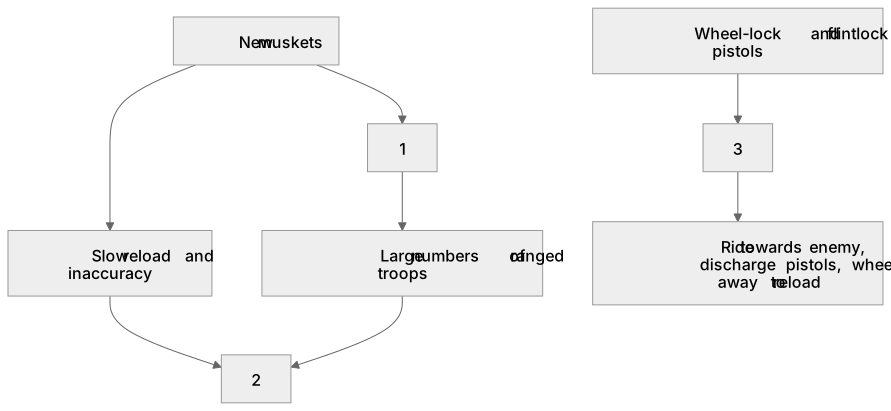
Developments in weaponry between 1500 and 1700 profoundly impacted the nature of warfare. The introduction of new firearms, particularly matchlock and later flintlock muskets, revolutionised infantry tactics. Muskets required less training than longbows, allowing armies to rapidly field large numbers of lethal ranged troops. To maximise firepower and compensate for slow reload times, infantry adopted linear formations and volley fire. The development of wheel-lock and flintlock pistols transformed cavalry tactics. Instead of charging with lances, cavalry units like the cuirassiers adopted the 'caracole' tactic, riding towards the enemy, discharging their pistols, and wheeling away to reload, fundamentally altering the pace and engagement style of battlefield cavalry.
What earns the marks
- Explain how the adoption of muskets led to the decline of the longbow due to easier training and greater armour-piercing capability.
- Describe the tactical changes forced by muskets, such as the development of volley fire and linear formations to maintain continuous fire.
- Analyse the impact of pistols on cavalry tactics, specifically the shift from lance charges to the caracole manoeuvre.
- Evaluate how improvements in firearm firing mechanisms (from matchlock to flintlock) increased reliability and rate of fire.
Common mistakes and how to put them right
Stating that early muskets were highly accurate.
Put it right: They were actually very inaccurate, which is why volley fire was necessary.
Claiming that the invention of the pistol made cavalry obsolete.
Put it right: It merely changed their tactics from shock charges to mobile firepower.
Assuming all soldiers immediately received the newest weapons.
Put it right: The transition from matchlock to flintlock was gradual due to cost.
Exam tips
- Link the development of the musket directly to changes in infantry formations, showing how technology drives tactical change.
- Use the term 'caracole' when discussing the impact of pistols on cavalry to demonstrate precise historical knowledge.
- Remember to discuss both the advantages (less training, power) and disadvantages (slow reload, inaccuracy) of early muskets.
Try the lesson
The start of the Option 12: c1500–c1700: Warfare and English society in the early modern period - 1 The nature of warfare: The impact on warfare of developments in weaponry, including new muskets and pistols. lesson, made from checked teaching notes for this specification point.
Have a go first
Which new cavalry tactic was developed in the sixteenth century in response to the introduction of wheel-lock pistols?
Listen
Developments in weaponry between 1500 and 1700 profoundly impacted the nature of warfare. The introduction of new firearms, particularly matchlock and later flintlock muskets, revolutionised infantry tactics. Muskets required less training than longbows, allowing armies to rapidly field large numbers of lethal ranged troops. To maximise firepower and compensate for slow reload times, infantry adopted linear formations and volley fire. The development of wheel-lock and flintlock pistols transformed cavalry tactics. Instead of charging with lances, cavalry units like the cuirassiers adopted the 'caracole' tactic, riding towards the enemy, discharging their pistols, and wheeling away to reload, fundamentally altering the pace and engagement style of battlefield cavalry. A strong answer earns marks for these points. Explain how the adoption of muskets led to the decline of the longbow due to easier training and greater armour-piercing capability. Describe the tactical changes forced by muskets, such as the development of volley fire and linear formations to maintain continuous fire. Analyse the impact of pistols on cavalry tactics, specifically the shift from lance charges to the caracole manoeuvre. Evaluate how improvements in firearm firing mechanisms (from matchlock to flintlock) increased reliability and rate of fire. Exam tip: Link the development of the musket directly to changes in infantry formations, showing how technology drives tactical change.
See it
Key words
Say what each word means before you turn the card.
Muskets
Try answering aloud or in your head before turning the card.
Linear formations
Try answering aloud or in your head before turning the card.
Caracole
Try answering aloud or in your head before turning the card.
Flintlock
Try answering aloud or in your head before turning the card.
See every definition
- Muskets
- New firearms, particularly matchlock and later flintlock, that required less training than longbows and allowed armies to rapidly field large numbers of lethal ranged troops.
- Linear formations
- A tactic adopted by infantry to maximise firepower and compensate for slow reload times, alongside volley fire.
- Caracole
- A cavalry tactic in which units rode towards the enemy, discharged their pistols, and wheeled away to reload, instead of charging with lances.
- Flintlock
- A later firing mechanism for muskets whose improvement over the matchlock increased reliability and rate of fire.
Label the diagram
Some boxes have lost their names. Pick the right name for each number.
1Box 1
2Box 2
3Box 3
There is more to this lesson
The full lesson goes on to check your understanding and help you earn the marks. Create a free account to carry on, with your progress saved.
A week of Premium from your first lesson · Then the free plan continues · No card, no charge
Test your understanding of Option 12: c1500–c1700: Warfare and English society in the early modern period - 1 The nature of warfare: The impact on warfare of developments in weaponry, including new muskets and pistols.
Active recall beats re-reading. Take an instant quiz now to test what you’ve learned and lock it into long-term memory.
A week of Premium from your first lesson · Then the free plan continues · No card, no charge