Pearson Edexcel · GCSE · History
Course version: 1HI0 · Version from Sept 2016
C1500–c1700: Warfare and English society in the early modern period - 1…
Full specification wording
Option 12: c1500–c1700: Warfare and English society in the early modern period - 1 The nature of warfare: The recruitment and training of combatants, including the New Model Army.
During the early modern period, the recruitment and training of combatants underwent a major transformation.
Checked against the Pearson Edexcel 1HI0 specification (opens in a new tab) on .
- Point 2 of 2
- 2 key terms
Study notes
From the checked teaching notes for this specification point.
The idea
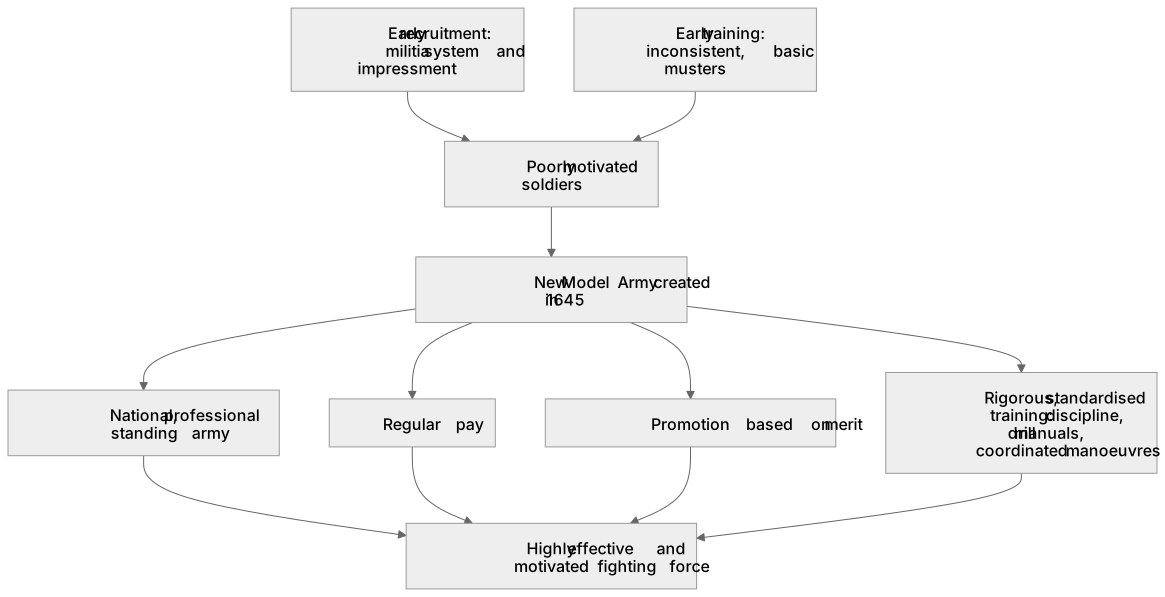
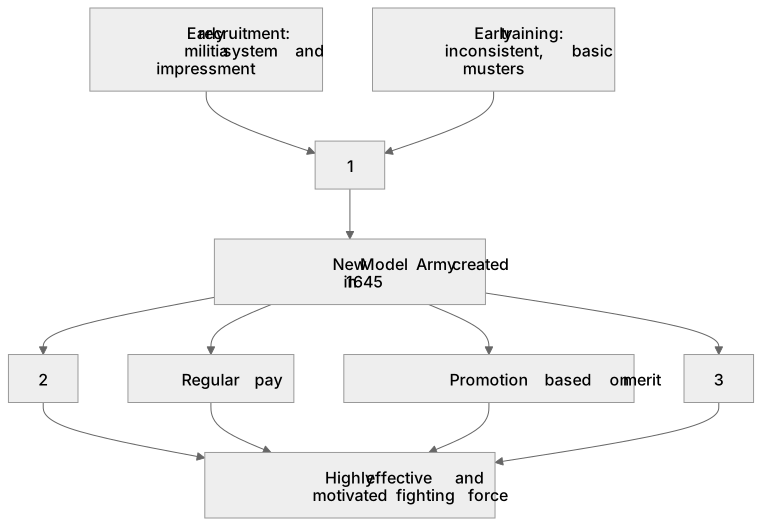
During the early modern period, the recruitment and training of combatants underwent a major transformation. Initially, recruitment relied on the militia system and impressment, resulting in poorly motivated soldiers. Training was inconsistent, usually limited to basic musters. This changed dramatically with the creation of the New Model Army in 1645. It introduced a national, professional standing army with regular pay, attracting better recruits. Training became rigorous and standardised, focusing on discipline, drill manuals, and coordinated battlefield manoeuvres. Promotion was based on merit rather than social status, creating a highly effective and motivated fighting force that contrasted sharply with earlier ad-hoc armies.
What earns the marks
- Describe early modern recruitment methods, including the militia system, volunteers, and the use of impressment.
- Explain the limitations of early training, which often lacked standardisation and relied on infrequent local musters.
- Analyse the innovations of the New Model Army, such as regular pay, national recruitment, and promotion based on merit.
- Evaluate how the New Model Army standardised training through drill manuals and strict discipline to create a professional force.
Common mistakes and how to put them right
Confusing the New Model Army with earlier Royalist or Parliamentarian forces.
Put it right: The New Model Army was a specific, reorganised force created in 1645.
Assuming impressment was completely abandoned.
Put it right: While the New Model Army relied heavily on volunteers, impressment was still used to fill ranks when necessary.
Believing that all officers in the New Model Army were commoners.
Put it right: Many officers were still gentlemen, but merit became a significant factor for advancement.
Exam tips
- Contrast the amateur nature of the early militia system with the professional standards of the New Model Army to highlight change.
- Mention the Self-Denying Ordinance when discussing the New Model Army to show how military command was separated from political status.
- Emphasise the importance of regular pay in maintaining discipline and preventing desertion or looting.
Try the lesson
The start of the Option 12: c1500–c1700: Warfare and English society in the early modern period - 1 The nature of warfare: The recruitment and training of combatants, including the New Model Army. lesson, made from checked teaching notes for this specification point.
Have a go first
Which method was commonly used to force men to join the army during the sixteenth and seventeenth centuries?
Listen
During the early modern period, the recruitment and training of combatants underwent a major transformation. Initially, recruitment relied on the militia system and impressment, resulting in poorly motivated soldiers. Training was inconsistent, usually limited to basic musters. This changed dramatically with the creation of the New Model Army in 1645. It introduced a national, professional standing army with regular pay, attracting better recruits. Training became rigorous and standardised, focusing on discipline, drill manuals, and coordinated battlefield manoeuvres. Promotion was based on merit rather than social status, creating a highly effective and motivated fighting force that contrasted sharply with earlier ad-hoc armies. A strong answer earns marks for these points. Describe early modern recruitment methods, including the militia system, volunteers, and the use of impressment. Explain the limitations of early training, which often lacked standardisation and relied on infrequent local musters. Analyse the innovations of the New Model Army, such as regular pay, national recruitment, and promotion based on merit. Evaluate how the New Model Army standardised training through drill manuals and strict discipline to create a professional force. Exam tip: Contrast the amateur nature of the early militia system with the professional standards of the New Model Army to highlight change.
See it
Key words
Say what each word means before you turn the card.
Professionalisation of the army
Try answering aloud or in your head before turning the card.
Social mobility and meritocracy
Try answering aloud or in your head before turning the card.
See every definition
- Professionalisation of the army
- The creation of the New Model Army in 1645 as a national, professional standing army with regular pay, attracting better recruits.
- Social mobility and meritocracy
- Promotion based on merit rather than social status, creating a highly effective and motivated fighting force.
Label the diagram
Some boxes have lost their names. Pick the right name for each number.
1Box 1
2Box 2
3Box 3
There is more to this lesson
The full lesson goes on to check your understanding and help you earn the marks. Create a free account to carry on, with your progress saved.
A week of Premium from your first lesson · Then the free plan continues · No card, no charge
Test your understanding of Option 12: c1500–c1700: Warfare and English society in the early modern period - 1 The nature of warfare: The recruitment and training of combatants, including the New Model Army.
Active recall beats re-reading. Take an instant quiz now to test what you’ve learned and lock it into long-term memory.
A week of Premium from your first lesson · Then the free plan continues · No card, no charge