Pearson Edexcel · GCSE · History
Course version: 1HI0 · Version from Sept 2016
The historic environment - 1 London and the Second World War, 1939–45: The…
Full specification wording
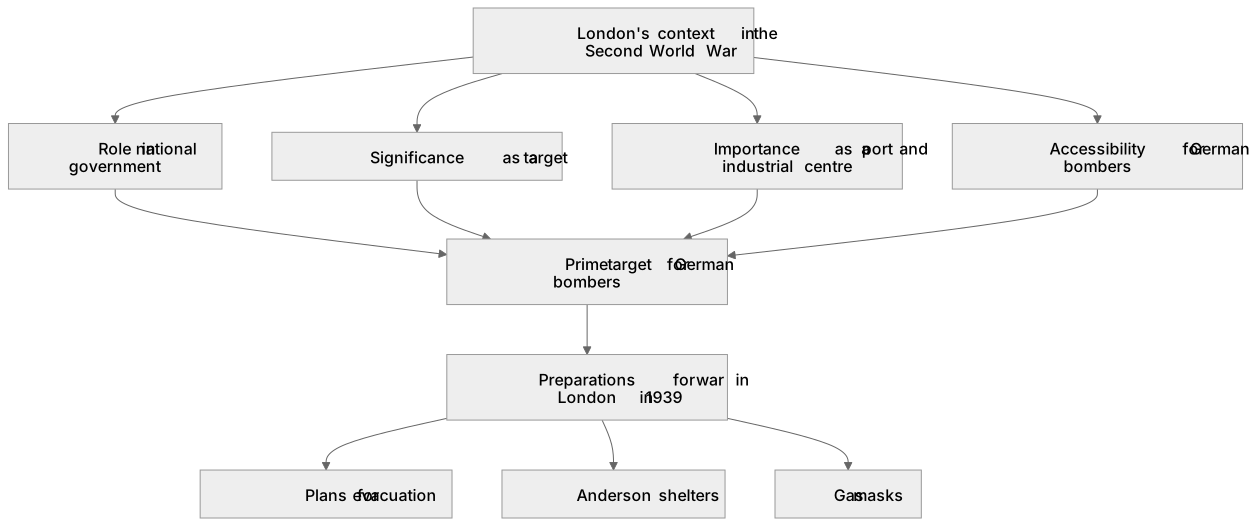
Option 12: The historic environment - 1 London and the Second World War, 1939–45: The context of London in the Second World War, including its role in national government, significance as a target, importance as a port and industrial centre and its accessibility for German bombers. Preparations for war in London in 1939 and ongoing measures to safeguard the population: implementation of plans for evacuation, provision of Anderson shelters and gas masks.
London's context in the Second World War made it a prime target for German bombers.
Checked against the Pearson Edexcel 1HI0 specification (opens in a new tab) on .
- Point 1 of 5
- 4 key terms
Study notes
From the checked teaching notes for this specification point.
The idea
London's context in the Second World War made it a prime target for German bombers. As the seat of national government, a major port, and a vital industrial centre, its destruction was intended to cripple the British war effort. Its geographical accessibility from occupied Europe further increased its vulnerability. In 1939, extensive preparations were made to safeguard the population. The government implemented mass evacuation plans, relocating over a million children and vulnerable individuals to rural areas. Ongoing measures included the widespread provision of Anderson shelters for domestic protection and the distribution of gas masks to the entire population to mitigate the threat of chemical attacks.
What earns the marks
- Explain London's significance as a target due to its concentration of national government, industry, and the vital docks in the East End.
- Describe how London's geographical location in the south-east made it highly accessible to Luftwaffe bombers flying from bases in occupied France and Belgium.
- Detail the implementation of Operation Pied Piper in September 1939, which evacuated children, mothers, and teachers from London to safer rural areas.
- Outline the provision of Anderson shelters, distributed free to poorer households, to provide blast protection in domestic gardens.
- Discuss the universal distribution of gas masks and the ongoing public information campaigns enforcing their carriage due to the fear of poison gas.
Common mistakes and how to put them right
Stating that evacuation only happened once.
Put it right: Evacuation occurred in waves, with many returning during the Phoney War before being evacuated again during the Blitz.
Assuming Anderson shelters protected against direct hits.
Put it right: They were designed to protect against blast damage and shrapnel from near misses, not direct bomb strikes.
Believing gas masks were frequently used during attacks.
Put it right: Although distributed universally, poison gas was never actually dropped on London during WWII.
Exam tips
- Link London's specific features (e.g., the River Thames acting as a navigational aid for bombers) to its vulnerability and accessibility.
- When discussing preparations, distinguish between pre-war planning (like the design of Anderson shelters) and the actual implementation in 1939.
- Use the historic environment context to explain why the East End suffered disproportionately due to its dual role as a port and industrial hub.
Try the lesson
The start of the Option 12: The historic environment - 1 London and the Second World War, 1939–45: The context of London in the Second World War, including its role in national government, significance as a target, importance as a port and industrial centre and its accessibility for German bombers. Preparations for war in London in 1939 and ongoing measures to safeguard the population: implementation of plans for evacuation, provision of Anderson shelters and gas masks. lesson, made from checked teaching notes for this specification point.
Have a go first
Which measure was widely implemented in London in 1939 to protect civilians from the anticipated threat of poison gas attacks?
Listen
London's context in the Second World War made it a prime target for German bombers. As the seat of national government, a major port, and a vital industrial centre, its destruction was intended to cripple the British war effort. Its geographical accessibility from occupied Europe further increased its vulnerability. In 1939, extensive preparations were made to safeguard the population. The government implemented mass evacuation plans, relocating over a million children and vulnerable individuals to rural areas. Ongoing measures included the widespread provision of Anderson shelters for domestic protection and the distribution of gas masks to the entire population to mitigate the threat of chemical attacks. A strong answer earns marks for these points. Explain London's significance as a target due to its concentration of national government, industry, and the vital docks in the East End. Describe how London's geographical location in the south-east made it highly accessible to Luftwaffe bombers flying from bases in occupied France and Belgium. Detail the implementation of Operation Pied Piper in September 1939, which evacuated children, mothers, and teachers from London to safer rural areas. Outline the provision of Anderson shelters, distributed free to poorer households, to provide blast protection in domestic gardens. Exam tip: Link London's specific features (e.g., the River Thames acting as a navigational aid for bombers) to its vulnerability and accessibility.
See it
Key words
Say what each word means before you turn the card.
evacuation
Try answering aloud or in your head before turning the card.
Anderson shelters
Try answering aloud or in your head before turning the card.
gas masks
Try answering aloud or in your head before turning the card.
port and industrial centre
Try answering aloud or in your head before turning the card.
See every definition
- evacuation
- The implementation of plans to relocate children and vulnerable individuals from London to rural areas to safeguard the population.
- Anderson shelters
- Provided for domestic protection, designed to protect against blast damage and shrapnel from near misses rather than direct bomb strikes.
- gas masks
- Distributed to the entire population to mitigate the threat of chemical attacks, with public information campaigns enforcing their carriage.
- port and industrial centre
- London's role as a major port and vital industrial centre, which made its destruction intended to cripple the British war effort.
Label the diagram
Some boxes have lost their names. Pick the right name for each number.
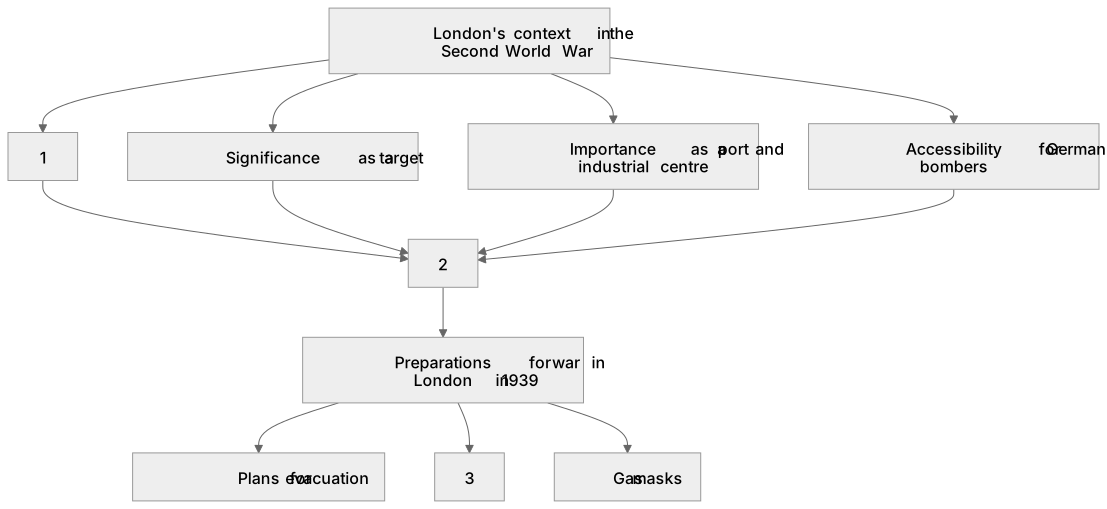
1Box 1
2Box 2
3Box 3
There is more to this lesson
The full lesson goes on to check your understanding and help you earn the marks. Create a free account to carry on, with your progress saved.
A week of Premium from your first lesson · Then the free plan continues · No card, no charge
Test your understanding of Option 12: The historic environment - 1 London and the Second World War, 1939–45: The context of London in the Second World War, including its role in national government, significance as a target, importance as a port and industrial centre and its accessibility for German bombers. Preparations for war in London in 1939 and ongoing measures to safeguard the population: implementation of plans for evacuation, provision of Anderson shelters and gas masks.
Active recall beats re-reading. Take an instant quiz now to test what you’ve learned and lock it into long-term memory.
A week of Premium from your first lesson · Then the free plan continues · No card, no charge