Pearson Edexcel · GCSE · History
Course version: 1HI0 · Version from Sept 2016
The historic environment - 1 London and the Second World War, 1939–45: The…
Full specification wording
Option 12: The historic environment - 1 London and the Second World War, 1939–45: The nature of attacks on London. Attacks on the docks and industries of the East End, including Black Saturday (7 September 1940), and the V2 attack on Deptford (1944). Types of bomb used in 1940–41 and 1944–45, the scale of attack and extent of devastation, including problems dealing with incendiaries and V1 and V2 rockets.
The bombing of London targeted strategic infrastructure, particularly the East End's docks and industries, to cripple the war effort.
Checked against the Pearson Edexcel 1HI0 specification (opens in a new tab) on .
- Point 2 of 5
Study notes
From the checked teaching notes for this specification point.
The idea
The bombing of London targeted strategic infrastructure, particularly the East End's docks and industries, to cripple the war effort. The campaign began with 'Black Saturday' on 7 September 1940, causing massive devastation. The types of bombs evolved: 1940–41 saw high explosives and incendiaries, which caused uncontrollable fires and overwhelmed civil defence. Later, in 1944–45, the scale and nature of attacks shifted with the introduction of V1 and V2 rockets. These weapons caused sudden, widespread destruction, exemplified by the devastating V2 attack on a Woolworths store in Deptford in 1944. V1 flying bombs could be heard approaching before their engines stopped, whereas supersonic V2 rockets arrived without warning, creating different challenges for emergency services and civilian morale.
What earns the marks
- Identify the strategic importance of the East End docks and industries as primary targets for the Luftwaffe.
- Describe the events and scale of devastation of Black Saturday on 7 September 1940.
- Explain the specific challenges posed by incendiary bombs in 1940–41, such as the rapid spread of fires.
- Analyse the shift in bombing technology in 1944–45, focusing on the psychological and physical impact of V1 and V2 rockets.
- Detail the V2 attack on Deptford in 1944 to illustrate the sudden and catastrophic nature of late-war bombings.
Common mistakes and how to put them right
Confusing the dates of the Blitz with the rocket attacks.
Put it right: Ensure you specify that the main Blitz involving high explosives and incendiaries was 1940–41, while V1 and V2 rockets were used in 1944–45.
Stating that both V1 and V2 attacks happened entirely without warning.
Put it right: V1 flying bombs had a distinctive engine sound before impact, while supersonic V2 rockets arrived without warning.
Treating V1 and V2 as the same weapon.
Put it right: Distinguish the pulsejet-powered V1 flying bomb from the ballistic V2 rocket.
Exam tips
- Use the Deptford V2 attack as a specific case study to demonstrate the scale of devastation caused by late-war weapons.
- When discussing 1940–41, explicitly link the use of incendiaries to the overwhelming of the fire services.
- Always connect the location of the attacks, such as the East End, to their strategic purpose of destroying docks and industries.
Try the lesson
The start of the Option 12: The historic environment - 1 London and the Second World War, 1939–45: The nature of attacks on London. Attacks on the docks and industries of the East End, including Black Saturday (7 September 1940), and the V2 attack on Deptford (1944). Types of bomb used in 1940–41 and 1944–45, the scale of attack and extent of devastation, including problems dealing with incendiaries and V1 and V2 rockets. lesson, made from checked teaching notes for this specification point.
Have a go first
Which area of London was the primary target of the heavy bombing on 'Black Saturday', 7 September 1940?
Listen
The bombing of London targeted strategic infrastructure, particularly the East End's docks and industries, to cripple the war effort. The campaign began with 'Black Saturday' on 7 September 1940, causing massive devastation. The types of bombs evolved: 1940–41 saw high explosives and incendiaries, which caused uncontrollable fires and overwhelmed civil defence. Later, in 1944–45, the scale and nature of attacks shifted with the introduction of V1 and V2 rockets. These weapons caused sudden, widespread destruction, exemplified by the devastating V2 attack on a Woolworths store in Deptford in 1944. V1 flying bombs could be heard approaching before their engines stopped, whereas supersonic V2 rockets arrived without warning, creating different challenges for emergency services and civilian morale. A strong answer earns marks for these points. Identify the strategic importance of the East End docks and industries as primary targets for the Luftwaffe. Describe the events and scale of devastation of Black Saturday on 7 September 1940. Explain the specific challenges posed by incendiary bombs in 1940–41, such as the rapid spread of fires. Analyse the shift in bombing technology in 1944–45, focusing on the psychological and physical impact of V1 and V2 rockets. A common slip: Confusing the dates of the Blitz with the rocket attacks. Instead, Ensure you specify that the main Blitz involving high explosives and incendiaries was 1940–41, while V1 and V2 rockets were used in 1944–45. Exam tip: Use the Deptford V2 attack as a specific case study to demonstrate the scale of devastation caused by late-war weapons.
See it
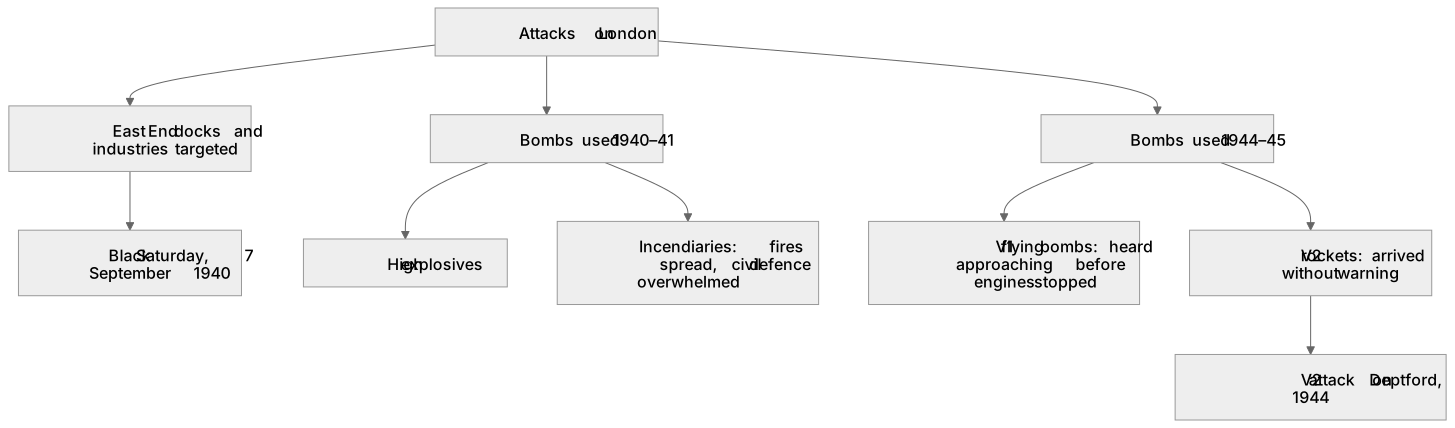
Label the diagram
Some boxes have lost their names. Pick the right name for each number.
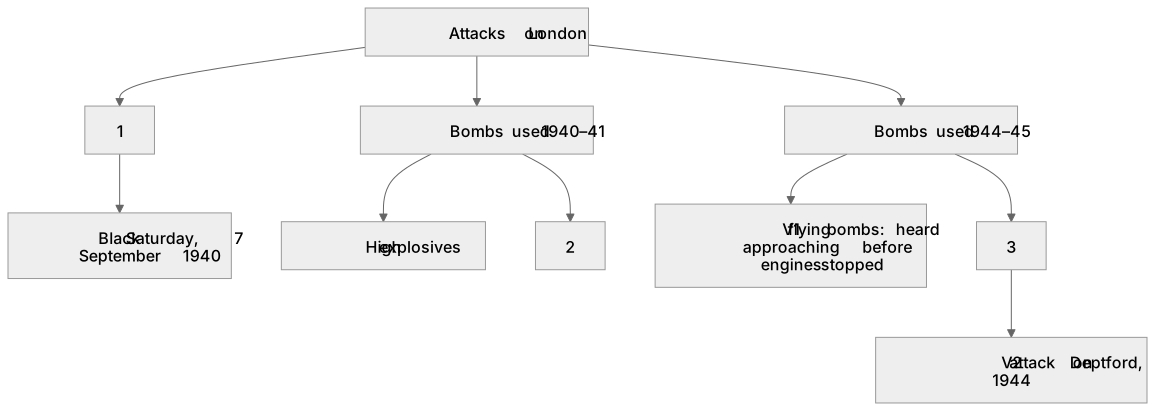
1Box 1
2Box 2
3Box 3
There is more to this lesson
The full lesson goes on to check your understanding and help you earn the marks. Create a free account to carry on, with your progress saved.
A week of Premium from your first lesson · Then the free plan continues · No card, no charge
Test your understanding of Option 12: The historic environment - 1 London and the Second World War, 1939–45: The nature of attacks on London. Attacks on the docks and industries of the East End, including Black Saturday (7 September 1940), and the V2 attack on Deptford (1944). Types of bomb used in 1940–41 and 1944–45, the scale of attack and extent of devastation, including problems dealing with incendiaries and V1 and V2 rockets.
Active recall beats re-reading. Take an instant quiz now to test what you’ve learned and lock it into long-term memory.
A week of Premium from your first lesson · Then the free plan continues · No card, no charge