Pearson Edexcel · GCSE · History
Course version: 1HI0 · Version from Sept 2016
The historic environment - 1 London and the Second World War, 1939–45: The…
Full specification wording
Option 12: The historic environment - 1 London and the Second World War, 1939–45: The historical context of the Second World War: the nature and purpose of the Blitz. Government use of propaganda and censorship to influence attitudes about the Blitz.
Understanding the historical context of the Second World War is essential for analysing the nature and purpose of the Blitz.
Checked against the Pearson Edexcel 1HI0 specification (opens in a new tab) on .
- Point 5 of 5
Study notes
From the checked teaching notes for this specification point.
The idea
Understanding the historical context of the Second World War is essential for analysing the nature and purpose of the Blitz. The bombing campaign was designed to destroy Britain's industrial capacity and break the morale of the civilian population, forcing a surrender. To counter the psychological impact of the raids, the British government heavily utilised propaganda and censorship. Censorship suppressed images of severe devastation and suppressed reports of panic or low morale to prevent defeatism. Concurrently, propaganda campaigns actively shaped public attitudes, promoting the image of the 'Blitz Spirit'—a resilient, cheerful and unified London—to maintain domestic resolve and influence international allies.
What earns the marks
- Define the strategic purpose of the Blitz: to cripple industrial production and shatter civilian morale.
- Explain how censorship was used to control the flow of information, specifically by restricting images of mass casualties or destroyed landmarks.
- Describe the role of propaganda in constructing and promoting the 'Blitz Spirit' to influence domestic and international attitudes.
- Analyse the relationship between the physical reality of the bombings and the curated narrative presented by the government.
- Evaluate the effectiveness of these government interventions in maintaining public support for the war effort.
Common mistakes and how to put them right
Assuming the press had freedom to report all details of the bombings.
Put it right: Explain that strict government censorship controlled what could be published, often delaying or altering reports of severe damage.
Believing the 'Blitz Spirit' was an entirely natural phenomenon without government influence.
Put it right: Recognise that while genuine resilience existed, the 'Blitz Spirit' was heavily amplified and shaped by official propaganda.
Confusing the purpose of the Blitz with a purely military strategy.
Put it right: Emphasise that a primary goal of the Blitz was psychological—to break the will of the civilian population.
Exam tips
- When discussing censorship, provide examples of what was hidden, such as the true scale of the South Hallsville School disaster, to protect morale.
- Use the concept of the 'Blitz Spirit' to evaluate how propaganda successfully influenced attitudes about the Blitz.
- Always link the government's use of censorship and propaganda back to their primary concern: preventing a collapse in civilian morale.
Try the lesson
The start of the Option 12: The historic environment - 1 London and the Second World War, 1939–45: The historical context of the Second World War: the nature and purpose of the Blitz. Government use of propaganda and censorship to influence attitudes about the Blitz. lesson, made from checked teaching notes for this specification point.
Have a go first
What was the primary strategic purpose of the German Blitz on London in 1940?
Listen
Understanding the historical context of the Second World War is essential for analysing the nature and purpose of the Blitz. The bombing campaign was designed to destroy Britain's industrial capacity and break the morale of the civilian population, forcing a surrender. To counter the psychological impact of the raids, the British government heavily utilised propaganda and censorship. Censorship suppressed images of severe devastation and suppressed reports of panic or low morale to prevent defeatism. Concurrently, propaganda campaigns actively shaped public attitudes, promoting the image of the 'Blitz Spirit'—a resilient, cheerful and unified London—to maintain domestic resolve and influence international allies. A strong answer earns marks for these points. Define the strategic purpose of the Blitz: to cripple industrial production and shatter civilian morale. Explain how censorship was used to control the flow of information, specifically by restricting images of mass casualties or destroyed landmarks. Describe the role of propaganda in constructing and promoting the 'Blitz Spirit' to influence domestic and international attitudes. Analyse the relationship between the physical reality of the bombings and the curated narrative presented by the government. A common slip: Assuming the press had freedom to report all details of the bombings. Instead, Explain that strict government censorship controlled what could be published, often delaying or altering reports of severe damage. Exam tip: When discussing censorship, provide examples of what was hidden, such as the true scale of the South Hallsville School disaster, to protect morale.
See it
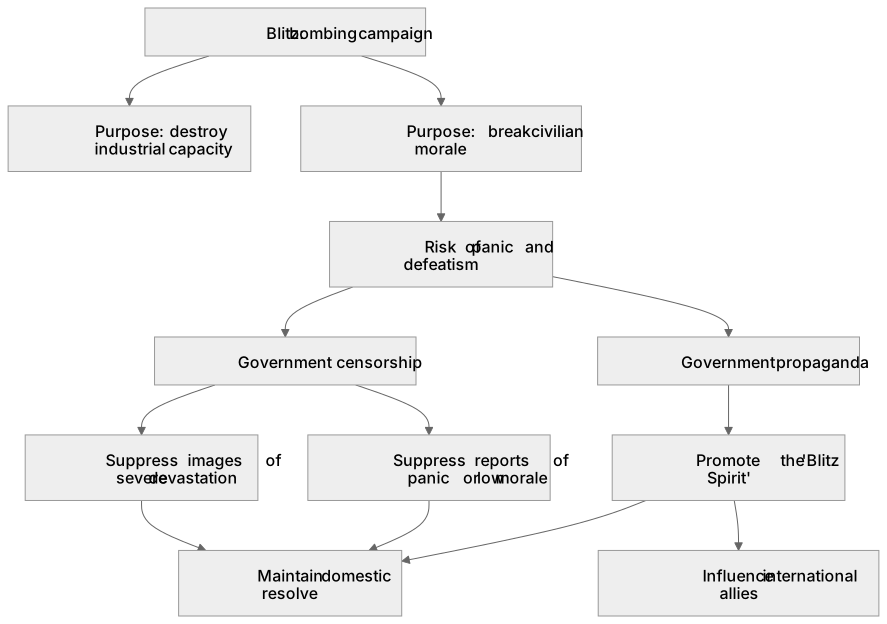
Label the diagram
Some boxes have lost their names. Pick the right name for each number.
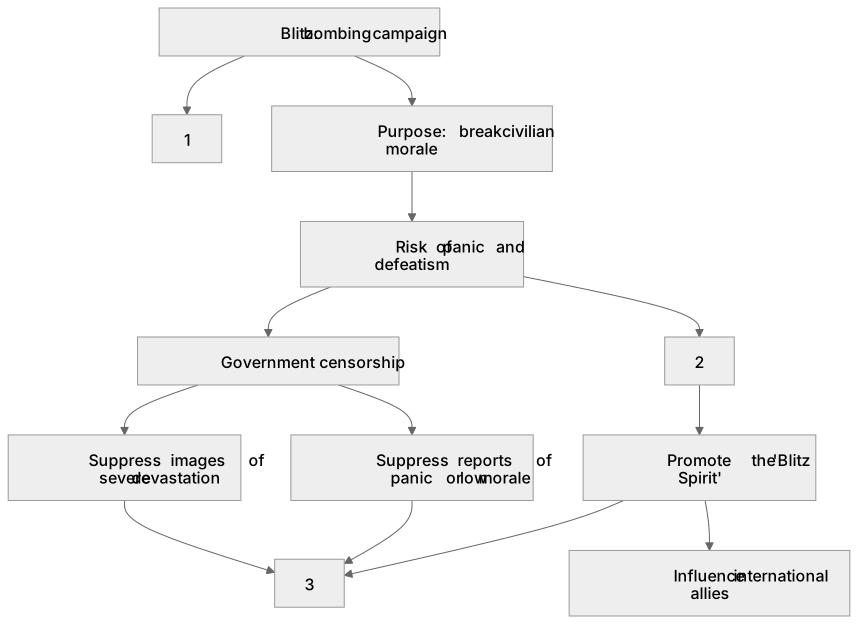
1Box 1
2Box 2
3Box 3
There is more to this lesson
The full lesson goes on to check your understanding and help you earn the marks. Create a free account to carry on, with your progress saved.
A week of Premium from your first lesson · Then the free plan continues · No card, no charge
Test your understanding of Option 12: The historic environment - 1 London and the Second World War, 1939–45: The historical context of the Second World War: the nature and purpose of the Blitz. Government use of propaganda and censorship to influence attitudes about the Blitz.
Active recall beats re-reading. Take an instant quiz now to test what you’ve learned and lock it into long-term memory.
A week of Premium from your first lesson · Then the free plan continues · No card, no charge