Pearson Edexcel · GCSE · History
Course version: 1HI0 · Version from Sept 2016
The historic environment - 1 London and the Second World War, 1939–45:…
Full specification wording
Option 12: The historic environment - 1 London and the Second World War, 1939–45: London’s response to the war. The continued presence of the Royal Family and government ministers; the Cabinet War Rooms. The use of public spaces, including Victoria Park and the Tower of London moat, as part of the ‘Dig for Victory’ campaign.
London's response to the war was characterised by a blend of high-level government action and widespread civilian participation.
Checked against the Pearson Edexcel 1HI0 specification (opens in a new tab) on .
- Point 4 of 5
- 4 key terms
Study notes
From the checked teaching notes for this specification point.
The idea
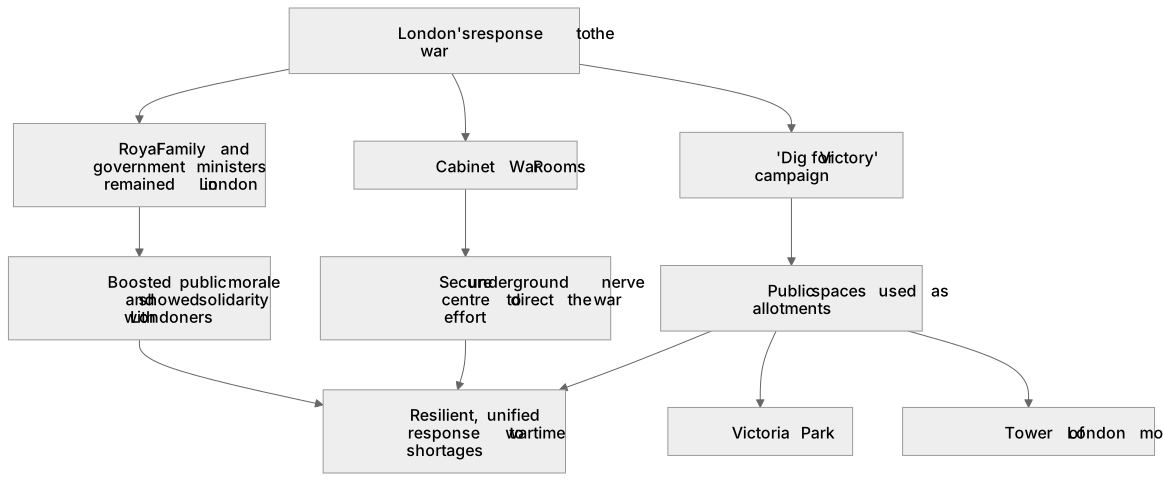
London's response to the war was characterised by a blend of high-level government action and widespread civilian participation. The continued presence of the Royal Family and government ministers in the capital was a deliberate strategy to boost public morale and demonstrate solidarity with Londoners. The Cabinet War Rooms provided a secure, underground nerve centre for Churchill's government to direct the war effort. Simultaneously, the 'Dig for Victory' campaign transformed the city's landscape, with public spaces like Victoria Park and the Tower of London moat being repurposed into allotments. This initiative not only increased food production but also fostered a resilient, unified response to wartime shortages.
What earns the marks
- Explain the psychological importance of the Royal Family and government ministers remaining in London during the bombings.
- Describe the function and significance of the Cabinet War Rooms in maintaining government operations.
- Identify the aims of the 'Dig for Victory' campaign in combating food shortages and rationing.
- Provide specific examples of public spaces repurposed for agriculture, such as Victoria Park and the Tower of London moat.
- Analyse how these combined responses fostered a sense of shared sacrifice and resilience among Londoners.
Common mistakes and how to put them right
Stating that the Royal Family evacuated London for their safety.
Put it right: Emphasise that King George VI and Queen Elizabeth deliberately remained at Buckingham Palace to show solidarity with the public.
Confusing the Cabinet War Rooms with public air-raid shelters.
Put it right: Clarify that the Cabinet War Rooms were a highly secure, secret underground complex exclusively for government and military leaders.
Viewing 'Dig for Victory' solely as a rural campaign.
Put it right: Highlight its urban impact by citing the transformation of iconic London spaces like the Tower of London moat.
Exam tips
- Link the presence of the Royal Family directly to the theme of civilian morale and government propaganda.
- Use the Tower of London moat as a memorable, specific example of how drastically the 'Dig for Victory' campaign altered London's public spaces.
- Discuss the Cabinet War Rooms to illustrate how the government ensured the continuity of the war effort despite the Blitz.
Try the lesson
The start of the Option 12: The historic environment - 1 London and the Second World War, 1939–45: London’s response to the war. The continued presence of the Royal Family and government ministers; the Cabinet War Rooms. The use of public spaces, including Victoria Park and the Tower of London moat, as part of the ‘Dig for Victory’ campaign. lesson, made from checked teaching notes for this specification point.
Have a go first
Which of the following public spaces in London was used to grow vegetables as part of the 'Dig for Victory' campaign?
Listen
London's response to the war was characterised by a blend of high-level government action and widespread civilian participation. The continued presence of the Royal Family and government ministers in the capital was a deliberate strategy to boost public morale and demonstrate solidarity with Londoners. The Cabinet War Rooms provided a secure, underground nerve centre for Churchill's government to direct the war effort. Simultaneously, the 'Dig for Victory' campaign transformed the city's landscape, with public spaces like Victoria Park and the Tower of London moat being repurposed into allotments. This initiative not only increased food production but also fostered a resilient, unified response to wartime shortages. A strong answer earns marks for these points. Explain the psychological importance of the Royal Family and government ministers remaining in London during the bombings. Describe the function and significance of the Cabinet War Rooms in maintaining government operations. Identify the aims of the 'Dig for Victory' campaign in combating food shortages and rationing. Provide specific examples of public spaces repurposed for agriculture, such as Victoria Park and the Tower of London moat. A common slip: Stating that the Royal Family evacuated London for their safety. Instead, Emphasise that King George VI and Queen Elizabeth deliberately remained at Buckingham Palace to show solidarity with the public. Exam tip: Link the presence of the Royal Family directly to the theme of civilian morale and government propaganda.
See it
Key words
Say what each word means before you turn the card.
Leadership and morale
Try answering aloud or in your head before turning the card.
Continuity of government
Try answering aloud or in your head before turning the card.
Wartime agriculture
Try answering aloud or in your head before turning the card.
Civilian participation
Try answering aloud or in your head before turning the card.
See every definition
- Leadership and morale
- The continued presence of the Royal Family and government ministers in the capital was a deliberate strategy to boost public morale and demonstrate solidarity with Londoners.
- Continuity of government
- The Cabinet War Rooms provided a secure, underground nerve centre for Churchill's government to direct the war effort.
- Wartime agriculture
- The 'Dig for Victory' campaign repurposed public spaces such as Victoria Park and the Tower of London moat into allotments, increasing food production.
- Civilian participation
- The 'Dig for Victory' campaign fostered a resilient, unified response to wartime shortages among Londoners.
Label the diagram
Some boxes have lost their names. Pick the right name for each number.
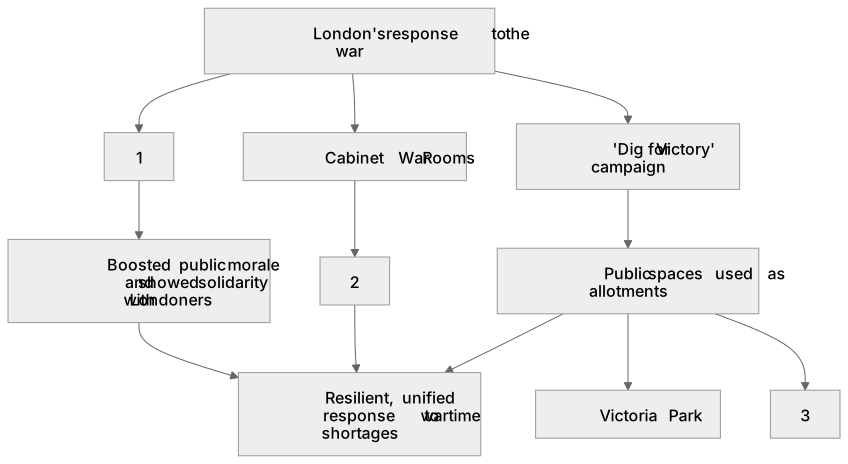
1Box 1
2Box 2
3Box 3
There is more to this lesson
The full lesson goes on to check your understanding and help you earn the marks. Create a free account to carry on, with your progress saved.
A week of Premium from your first lesson · Then the free plan continues · No card, no charge
Test your understanding of Option 12: The historic environment - 1 London and the Second World War, 1939–45: London’s response to the war. The continued presence of the Royal Family and government ministers; the Cabinet War Rooms. The use of public spaces, including Victoria Park and the Tower of London moat, as part of the ‘Dig for Victory’ campaign.
Active recall beats re-reading. Take an instant quiz now to test what you’ve learned and lock it into long-term memory.
A week of Premium from your first lesson · Then the free plan continues · No card, no charge