Pearson Edexcel · GCSE · History
Course version: 1HI0 · Version from Sept 2016
The historic environment - 2 Knowledge, selection and use of sources for…
Full specification wording
Option 12: The historic environment - 2 Knowledge, selection and use of sources for historical enquiries: Framing of questions relevant to the pursuit of a specific enquiry.
A crucial skill in historical research is the framing of questions that are directly relevant to the pursuit of a specific enquiry.
Checked against the Pearson Edexcel 1HI0 specification (opens in a new tab) on .
- Point 4 of 5
- 3 key terms
Study notes
From the checked teaching notes for this specification point.
The idea
A crucial skill in historical research is the framing of questions that are directly relevant to the pursuit of a specific enquiry. When presented with a source, historians must determine what further information is needed to deepen their understanding of the topic. Formulating effective questions involves identifying gaps in the current evidence and asking targeted queries that would yield specific, useful answers. For instance, if an enquiry focuses on civilian morale during the Blitz and the source is a government poster, a relevant question might ask how ordinary citizens actually reacted to the poster. Good questions move beyond simple factual recall, prompting deeper investigation into causes, consequences, or hidden perspectives.
What earns the marks
- Identify gaps in the knowledge provided by a specific source regarding the overall enquiry.
- Formulate clear, targeted questions that directly address the specific historical enquiry.
- Explain how the answer to the framed question would help to advance the historical investigation.
- Ensure the framed question is historically valid and could realistically be answered by consulting further sources.
Common mistakes and how to put them right
Asking questions that are already answered by the provided source.
Put it right: Frame questions that seek new information or different perspectives not present in the source.
Formulating vague or overly broad questions.
Put it right: Ensure questions are specific, targeted, and directly linked to the exact wording of the enquiry.
Asking 'what if' counterfactual questions.
Put it right: Frame questions that investigate actual historical events, attitudes, or policies.
Exam tips
- Start your question with 'How', 'Why', or 'To what extent' to ensure it prompts analytical investigation rather than a simple yes/no answer.
- Explicitly state how finding the answer to your question would help you understand the specific enquiry better.
- Think about the limitations of the source you are given; your question should aim to overcome those limitations.
Try the lesson
The start of the Option 12: The historic environment - 2 Knowledge, selection and use of sources for historical enquiries: Framing of questions relevant to the pursuit of a specific enquiry. lesson, made from checked teaching notes for this specification point.
Have a go first
A historian is using a 1940 photograph of a ruined London street to begin an enquiry into the impact of the Blitz. Which question is most relevant to this specific enquiry?
Listen
A crucial skill in historical research is the framing of questions that are directly relevant to the pursuit of a specific enquiry. When presented with a source, historians must determine what further information is needed to deepen their understanding of the topic. Formulating effective questions involves identifying gaps in the current evidence and asking targeted queries that would yield specific, useful answers. For instance, if an enquiry focuses on civilian morale during the Blitz and the source is a government poster, a relevant question might ask how ordinary citizens actually reacted to the poster. Good questions move beyond simple factual recall, prompting deeper investigation into causes, consequences, or hidden perspectives. A strong answer earns marks for these points. Identify gaps in the knowledge provided by a specific source regarding the overall enquiry. Formulate clear, targeted questions that directly address the specific historical enquiry. Explain how the answer to the framed question would help to advance the historical investigation. Ensure the framed question is historically valid and could realistically be answered by consulting further sources. A common slip: Asking questions that are already answered by the provided source. Instead, frame questions that seek new information or different perspectives not present in the source. Exam tip: Start your question with 'How', 'Why', or 'To what extent' to ensure it prompts analytical investigation rather than a simple yes/no answer.
See it
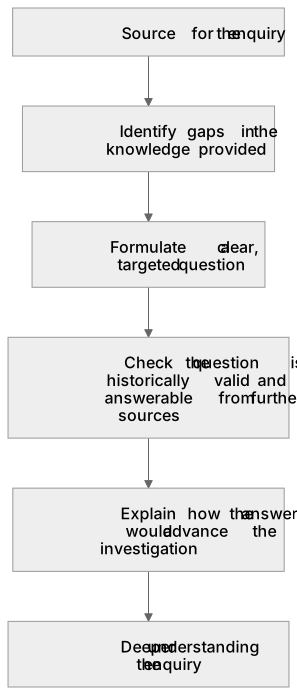
Put it in order
Put these steps in the order they happen.
- 1. Formulate a clear, targeted question
- 2. Identify gaps in the knowledge provided
- 3. Source for the enquiry
- 4. Deeper understanding of the enquiry
- 5. Explain how the answer would advance the investigation
- 6. Check the question is historically valid and answerable from further sources
Key words
Say what each word means before you turn the card.
Historical enquiry
Try answering aloud or in your head before turning the card.
Evidence gaps
Try answering aloud or in your head before turning the card.
Analytical questioning
Try answering aloud or in your head before turning the card.
See every definition
- Historical enquiry
- The pursuit of a specific investigation into the past, to which the framing of relevant questions is crucial.
- Evidence gaps
- Missing information or perspectives in a source that historians identify when determining what further information is needed.
- Analytical questioning
- Formulating questions that move beyond simple factual recall, prompting deeper investigation into causes, consequences, or hidden perspectives.
Label the diagram
Some boxes have lost their names. Pick the right name for each number.
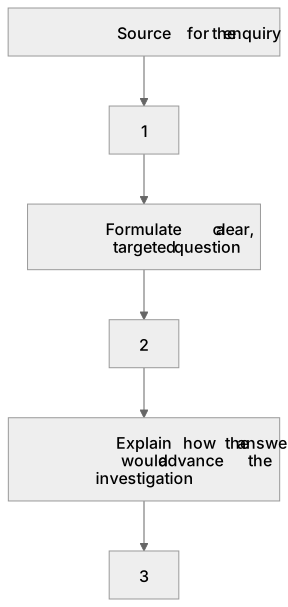
1Box 1
2Box 2
3Box 3
There is more to this lesson
The full lesson goes on to check your understanding and help you earn the marks. Create a free account to carry on, with your progress saved.
A week of Premium from your first lesson · Then the free plan continues · No card, no charge
Test your understanding of Option 12: The historic environment - 2 Knowledge, selection and use of sources for historical enquiries: Framing of questions relevant to the pursuit of a specific enquiry.
Active recall beats re-reading. Take an instant quiz now to test what you’ve learned and lock it into long-term memory.
A week of Premium from your first lesson · Then the free plan continues · No card, no charge